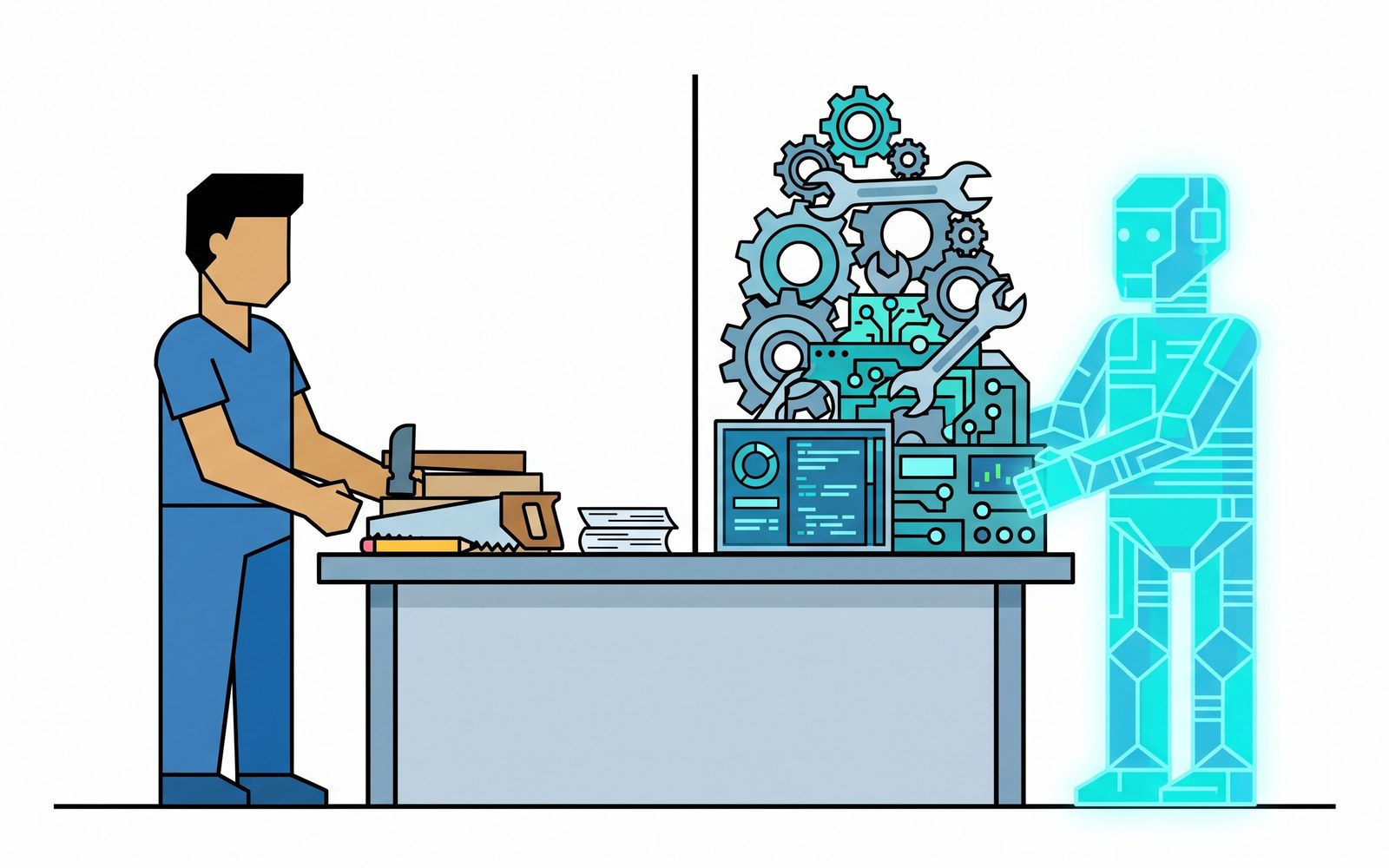
On September 18th, Anthropic put a number on something everyone in the industry has been circling. It said its own model, Claude, now leads about a quarter of the company’s model research and development — 26%, up from essentially zero in February — and that roughly nine-tenths of that R&D now happens in collaboration with the model. Tens of thousands of agents, by the company’s account, were doing research and engineering work over the summer. The work is still supervised; the model isn’t running the lab. But the direction of the line is the whole story: the share it leads went from 0 to 26 in half a year.
Read that as a builder and a small cold feeling shows up. If the thing can do a quarter of the hardest work at a frontier lab, and the number only climbs, what exactly is left for the person? The instinct is to start a list — the things I’m still better at than the model — and to defend it. That list is real, and it is shrinking, and defending a shrinking list is a miserable way to work.
It’s also the wrong list. There’s an older idea that tells you why.
Better at everything, and it still can’t do everything
In 1817 David Ricardo laid out the least intuitive result in economics, and two centuries of trade haven’t dented it. Take two parties. One is faster at every task — absolutely better, no exceptions. The surprising claim is that the two should still divide the work and both come out ahead. The reason is that the better party’s time is finite. Every hour it spends on a task is an hour it can’t spend on a more valuable one. So it should pour its hours into whatever it’s relatively best at, and hand off the rest — even tasks it would do faster itself — because handing them off frees its time for where its edge is largest.
The thing that decides who does what is not absolute advantage — who’s better in a vacuum. It’s comparative advantage — who gives up the least by taking a task on. You can be worse at everything and still have a comparative advantage somewhere, because the machine, doing that task, is paying the price of not doing the thing only it can do.
This flips the anxious question. Stop asking “what am I better at than the model” — that’s an absolute-advantage question, and you will keep losing it, task by task, for years. Ask instead: given that the machine’s time is genuinely scarce and expensive, where is its hour worth the most — and what therefore falls to me? You don’t earn your place by beating it. You earn it by being the cheaper place to put the work that isn’t its best use.
What that means at the desk
The 26% is a boundary, and the boundary slides. Designing your work around it means designing for the slide, not for a fixed line: hand the machine the work that is high-volume and cheaply checked — not because you couldn’t do it, but because that’s where its speed pays off most and where your hour is least worth spending, the broad generation, the first drafts, the mechanical eighty percent. Keep the work where being wrong is expensive and being right is a judgment call — what to build at all, which trade-off to accept, whose trust is on the line, what “good” even means here — not because the model can’t attempt these, but because your comparative cost of doing them is lowest, and its comparative cost of doing them, in frontier hours not spent, is highest. And re-cut the division on a schedule, because the model’s relative edge on each task keeps moving. The role that’s defensible isn’t a task. It’s the act of re-drawing the line as the capability climbs.
Somewhere in your own week there’s a task you handed to an agent recently that you’d have sworn last year was yours to do — and a freed hour you spent on something else entirely. The honest version of that story includes the handoff that went badly and the work you took back. That contrast, kept and revisited, is a better map of where the line actually sits than any announcement will give you.
The honest caveats
Two. First, this is Anthropic describing Anthropic; 26% is the company’s own internal metric, not an audited one, and the company has an interest in the number sounding large — which is partly why, in the same breath, it called for shared transparency metrics across labs and outside evaluators. Take the exact figure as a self-report, the trend as the real signal. Second, Ricardo’s toy model assumes each party’s capacity is basically fixed — but the machine’s capacity is not fixed; it’s being scaled, thirty thousand agents and counting, and improved at the same time. When one side can add capacity and climb the ladder at once, “just specialize and trade” gets more complicated than the tidy version. The core still holds — finite time forces specialization even against a superior party — but hold the neatness loosely.
The reassuring part isn’t that you’ll stay better than the machine at something. You probably won’t. It’s that “better than the machine” was never what made your hours worth spending.
The science, to look up: comparative advantage — David Ricardo, “On the Principles of Political Economy and Taxation” (1817); the standard two-party, two-good exposition in any economics text. The caution about capacity not being fixed is the departure from the classical model, not part of it.
The news, to check: Anthropic’s Sept 18 2026 statement that Claude leads ~26% of its model R&D (up from ~0% in February), that ~90% of R&D is done in collaboration with the model, and that ~30,000 agents were doing research/engineering work as of August, all under human supervision — reported via the Associated Press and carried by CP24, Spectrum News and others (Sept 18 2026), and Tech Xplore. The company also called for cross-lab transparency metrics and named the use of external third-party evaluators. Figures are Anthropic’s own self-reported internal metrics.
Sources
- Comparative advantage — David Ricardo, On the Principles of Political Economy and Taxation (1817). News: Anthropic's Sept 18 2026 statement on Claude's share of its own model R&D
Liked this? Get the next one in Working Theory.
Going weekly in August (it's in beta now). One genuinely interesting read on building, the brain, and the science most people missed.
Subscribe →