Last time: did Germany's home front collapse cause its military defeat, or did its military defeat cause the home front to collapse? The military defeat came first, by the documented sequence and by Ludendorff's own private admission — Amiens in August, the allies falling away in September and October, and only then Kiel and Berlin in November. The stab-in-the-back myth reversed that order because the true one was politically unusable for the people who had run the war. Getting the sequence right isn't pedantry here; it's the difference between a settled historical record and the false story a defeated military leadership told next, with consequences this series is not done following.
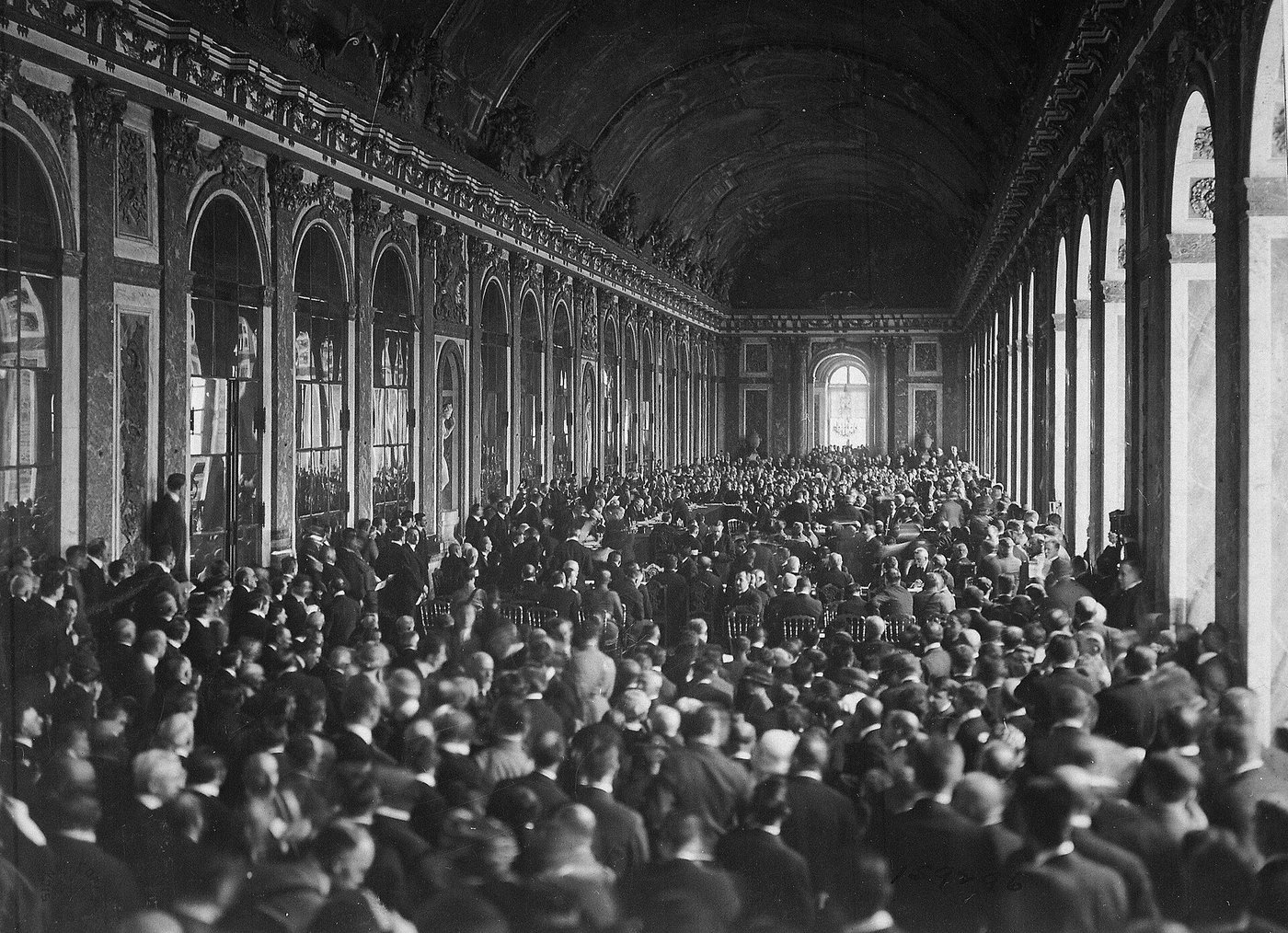
Delegates from 32 countries gathered in Paris in January 1919 to settle the war this series has spent eighteen parts following. Germany was not one of the countries doing the negotiating. Its representatives were summoned only once the terms had already been decided among the victors — chiefly the “Big Four”: Woodrow Wilson of the United States, David Lloyd George of Britain, Georges Clemenceau of France, and Vittorio Orlando of Italy — and were presented with a finished treaty to sign, under the threat of renewed invasion and continued blockade if they refused. The document that resulted, the Treaty of Versailles, was signed on June 28, 1919 — five years to the day after Franz Ferdinand’s assassination in Sarajevo, the event this series opened with in Part 5.
You are the Allied leadership planning the peace conference. Wilson's Fourteen Points, announced in January 1918, had promised a settlement based on self-determination — echoing the "peace without victory" principle Wilson had set out a year earlier, in his January 1917 address to the Senate. Clemenceau, representing a France that had fought the war's costliest Western Front campaigns on its own soil, wants firm guarantees against a future German attack. Do you negotiate the treaty's terms directly with Germany, or present Germany with terms already agreed among the Allies alone?
Negotiating directly with Germany risked a weaker settlement that failed to address French security demands. Presenting finished terms risked a settlement Germany's new government could credibly call an imposed dictate rather than a negotiated peace.
The Allies chose [b]. Germany's delegation, on seeing the terms in May 1919, formally protested several provisions, particularly Article 231 — the clause assigning Germany responsibility for the war's damages, the legal basis for reparations — as an admission of guilt it had not agreed to and did not accept. The protest changed little; the Allies threatened to resume the war if Germany did not sign, and the German government, with no military capacity left to resist, signed on June 28. The word many Germans used for the result at the time, "Diktat" — a dictated peace, not a negotiated one — is itself a documented piece of the historical record, not a later reinterpretation.
The treaty’s terms were extensive: Alsace-Lorraine returned to France; a new Polish state received territory including a corridor to the sea that split East Prussia from the rest of Germany; Germany’s overseas colonies became League of Nations mandates, administered chiefly by Britain and France; the German army was capped at 100,000 men, its air force banned, its navy sharply limited, and the Rhineland demilitarized; and reparations, a final figure set in 1921 at 132 billion gold marks, were imposed for war damages — a sum whose actual economic burden and eventual real payment were repeatedly renegotiated over the following decade through the Dawes Plan of 1924 and the Young Plan of 1929. The League of Nations, the international body Wilson had championed as the treaty’s centerpiece for preventing future wars, was created by the same settlement — and the United States Senate, in a domestic political outcome separate from anything decided in Paris, then declined to ratify the treaty or join the League Wilson himself had designed.
John Maynard Keynes, present at the negotiations as a British Treasury official, published a scathing contemporary critique in 1919 arguing the reparations burden was economically ruinous and would destabilize Germany and Europe for a generation — a view that shaped much of the popular understanding of Versailles for decades afterward. More recent historians, including Margaret MacMillan in her history of the conference and Sally Marks in a widely cited reassessment, argue the treaty was not unusually harsh by the standards of the era's peace settlements — considerably milder, for instance, than the terms Germany itself had imposed on Russia at Brest-Litovsk the year before — and that its worst outcomes owed at least as much to inconsistent enforcement, later political choices, and the global economic collapse of the 1930s as to the treaty's original terms. Both camps agree the settlement left real, documented grievances in Germany. They disagree substantially about how much of what followed the treaty caused directly, and how much later actors chose to build on it.
What is not in dispute is what German political movements did with those grievances over the following decade and a half. The stab-in-the-back myth this series’ last part traced, and the resentment over reparations, territorial losses, and a treaty widely experienced in Germany as imposed rather than agreed, became documented, explicit material in the political messaging of multiple German nationalist movements through the 1920s and early 1930s — the Nazi Party’s rise among them, a subject the next series on this site takes up directly rather than this one. Naming that connection is a statement about what those later political movements chose to claim and exploit, not a claim that the treaty made any particular later outcome the only possible one.
In one sentence, to close nineteen parts: was the war this series has followed decided by the machines that ran it, or by the people who kept choosing, at every point along the way, not to stop them?
Both, in a proportion this series has tried to show changing part by part rather than settle once at the start. Alliances, mobilization schedules, and trench arithmetic were real machines with real momentum of their own. They were never, at any single point this series has followed — not July 1914, not the Somme, not 1917, not the room in Paris where this part's treaty was signed — running without someone who could still have chosen differently and didn't. That's the actual claim underneath this series' title: not that the machine ran on its own, but that enough people, at enough decision points, chose to keep feeding it rather than be the one who stopped it.
Nineteen parts, four Acts, one war. The next series on this site, The War the Peace Built, picks up the thread this part leaves open — the same peace, the same grievances, and a different war still to come.
Sources
- Margaret MacMillan, Paris 1919: Six Months That Changed the World (2001)
- John Maynard Keynes, The Economic Consequences of the Peace (1919)
- Sally Marks, 'Mistakes and Myths: The Allies, Germany, and the Versailles Treaty, 1918-1921' (2013)
- Erik Goldstein, The First World War Peace Settlements, 1919-1925 (2002).
Liked this? Get the next one in Working Theory.
Going weekly in August (it's in beta now). One genuinely interesting read on building, the brain, and the science most people missed.