Last time: was the war Europe got in early August the war its governments had actually chosen, or the war their own machinery left them with once the telegrams ran out? Some of both, and the proportion is exactly what historians still argue about. Austria-Hungary and Germany chose to risk a wider war when they issued the blank cheque and the ultimatum — that much is a choice, made in July, by named people. But by August 1, the decision in front of most governments was no longer "should we fight" so much as "can we still afford not to, given what the others are already doing" — and that second question is where this part's machinery starts to take over.
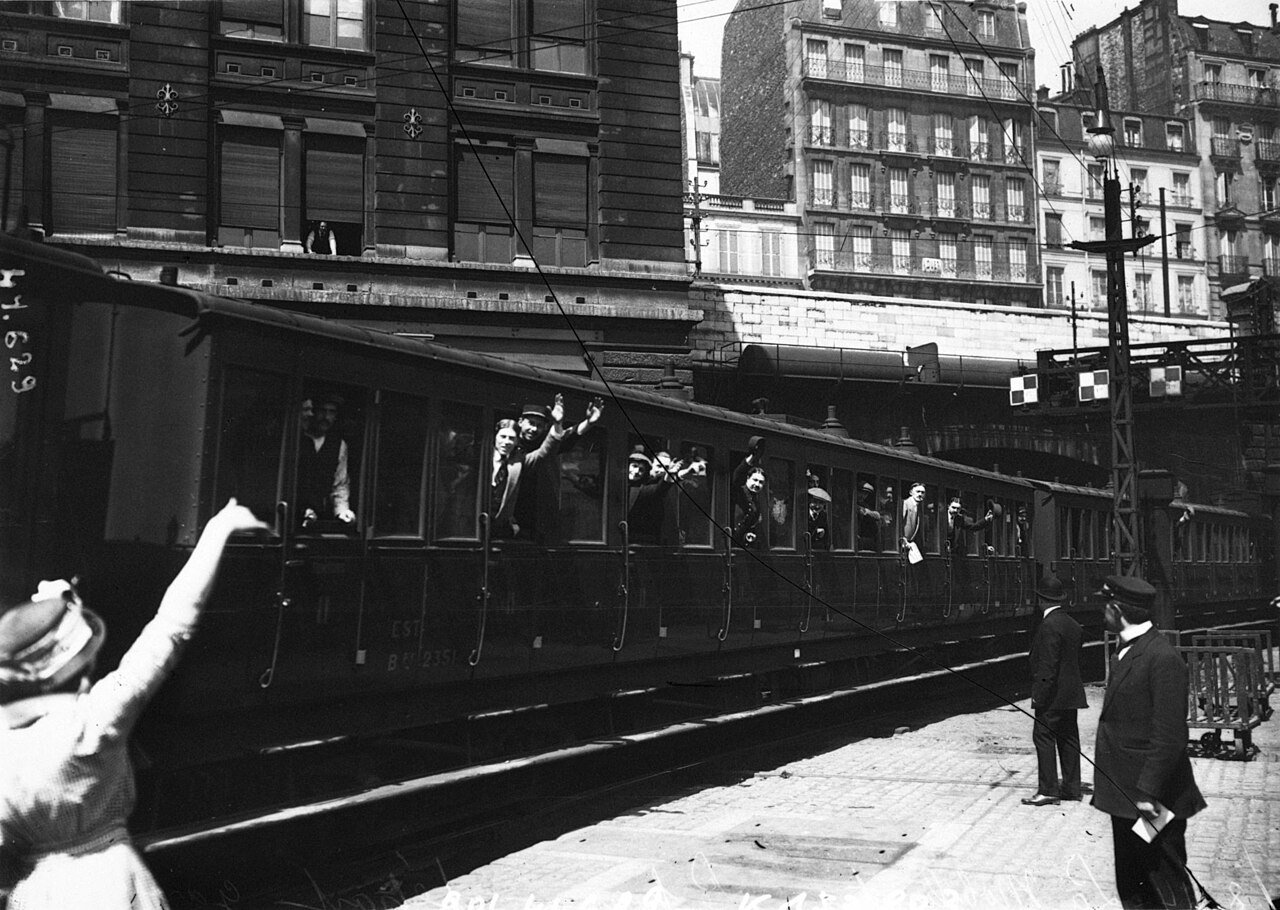
By 1914, “mobilization” did not mean calling men up and waiting to see what happened. It meant a railway operation, scheduled to the minute, years in the making — millions of reservists, their horses, their supplies, moved to the frontier in a fixed sequence on tracks with no slack built in: a second train could not follow the first until the first had cleared the line, so every junction and every stretch of track was pre-allocated, sometimes years ahead. Germany’s own war plan then called for roughly forty days to force a decision in the west — a campaign horizon, not the length of the opening deployment; fighting itself began within days, at Liège on August 5–6, while troops were still arriving at the frontier. Military planners across Europe believed, with real operational justification, that mobilizing against one enemy was not a smaller version of mobilizing against two — it was a different, incompatible schedule. Redirecting trains mid-sequence risked collisions, or units arriving without the ammunition and horses that were supposed to reach them on a different train, on a different day. This is the mechanical fact underneath this part’s title, and underneath a real, ongoing argument about how much it actually explains.
Nobody lived that mechanism more directly than Tsar Nicholas II, on the two days that decided which version of mobilization Russia would run.
You are Tsar Nicholas II. Your foreign minister and your generals tell you partial mobilization — against Austria-Hungary only — isn't a real, executable plan; Russia's staff work was never built to run it cleanly, and it would leave you exposed to Germany without protecting you from Austria. Full mobilization is the only option your military can actually carry out. Your cousin Wilhelm keeps cabling you to hold back. What do you order?
You had already ordered general mobilization once, the evening before, then reversed it under the weight of Wilhelm's telegrams and switched to partial instead.
Nicholas chose [b]. On the evening of July 30, under pressure from his foreign minister Sazonov and his military leadership, he ordered general mobilization, effective the next day — his second reversal in two days. He was not wrong that the choice was narrow: Russian staff doctrine genuinely had no clean partial-mobilization plan to fall back on. Whether that operational fact should have carried as much weight as it did against his own cousin's direct appeals is exactly the question this part's Contingency Meter is built to hold open, not answer for you.
Two days later, a German Kaiser asked his own general staff the same kind of question Nicholas had just faced — and got an answer that has become the single most-quoted illustration of what “war by timetable” actually meant in practice.
One evening at German headquarters, reconstructed from Helmuth von Moltke's own postwar account and the secondary histories built on it — most fully in Barbara Tuchman's The Guns of August. Tap through it once on its own.
A telegram raises a possibility
Germany's ambassador in London cables that Britain might guarantee French neutrality if Germany doesn't attack France — meaning Germany could fight Russia alone. Kaiser Wilhelm II, elated, orders the westward deployment stopped and the army redirected east.
"It cannot be done"
Summoned to explain, Chief of Staff Helmuth von Moltke tells the Kaiser this is operationally impossible. In the rendering most historians quote, drawn from his own postwar memoir: the deployment of millions "cannot be improvised," the arrangements took a year of intricate work to complete, and "once settled, it cannot be altered." Treat the exact sentence as a close paraphrase of Moltke's own account rather than a verbatim transcript — no primary recording of the conversation survives — but the substance is not in dispute.
The westward advance proceeds
Troops already moving into Luxembourg continue on schedule. The question of an eastern-only war is not raised again.
The misunderstanding is confirmed
A second telegram, from King George V, clarifies that no such British guarantee had actually been offered. The westward deployment — which had, in practice, never really stopped — continues as originally scheduled.
That episode is the closest thing this period has to a documented instance of the machine visibly overriding a leader’s stated wish. It is also, on its own, not proof that the machine caused the war — only that once mobilization began, reversing it was not realistically on the table. Those are different claims, and this part’s title states the stronger one on purpose, so it can hand you the argument over whether the stronger one actually holds.
A.J.P. Taylor gave this part its title in his 1969 book of the same name, arguing the railway schedules were close to decisive once triggered — that general war followed "mainly" from the machinery, not from any single leader's intent. L.C.F. Turner's work on Russia's 1914 mobilization reaches a similar place from the technical side: once general mobilization was ordered, the plans' own rigidity made stopping genuinely, mechanically difficult. Christopher Clark, in The Sleepwalkers, pushes back against the stronger version of that reading: he treats the schedules as real constraints but insists the war still came from a chain of specific, avoidable choices by named people — Sazonov, Bethmann-Hollweg, Berchtold — who wrongly believed the conflict could still be localized or that rivals would back down. Both sides agree the machine was real. They disagree about how much of the explaining it actually does.
In one sentence: once Germany's trains started moving on August 1, was the war still anyone's decision to make?
The decision to start it was made earlier, by people, in July — the blank cheque, the ultimatum, Russia's mobilization order. What August 1 actually shows is narrower and in some ways more useful: that a large enough machine, once running, can make "stop" and "continue" stop being equally available options, even to the person who technically commands it. That's not the same as saying nobody was responsible. It's a reason to ask, at each earlier point, who still had a real off-ramp — and exactly when they lost it.
Sources
- A.J.P. Taylor, War by Timetable: How the First World War Began (1969)
- Barbara Tuchman, The Guns of August (1962)
- Christopher Clark, The Sleepwalkers (2012)
- L.C.F. Turner, Origins of the First World War (1970)
- Sean McMeekin, July 1914 (2013).
Liked this? Get the next one in Working Theory.
Going weekly in August (it's in beta now). One genuinely interesting read on building, the brain, and the science most people missed.