Last time: by 1916, was there still a meaningful line between "the front" and "the home front" in any of the major belligerent countries? Formally, yes — no one was shooting at the factory workers or the ration queues. Functionally, less and less. A state that can conscript its citizens, compel their labor, ration their food, and treat their public opinion as something to be managed has already stopped drawing a hard line between the war and everyday civilian life. That shift — quiet, incremental, and rarely voted on as a single decision — is exactly what makes the war Part 17 covers next different from the one this series opened with in 1914.
By the start of 1917, every major belligerent had been at war for two and a half years, and exhaustion — of manpower, of supply, of political patience — had become as real a strategic factor as any army’s size. What makes 1917 the hinge of this whole series is that the exhaustion hit multiple countries at nearly the same time, and each government’s political system handled it completely differently.
Five events, on four fronts, in eleven months.
Germany's gamble draws in the country it was betting against
Germany resumes unrestricted submarine warfare on February 1, the wager Part 13 already flagged — calculating Britain could be starved out before American intervention mattered. British intelligence intercepts and decodes the "Zimmermann Telegram," in which German Foreign Secretary Arthur Zimmermann proposes an alliance with Mexico against the United States, promising Mexico help reclaiming Texas, New Mexico, and Arizona if war came. Its publication in early March, combined with American ship losses to U-boats, turns public opinion decisively. The United States declares war on Germany on April 6, 1917.
The February Revolution
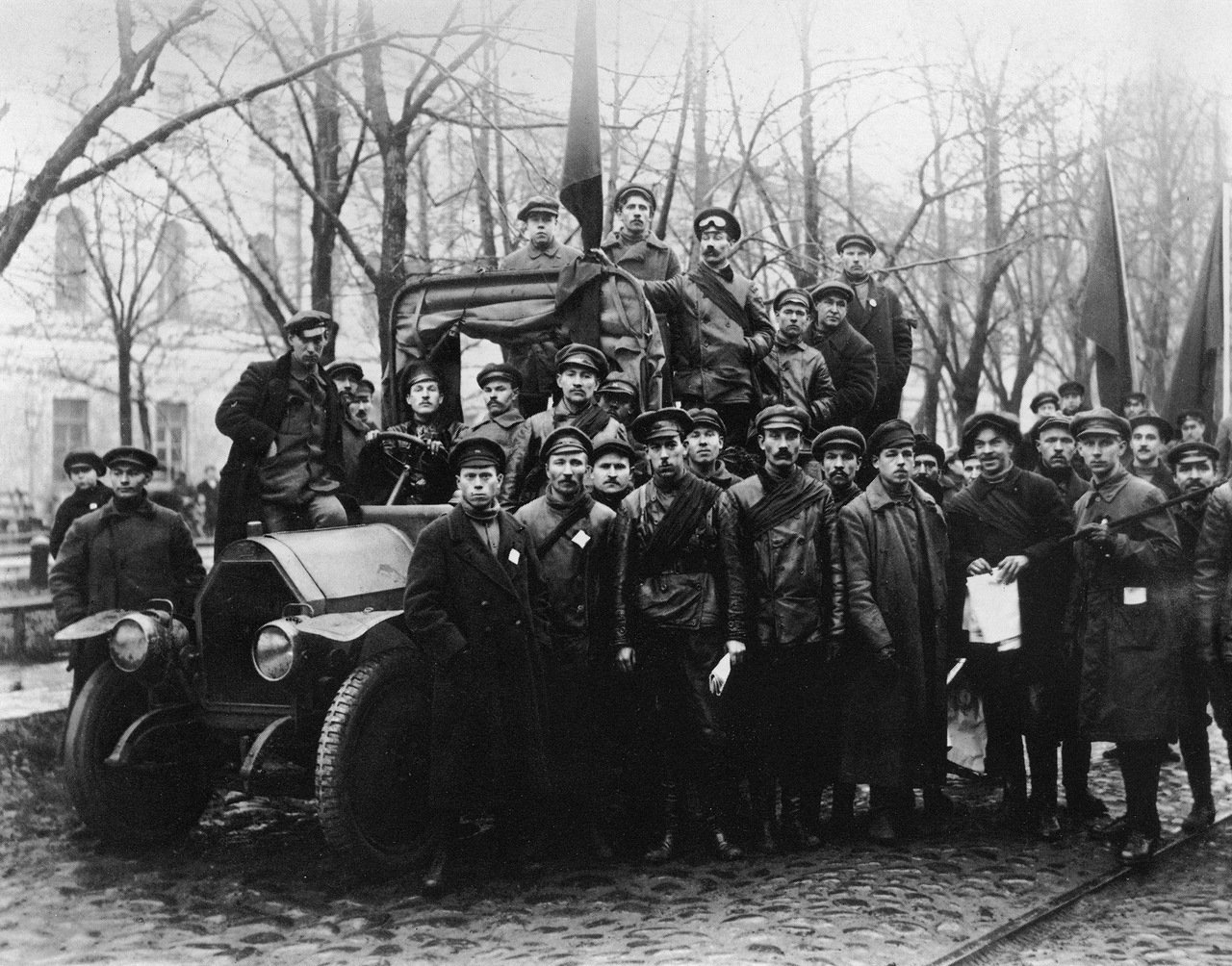
Bread shortages, war exhaustion, and mass strikes in Petrograd (dated by the Julian calendar Russia then used, hence "February" for events in early March by the modern calendar) force Tsar Nicholas II's abdication. A Provisional Government takes power but chooses to continue the war — a decision that costs it what remaining legitimacy it had.
The Nivelle Offensive fails, and the army mutinies
General Robert Nivelle promises a war-ending breakthrough at the Chemin des Dames; it fails within days at heavy cost, against defenses the Germans had reinforced with warning. Widespread mutiny follows across dozens of French divisions — soldiers refusing further offensive action while, in most units, remaining willing to hold defensive positions. It is a crisis in discipline, not a revolution.
Caporetto
A combined Austro-German offensive routs the Italian Second Army at Caporetto, driving Italian forces back roughly 100 kilometers before British and French reinforcements help stabilize a new line on the Piave River. It is one of the war's most severe single defeats for any army still fighting, and a further sign of how thin morale had worn on every side by this point in the year.
The October Revolution
Lenin's Bolsheviks, campaigning openly on ending the war, seize power from the Provisional Government (in early November by the modern calendar; "October" by the Julian calendar Russia still used). Within weeks they open armistice negotiations with the Central Powers — negotiations this series' next part follows to a treaty, and to what Germany does with the eastern peace it produces.
You are General Philippe Pétain, given command of the French Army in the middle of a mutiny crisis affecting dozens of divisions. Courts-martial have already begun. How do you restore an army that has just told its own commanders it will not attack again?
Mass, severe punishment risked breaking discipline further, and risked confirming the mutineers' complaint that the army's command didn't take their conditions seriously. Doing nothing risked losing the army's remaining fighting capacity entirely.
Pétain chose [b]. Several thousand soldiers were court-martialed, and death sentences were handed down to a substantial number of them, but the number actually carried out was far smaller — historians' figures vary, but consistently describe executions in the dozens rather than anything close to the number sentenced. Alongside that limited severity, Pétain improved leave rotations, food, and rest, and avoided major offensive operations for the rest of 1917. The French Army held for the remainder of the war without a comparable crisis recurring — a genuinely different outcome from what the same underlying exhaustion produced in Russia that same year.
Leonard Smith's study of the French mutinies emphasizes Pétain's specific mix of reform and limited discipline as genuinely decisive in containing the crisis — a case where a flexible response mattered. Orlando Figes' history of the Russian Revolution locates Russia's collapse in causes running much deeper and further back than 1917's exhaustion alone: a monarchy with almost no remaining base of political support even before the war, an economy already strained, and a Provisional Government that inherited that weakness and then compounded it by choosing to continue the war rather than address it. Both readings can be true together: France had a political system with real reform capacity left when its crisis peaked; Russia's system, historians broadly agree, had far less left to give — which is a real difference in the systems' underlying condition, not only in how each government happened to respond in the moment.
In one sentence: why did the same wartime exhaustion produce a contained mutiny in France and a collapsed empire in Russia?
Not because the French were more exhausted or less exhausted than the Russians — by most accounts the exhaustion itself was comparably real on both sides. The difference sat in what each political system still had available to offer once that exhaustion peaked. France had reforms left to make and a command structure able to make them. Russia's monarchy, and then its Provisional Government, had already spent whatever flexibility it once had, and had nothing left to give the people asking for it.
Sources
- Barbara Tuchman, The Zimmermann Telegram (1958)
- Leonard Smith, Between Mutiny and Obedience (1994, on the French Army mutinies)
- Orlando Figes, A People's Tragedy: The Russian Revolution 1891-1924 (1996)
- Mark Thompson, The White War: Life and Death on the Italian Front (2008, on Caporetto).
Liked this? Get the next one in Working Theory.
Going weekly in August (it's in beta now). One genuinely interesting read on building, the brain, and the science most people missed.