Last time: did any single new weapon of this war live up to what its own advocates promised for it? Not on its own, and not on the timeline its advocates hoped for — which is a different claim than saying the machines didn't matter. Gas, aircraft, and tanks all mattered, all changed how the war was fought, and all fell short of the single-weapon breakthrough their most enthusiastic proponents promised. What actually mattered by 1918 was the years of partial, expensive failure it took to learn how to use them together — the least dramatic possible answer to a question that kept attracting dramatic ones.
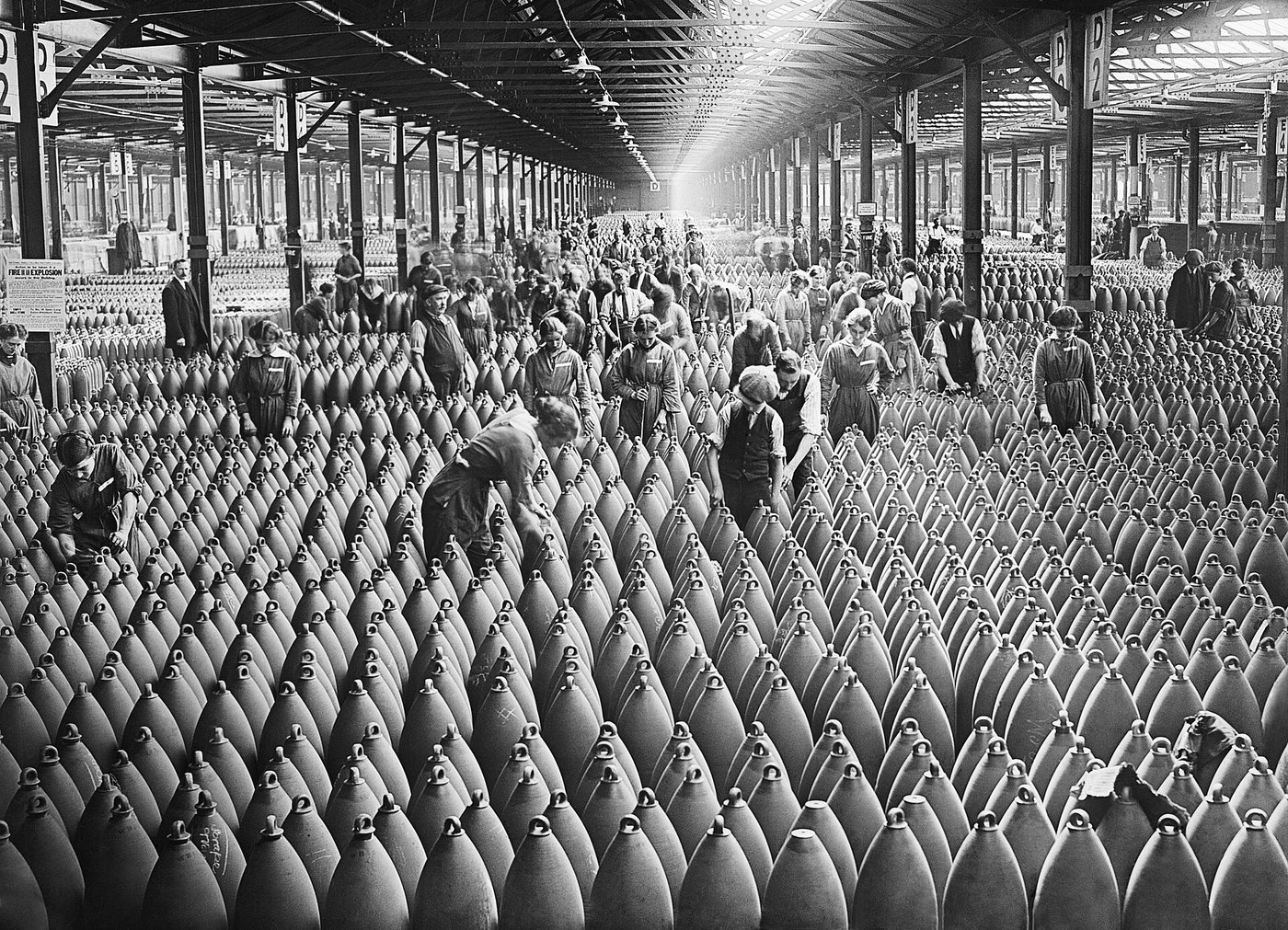
Every government fighting this war entered it assuming a short campaign, funded and supplied more or less the way peacetime armies already were. By 1916, all of them had abandoned that assumption and begun treating their own civilian populations as something closer to a second front — one that had to be organized, rationed, propagandized, and in some cases legally coerced, with nearly as much deliberate state planning as the front lines this series has followed so far.
Britain’s Ministry of Munitions, created in 1915 under David Lloyd George, took direct state control over war production in a way peacetime Britain had never attempted, redirecting factories, setting wages, and recruiting a workforce that increasingly meant women. Estimates for the number of British women who moved into munitions work over the course of the war vary by source and by exactly what counts as munitions labor, but commonly cited figures run from several hundred thousand into the high hundreds of thousands by the war’s final years. Many worked directly with TNT and other explosives; prolonged exposure caused a form of toxic jaundice that turned some workers’ skin visibly yellow, and they became known, at the time and since, as “canary girls” — a real, documented occupational hazard, not a figure of speech.
Germany went further, faster. The Hindenburg Program, launched in 1916 under the joint authority of Hindenburg and Ludendorff, set sweeping production targets for munitions and war matériel and, through the accompanying Auxiliary Service Law, compelled labor from German men aged 17 to 60 not already serving in the military — a degree of direct state control over civilian labor well beyond what Britain or France attempted at the same point in the war. Rationing followed in both countries as food supplies tightened, driven on the German side heavily by the British blockade this series’ last-but-two part already covered, and in Britain increasingly by U-boat losses to merchant shipping.
You are the British government. The volunteer army raised under Lord Kitchener in 1914 has taken catastrophic losses, and voluntary recruitment can no longer supply the men the war effort now requires. Britain has never conscripted its citizens for a foreign war. What do you do?
Conscription would break with a long British tradition of an all-volunteer military and face real political opposition, but the volunteer system was, by early 1916, plainly no longer meeting the army's manpower needs.
Britain chose [a]. The Military Service Act passed in January 1916, introducing conscription for the first time in British history for a war fought outside its own borders — with Ireland notably excluded after fierce political opposition there. It marked, as clearly as any single law could, the point at which Britain's government treated the war as something the state could compel citizens into, not just recruit them for.
In 1918, Britain's Representation of the People Act granted the vote to women over 30 who met a property qualification — partial, but a real first breach in a total exclusion that decades of prewar suffrage campaigning, including militant action by the Suffragettes, had failed to break outright. Some historians credit women's visible, essential wartime labor — munitions work chief among it — with making the political case for enfranchisement newly unanswerable. Others, including several historians of the suffrage movement itself, caution against a too-clean "the war caused the vote" narrative: the pre-war campaign had already shifted public and parliamentary opinion substantially, and the specific 1918 law was also shaped by an unrelated practical problem — needing to re-enfranchise millions of returning male soldiers who had lost residency-based voting eligibility while serving, which forced a broader franchise bill regardless. Most current accounts treat the war as a real accelerant layered onto a change already underway, rather than a clean cause on its own.
In one sentence: by 1916, was there still a meaningful line between "the front" and "the home front" in any of the major belligerent countries?
Formally, yes — no one was shooting at the factory workers or the ration queues. Functionally, less and less. A state that can conscript its citizens, compel their labor, ration their food, and treat their public opinion as something to be managed has already stopped drawing a hard line between the war and everyday civilian life. That shift — quiet, incremental, and rarely voted on as a single decision — is exactly what makes the war Part 17 covers next different from the one this series opened with in 1914.
Sources
- Susan Grayzel, Women and the First World War (2002)
- Adrian Gregory, The Last Great War (2008, on British home-front experience)
- Angela Woollacott, On Her Their Lives Depend (1994, on British munitions workers)
- Roger Chickering, Imperial Germany and the Great War (1998, on the Hindenburg Program).
Liked this? Get the next one in Working Theory.
Going weekly in August (it's in beta now). One genuinely interesting read on building, the brain, and the science most people missed.