Last time: once a campaign like Verdun or the Somme has already cost hundreds of thousands of lives, is continuing it still a real decision, or has it become one only in name? It stays a real decision — that's what makes the sunk cost trap worth naming rather than treating as an inevitability. Haig, Falkenhayn, and every commander who kept feeding these two battles could have stopped; nothing structural made that impossible the way mobilization's timetables had in 1914. What made stopping so hard was organizational and reputational, not mechanical — which means it was, in the end, a choice, made harder to see as one by everything already spent trying to avoid making it.
Part 9 named the arithmetic that dug the trenches: by 1914, defense outmatched offense, and no one yet had the tools to close that gap. The years that followed produced three real attempts to close it — the tank, the aircraft, and poison gas — each arriving with real advocates who believed it could be the single weapon that broke the deadlock outright. Each did change the war. None of them, by itself, was that weapon.
Gas came first and promised the most relative to how little it delivered. Chlorine gas, first used by Germany in a major attack at the Second Battle of Ypres in April 1915, did break a section of the Allied line outright — but German commanders, not fully expecting the gap it opened, lacked the reserves in position to exploit it before Allied forces recovered. Later gas types, including phosgene and the blistering agent mustard gas — generally dated to its first major use in mid-1917, though the exact date is sometimes given slightly differently across sources — caused significant casualties and real, lasting suffering for survivors, but never again produced a breakthrough gas alone could hold open. Gas masks were developed and issued within months of the first attacks; wind dependency, as Part 9 already showed at Loos, made the weapon as likely to backfire as to succeed. Gas made trench warfare more miserable. It did not end trench warfare.
Aircraft followed a different arc. Their most consistently valuable role throughout the war, and the least glamorous, was reconnaissance and artillery spotting — telling ground commanders what the enemy was actually doing, and correcting artillery fire in real time, both genuinely decisive contributions that rarely make it into popular memory of the air war. What did make it into popular memory was the fighter pilot: dogfighting aces credited with dozens of victories, most famously Manfred von Richthofen, the “Red Baron,” credited with roughly 80 confirmed kills before his death in April 1918. Strategic bombing arrived too — German Gotha bombers raided London starting in 1917, the first sustained bombing campaign against a civilian capital from the air — with real psychological effect and real but limited material damage. None of it, reconnaissance aside, decided a battle outright in this period; airpower’s more genuinely decisive combined-arms role was still being worked out when the war ended.
Tanks arrived with the largest gap between promise and early performance, and the clearest arc from disappointment toward real effectiveness.
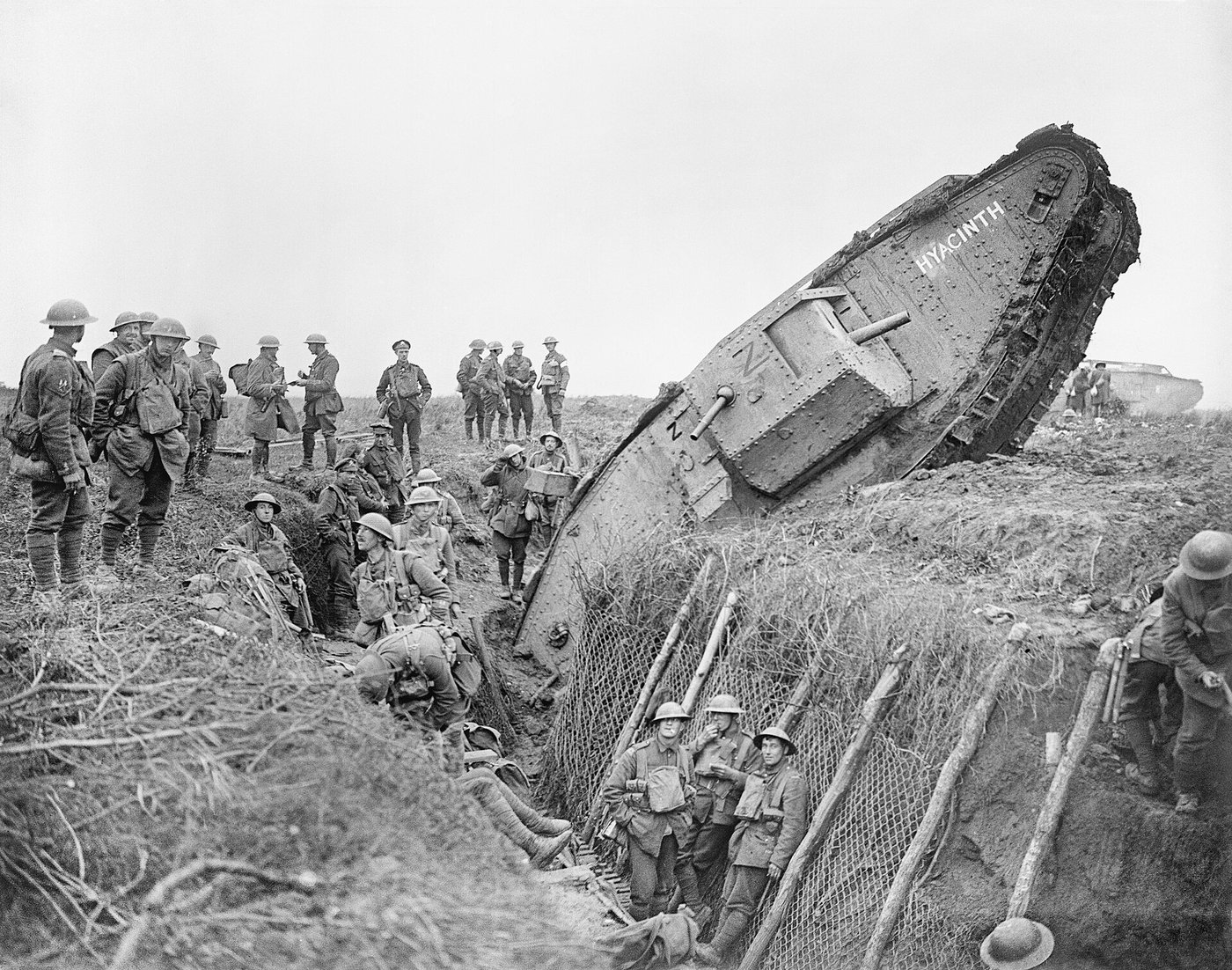
You are planning the British attack at Cambrai. Previous tank use, at the Somme in 1916 and at Third Ypres earlier in 1917, was hampered by small numbers, mechanical breakdowns, and ground churned by preliminary bombardment into mud the tanks couldn't cross. For this attack, do you follow standard doctrine?
Standard doctrine called for days of preliminary artillery bombardment before an infantry assault — effective at damaging enemy defenses, but it also destroyed the ground tanks needed to maneuver, and it told the enemy exactly where and when the attack was coming.
British command chose [b]. The attack on November 20, 1917 broke through German lines to a depth unseen since 1914, with church bells rung in London to celebrate before the battle was even fully over. Within two weeks a German counterattack recovered nearly all the ground gained — British infantry and reserves hadn't been positioned to hold or exploit the breakthrough tanks alone had opened. Cambrai proved tanks could break a trench line. It also proved, immediately, that breaking a line and holding the ground behind it were two different problems, and 1917's tools had only solved the first one.
Some popular accounts of the war's end credit the tank specifically with finally breaking the stalemate. Most specialist military historians push back on that as too simple: the "learning curve" school this series named in Part 9 emphasizes that what actually worked, when it worked — most clearly at Amiens in August 1918 — was tanks, aircraft, artillery, and infantry operating together under doctrine refined over three years of exactly these kinds of costly, partial experiments. On that reading, no single new machine broke the deadlock. What broke it was armies finally learning to combine several imperfect machines into something more effective than any one of them alone — a lesson each of this part's three technologies had to fail partially, more than once, before anyone learned it.
In one sentence: did any single new weapon of this war live up to what its own advocates promised for it?
Not on its own, and not on the timeline its advocates hoped for — which is a different claim than saying the machines didn't matter. Gas, aircraft, and tanks all mattered, all changed how the war was fought, and all fell short of the single-weapon breakthrough their most enthusiastic proponents promised. What actually mattered by 1918 was the years of partial, expensive failure it took to learn how to use them together — the least dramatic possible answer to a question that kept attracting dramatic ones.
Sources
- J.F.C. Fuller, Tanks in the Great War (1920)
- Lyn Macdonald, To the Last Man: Spring 1918 (1998)
- John Morrow, The Great War in the Air (1993)
- L.F. Haber, The Poisonous Cloud: Chemical Warfare in the First World War (1986).
Liked this? Get the next one in Working Theory.
Going weekly in August (it's in beta now). One genuinely interesting read on building, the brain, and the science most people missed.