Last time: did the German plan fail because the plan itself was flawed, or because one commander made a decision no plan could have specified in advance? Both, and that's the actual lesson, not a dodge. Moltke's version of the plan was already a hedge against Schlieffen's more extreme original — a sign the plan's authors themselves doubted it could run exactly as written. Kluck's turn was a real, specific choice, made with the information he had at the time, not a flaw baked into the blueprint. Large plans fail at the seam between the two: the parts a strategist can specify in advance, and the parts that only ever get decided by whoever is actually standing at the front when the moment arrives.
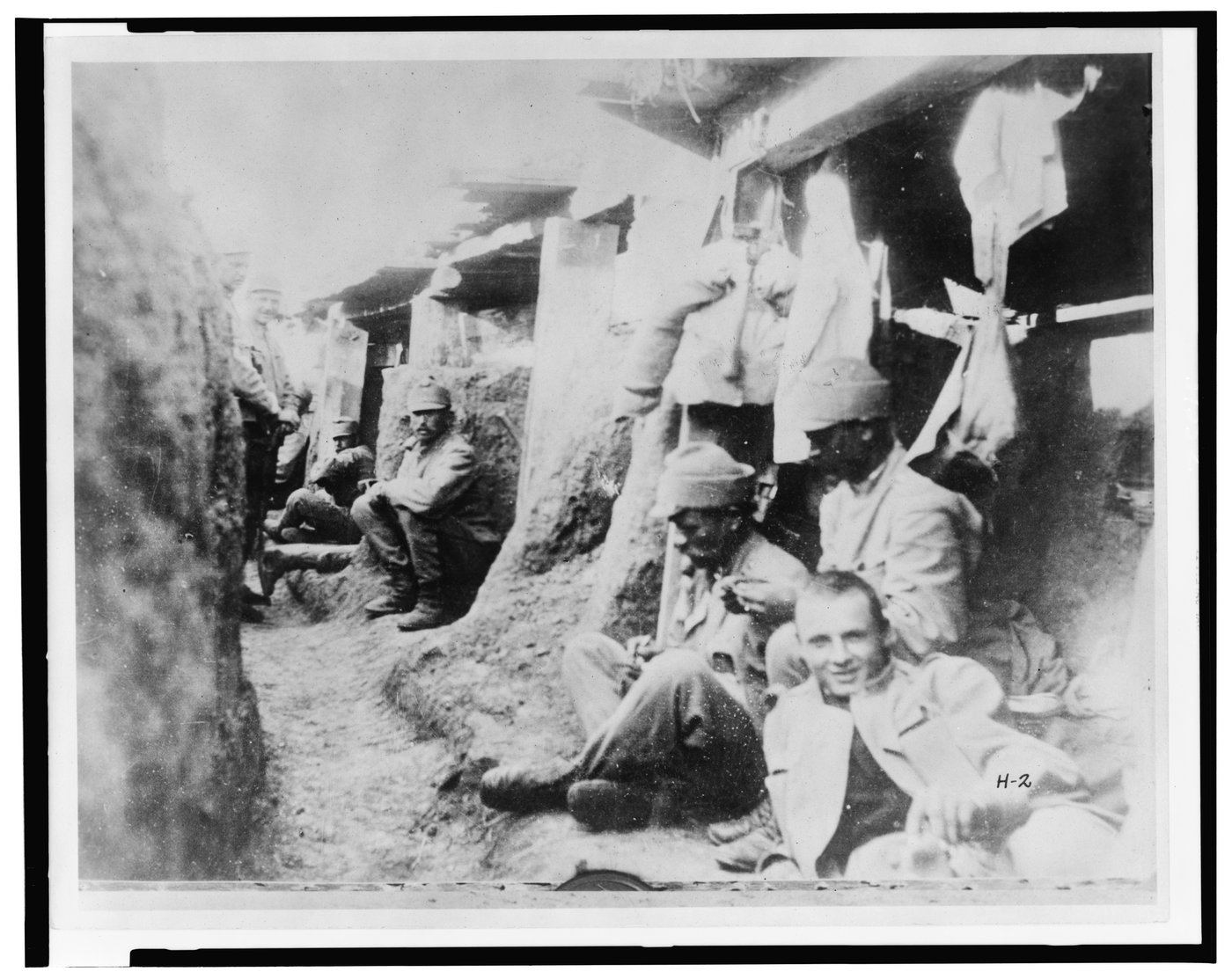
By November 1914, after the Marne and the “Race to the Sea” that followed it, a continuous line of trenches ran roughly 700 kilometers from the English Channel to the Swiss border. It would barely move for the next three years. The reason wasn’t a failure of imagination on either side — it was arithmetic. A defender with a machine gun, rifles firing 15 rounds a minute, and belts of barbed wire could stop an advancing line of infantry faster than that infantry could cross the open ground between the trenches, and quick-firing artillery could break up any formation dense enough to punch through. Offense in 1914 had no answer yet to defense’s advantage. That gap — not a lack of will on any side — is what dug the trenches and kept everyone in them.
A trench system was never just one ditch. Front-line, support, and reserve trenches ran roughly parallel, connected by communication trenches, each dug in a zigzag pattern — traverses — so a shell landing in one section, or an enemy who broke into it, couldn’t fire straight down the whole line. Soldiers stood on a raised firing step to shoot over the parapet; duckboards kept them out of the mud and standing water that collected at the bottom. Between the two front lines sat “no man’s land,” anywhere from thirty meters to several hundred, churned by shellfire into a landscape of craters, wire, and the dead who couldn’t be recovered.
Life inside that system ran on rotation — units cycled between front-line, support, and rest, rather than any single group holding the worst ground indefinitely, though exactly how long each rotation lasted varied by army and by year. What didn’t vary was the environment: rats drawn to unburied bodies and discarded rations, lice that bred in uniform seams no laundering reached, and trench foot, a condition caused by feet standing in cold water for days at a stretch, damaging circulation and tissue rather than a simple infection — painful enough on its own to disable a soldier without a single enemy shot fired.
One real, published witness followed the war from inside that system: Louis Barthas, a French barrelmaker from the Aude region called up as a corporal in 1914. His notebooks — kept through the war and eventually published as Poilu — describe the front with a civilian’s plain eye rather than a soldier’s official one, and this series returns to his account as it moves through Act III.
Even inside that grinding stalemate, one real, well-documented moment briefly broke the pattern.
It never happened again at that scale. Commanders on both sides moved quickly to prevent a repeat in 1915 and after, rotating units before Christmas and issuing explicit orders against fraternization — a sign of how seriously they took even a one-day crack in the system this part has just described.
You command a British unit at the Battle of Loos, about to use poison gas for the first time in a British attack. The wind is marginal — not clearly favorable, not clearly against you. Zero hour is set. What do you do?
Chlorine gas depends entirely on wind carrying it toward the enemy trench. Delaying risks losing the coordinated timing of the wider attack; releasing on a bad wind risks the gas drifting back onto your own line.
British commanders released on schedule. In several sectors the marginal wind shifted or stalled, and the gas drifted back over the trenches it was launched from — British troops became casualties of their own weapon in places, before the attack on German lines had even fully developed. Loos is remembered less for what it achieved than for how plainly it showed a new weapon doesn't remove the old uncertainties; it just adds new ways for them to go wrong.
Tim Travers, in The Killing Ground, argues the deadlock persisted as long as it did partly because of rigid, hierarchical command cultures across the belligerent armies — slow to adapt tactics even once new tools and lessons were available. Paddy Griffith, in Battle Tactics of the Western Front, pushes back with what's become known as the "learning curve" thesis: he reads the armies, the British in particular, as adapting continuously and effectively across the war, with 1918's breakthroughs the payoff of lessons absorbed since 1915-16, not a late correction of years of stubbornness. Both agree the technology gap was real. They disagree about how much of the three-year delay in closing it sits on the machines, and how much sits on the people commanding around them.
In one sentence: was the trench stalemate a problem of technology, or a problem of the people commanding around it?
The gap opened as a technology problem — defense had simply outrun offense by 1914 — but how long it stayed open is genuinely a command-culture question, which is exactly why historians still argue about it. The tank, developed and first used within this same period, is the technological fix arriving. Whether it arrived as fast as it reasonably could have is the part of this question that isn't settled by hardware alone.
Sources
- Tim Travers, The Killing Ground (1987)
- Paddy Griffith, Battle Tactics of the Western Front (1994)
- Malcolm Brown and Shirley Seaton, Christmas Truce (1984)
- Stanley Weintraub, Silent Night (2001)
- Louis Barthas, Poilu: The World War I Notebooks of Corporal Louis Barthas, trans. Edward M. Strauss (Yale University Press, 2014).
Liked this? Get the next one in Working Theory.
Going weekly in August (it's in beta now). One genuinely interesting read on building, the brain, and the science most people missed.