Last time: why did every great power keep expanding its army and navy even though none of them wanted a war? Each government was building to match what a rival had just built, not to start a fight — British shipyards answered German ones, and German conscription laws answered French and Russian ones, until every capital had convinced itself that falling behind was the one truly dangerous move. That logic didn't make a war certain. It meant that when a spark did come, six countries already had the men and the machines standing ready.
Sarajevo, the provincial capital of Bosnia-Herzegovina, woke up on Sunday, June 28, 1914, to a city dressed for a visit. Archduke Franz Ferdinand, heir to the Austro-Hungarian throne, and his wife Sophie, Duchess of Hohenberg, had come to Bosnia so he could inspect army maneuvers nearby. Sarajevo was the last stop, a short, formal city visit before heading home. It was also, by a coincidence of the calendar rather than the couple’s choosing, exactly fourteen years to the day since Franz Ferdinand had signed the oath giving up his future children’s claim to the throne — the price Vienna’s court had set for letting him marry Sophie at all, since she came from a noble but not royal family. Their actual wedding had followed three days later. Franz Ferdinand and Sophie had never been allowed to forget that their marriage carried a price; June 28 was the date that price had been signed into law, fourteen years before it would take a very different toll.
The day’s route had been printed in local newspapers ahead of time: six open cars would drive along the Appel Quay, the road running beside the Miljacka River, on the way to a welcome ceremony at City Hall. Security along that route was thin. Bosnia’s governor, Oskar Potiorek, was responsible for protecting the Archduke, and he had far fewer police posted than the visit called for — most of the local garrison’s soldiers were kept out of the security detail entirely, reserved instead for the army review.
Along that same stretch of riverbank that morning stood six young men, spaced out at intervals, each carrying a bomb or a pistol or both. They belonged to a loose, Serb-nationalist student network called Young Bosnia — the group this series has already met, formed in the years after Austria-Hungary annexed Bosnia in 1908. Their plan had been organized by a young radical named Danilo Ilić. None of the six had ever done anything like this before.
At around 10:00, the motorcade pulled away from the train station. Franz Ferdinand and Sophie rode in the third car, an open Gräf & Stift touring car, with the driver Leopold Lojka, Governor Potiorek, and the car’s actual owner, Lieutenant Colonel Count Franz von Harrach, who stood on the running board beside them. The first two conspirators along the route, closest to the station, lost their nerve and did nothing as the cars passed.
At 10:10, the third conspirator, Nedeljko Čabrinović, threw a bomb at the Archduke’s car. It bounced off the car’s folded-back roof and rolled underneath the vehicle following behind before it exploded, wounding somewhere between sixteen and twenty people, including one of Potiorek’s own aides, Erik von Merizzi. Čabrinović swallowed a cyanide pill and jumped into the Miljacka River to avoid capture. The poison was old and only made him vomit, and the river at that spot was barely knee-deep. The crowd pulled him out, beat him, and handed him to police. Franz Ferdinand and Sophie were unhurt. The motorcade did not stop for long. It continued on to City Hall.
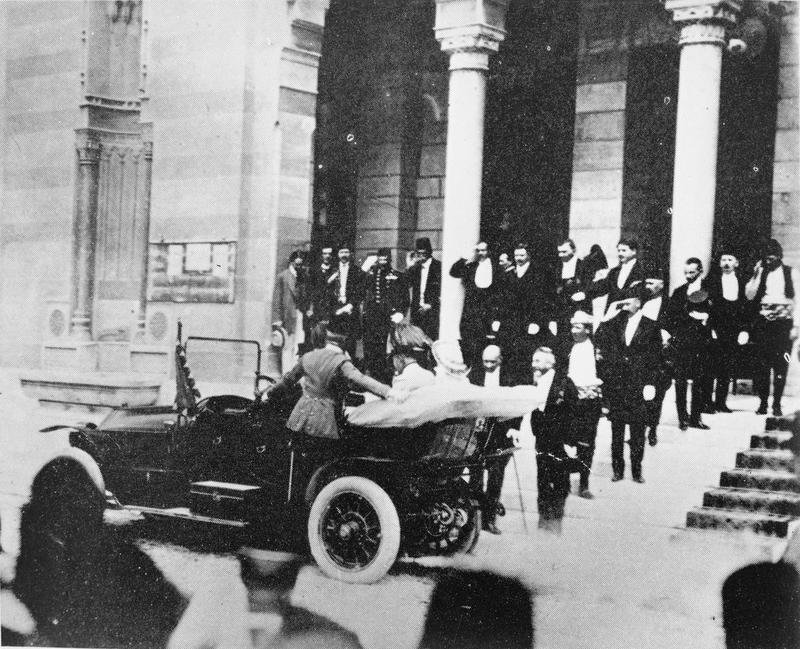
A bomb had just been thrown at the heir to the throne. Sixteen to twenty bystanders were wounded. One of the governor’s own staff was among them, now on his way to the garrison hospital. The rest of the day’s official program — a City Hall reception, then a museum visit, then more of the published route — was still sitting on the schedule, unchanged.
You are Governor Potiorek. A bomb has just been thrown at the motorcade. What do you do with the rest of the day's program?
Security along the route was already light — mostly local police, no heavy troop presence — and the published schedule still called for a City Hall reception, a museum stop, and more travel along Sarajevo's streets.
Potiorek chose closest to option [c] — and the plan he claims he intended (a direct route to the hospital, avoiding the side streets) was never actually communicated to the driver. The record doesn't resolve who was supposed to pass that message along and didn't. What happened next was a routing mistake, not a chosen risk.
Here is what the record actually shows happened next, in order.
The motorcade reached City Hall a few minutes after the bombing. Mayor Fehim Čurčić began his prepared welcome speech, the kind of formal remarks any visiting dignitary would expect. Franz Ferdinand cut him off. His documented words, recorded by witnesses and preserved in multiple accounts: “Mr. Mayor, I came here on a visit and I am greeted with bombs. It is outrageous.” He let the mayor finish the speech after that, then insisted on doing one thing before anything else on the schedule: visiting Erik von Merizzi, his wounded aide, at the garrison hospital.
That single choice is the hinge the rest of the day turns on, and it’s worth being precise about what did and didn’t happen around it. Potiorek did not call in additional troops. He did not cancel the museum visit or the remaining stops. Several secondary accounts attribute to him a dismissive line about added security along the lines of “Do you think Sarajevo is full of assassins?” — historians report this as attributed, not as a verified word-for-word quote, and it should be read that way. What is more solidly documented is the plan Potiorek says he intended: skip the narrow side streets on the way to the hospital and take the motorcade straight down the wide Appel Quay instead, the same road they’d just come in on.
That plan was never actually given to the driver. Leopold Lojka left City Hall not knowing the route had changed. Exactly why is a genuinely disputed point, and the surviving sources do not resolve it. Some historians place the blame on Potiorek himself, for simply forgetting to pass the new instruction along in the chaos of the morning. Others argue the message was supposed to come from Merizzi, who was at the hospital and wounded, or from the police chief, Edmund Gerde, and that one of them failed to relay it. No account settles which explanation is correct, and this piece won’t pretend otherwise.
At around 10:45, the motorcade left City Hall. At the corner where the Appel Quay meets Franz Josef Street, Lojka — following the original, published route out of habit — turned right onto the side street. Potiorek realized the mistake immediately and shouted for him to stop and reverse. The car stalled directly in front of a delicatessen owned by a man named Moritz Schiller.
Standing on the pavement outside that shop, having failed earlier to get a clear shot along the Quay and simply drifted toward that corner afterward, was Gavrilo Princip.
He stepped up to the stalled car and fired twice with a Belgian-made pistol, at close range. The exact minute isn’t recorded with certainty — most of what’s known comes from Harrach’s later testimony, not a synchronized clock — so this account places it at roughly 10:45 to 10:55 rather than pretending to a precision the sources don’t have. Sophie was hit in the abdomen. Franz Ferdinand was hit in the neck. Harrach’s own documented account describes the Archduke’s last words, spoken to his wife: “Sophie, Sophie, don’t die. Live for my children.” Sophie died within minutes. Franz Ferdinand died roughly ten minutes after her. Formal announcements of their deaths went out between about 11:00 and 11:30, depending on the source — a small gap, not a real historical dispute.
Every position below is the same record already laid out above — nothing new. Tap through it once on its own, stripped of narration, and the shape of the morning gets easier to hold in your head: how few decisions actually separated a survived attempt from a successful one.
The motorcade departs
Six open cars pull away along the Appel Quay. Six Young Bosnia conspirators are spaced along the riverbank ahead, each carrying a bomb or a pistol or both. Security is thin — most of the local garrison was held back for the army review instead.
Čabrinović throws his bomb
It bounces off the folded roof of the Archduke's car and explodes under the car behind, wounding sixteen to twenty people, including one of Governor Potiorek's own aides. Čabrinović swallows a cyanide pill — too old to work — and jumps into the Miljacka, barely knee-deep at that spot. The crowd pulls him out and beats him before police take him.
The decision that mattered most
Franz Ferdinand cuts off Mayor Čurčić's prepared speech: "Mr. Mayor, I came here on a visit and I am greeted with bombs. It is outrageous." He lets the mayor finish, then insists on one thing before anything else on the schedule: visiting his wounded aide at the garrison hospital.
A route change nobody delivers
Potiorek's intended plan — skip the side streets, take the wide Appel Quay straight to the hospital — is never actually passed to the driver, Leopold Lojka.
The wrong turn
Following the original published route out of habit, Lojka turns right onto the side street. Potiorek shouts for him to stop and reverse. The car stalls directly in front of Moritz Schiller's delicatessen.
Two shots
Princip steps up and fires twice at close range with a Belgian-made pistol. Sophie is hit in the abdomen. Franz Ferdinand is hit in the neck.
"Live for my children"
Count Harrach's documented account records Franz Ferdinand's last words, spoken to his wife: "Sophie, Sophie, don't die. Live for my children." Sophie dies within minutes. Franz Ferdinand dies roughly ten minutes after her.
The announcement
Formal word of both deaths goes out to the city and, within hours, the wider empire. Danilo Ilić and several of the other conspirators are arrested before the day is over; one, Muhamed Mehmedbašić, escapes across the border and isn't caught for weeks.
This gauge is about one narrow question: whether the assassination itself happening was contingent — genuinely capable of not occurring — or close to inevitable given everything already in place. Christopher Clark, in The Sleepwalkers, treats it as real near-miss contingency: two failed bombers, a wrong turn nobody planned, a stalled engine, all of it had to break the assassins' way for Princip to end up standing where he was. That's a separate question from what the assassination's consequences meant — whether the July Crisis that followed was a pretext for a war Vienna and Berlin already wanted, as David Fromkin argues, or a chain of real remaining choices, as Margaret MacMillan's account suggests. This series doesn't resolve that second question here. Part 6 picks it up.
The rest of the morning followed quickly. Čabrinović, pulled from the river and beaten, was already in custody. Princip was seized on the spot before he could use the cyanide pill he was also carrying; his, too, turned out to be too old to work as intended. Within hours, Danilo Ilić and the other conspirators were being rounded up across the city.
Franz Ferdinand and Sophie were real people, and they died that late morning in a stalled car on a Sarajevo street corner. So did the sixteen to twenty bystanders wounded by the earlier bomb, most of them ordinary residents who had come out to watch a motorcade pass. None of what follows in this series treats any of that as a plot point. It is stated here plainly, once, because it happened, and then the account moves on to what it set in motion — not because the deaths matter less than the politics, but because dwelling on them further wouldn’t add anything true.
What it set in motion is a separate, larger question — the one this part deliberately leaves open. The assassination did not, by itself, cause a European war; a month of decisions by governments in Vienna, Berlin, St. Petersburg, Paris, and London still had to happen first, and none of those decisions were made on June 28. What can be said honestly, today, is narrower: a chain of small failures — two bombers who lost their nerve, a message never passed to a driver, a wrong turn at one intersection — put the heir to a European throne within arm’s reach of a nineteen-year-old with a pistol. Whether that mattered, and how much, is where Act II begins.
The actual car — the Gräf & Stift double phaeton Lojka was driving — survives today, along with Franz Ferdinand’s blood-stained tunic, in a dedicated exhibit at the Heeresgeschichtliches Museum, the Museum of Military History, in Vienna. Sophie’s jacket and some of her personal effects are held there too, along with the pistols and grenades the conspirators carried that morning. They are, unglamorously, just objects in glass cases now — a car, a coat, a gun — the physical residue of one late June morning that a great many people, for a great many different reasons, spent the following month trying to make sense of.
In one sentence: what actually put Franz Ferdinand's car in front of Gavrilo Princip — a plot that worked, or a string of accidents?
Mostly accidents layered on top of a real plan gone wrong: two conspirators froze, the bomb missed, and the one precaution that might have kept the car away from that corner — a revised route to the hospital — never reached the driver. Princip didn't out-plan anyone that morning. He was standing on the one corner the car wasn't supposed to drive through, and it stalled there anyway.
Sources: Christopher Clark, The Sleepwalkers: How Europe Went to War in 1914 (2012); Margaret MacMillan, The War That Ended Peace (2013); David Fromkin, Europe’s Last Summer (2004); Vladimir Dedijer, The Road to Sarajevo (1966); W.A. Dolph Owings, Elizabeth Pribic, and Nikola Pribic (trans/eds), The Sarajevo Trial (1984); Luigi Albertini, The Origins of the War of 1914, Vol. II.
Five parts, no war yet fired. Act II — "The Month" — picks up July 1914's telegrams, day by day.
A preview — Act II opens here
Twenty-five days after Sarajevo, Austria-Hungary hands Belgrade a ten-point ultimatum with a 48-hour deadline. Below is what it actually demanded, point by point, and what Serbia actually did with each one on July 25 — not a summary, the record itself. Part 6 picks up the story around it.
Serbia pledges to legislate penalties for this, but notes the change needs parliamentary action at the next session — it can't simply be decreed overnight.
Serbia agrees to comply, while noting it has seen no evidence the organization committed any crime.
Serbia agrees in principle, but asks Vienna to supply the specific facts and materials it's referring to first.
Serbia agrees to dismiss anyone proven guilty, but asks Vienna to supply names and evidence before acting.
Serbia says it does not clearly understand the scope of this demand, but would admit collaboration insofar as it agrees with international law and criminal procedure — an answer vague enough to mean almost anything.
Serbia will investigate its own citizens involved in the plot, but will not admit Austro-Hungarian officials into that investigation on its own territory — again citing its constitution. This is the one refusal Vienna treated as the pretext it needed.
Serbia confirms Tankosić's arrest. It says Ciganović cannot yet be located and asks Vienna to share the evidence gathered in Sarajevo.
Serbia commits to reinforcing border controls and investigating the officials involved.
Serbia offers to explain, but asks Vienna to first specify which statements it means and provide evidence they were made.
Serbia agrees to keep Vienna informed as the other measures are carried out.
Sources
- Christopher Clark, The Sleepwalkers: How Europe Went to War in 1914 (2012)
- Margaret MacMillan, The War That Ended Peace (2013)
- David Fromkin, Europe's Last Summer (2004)
- Vladimir Dedijer, The Road to Sarajevo (1966)
- W.A. Dolph Owings, Elizabeth Pribic, and Nikola Pribic (trans/eds), The Sarajevo Trial (1984)
- Luigi Albertini, The Origins of the War of 1914, Vol. II.
Liked this? Get the next one in Working Theory.
Going weekly in August (it's in beta now). One genuinely interesting read on building, the brain, and the science most people missed.