Last time: two alliance blocs locked Europe's great powers together. What actually bound them to fight for each other? Almost nothing, formally. Only the Dual Alliance and the Franco-Russian pact were real mutual-defense treaties; Britain's ties to France and Russia were just settlements of colonial arguments, with no promise attached to send an army.
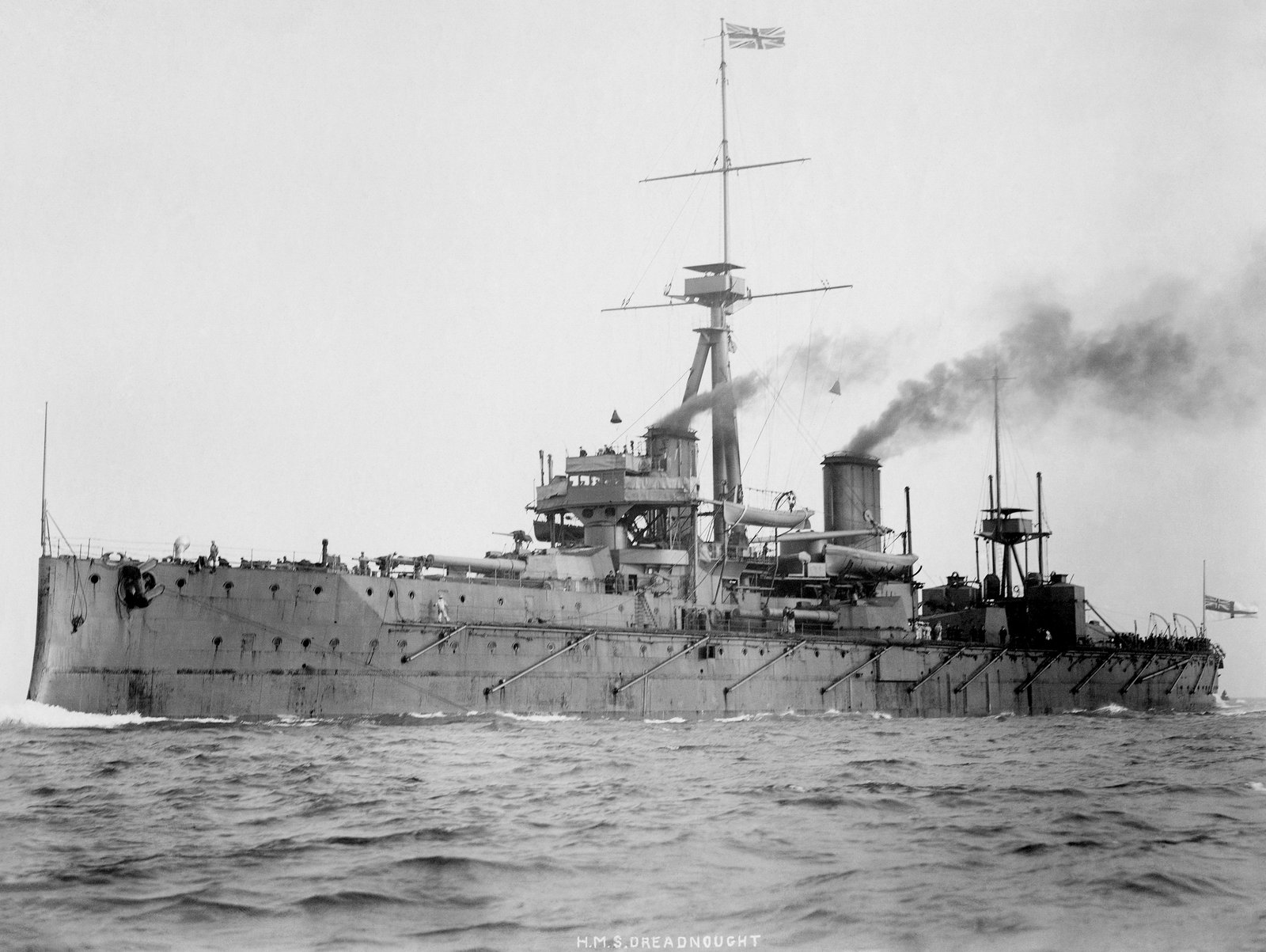
On the morning of 10 February 1906, at Portsmouth Dockyard on England’s south coast, a ship slid down the slipway into the water and made every other battleship on the planet obsolete. Not just Britain’s rivals’ ships. Britain’s own ships too, dozens of them, some barely a few years old, paid for with millions of pounds of taxpayer money. HMS Dreadnought was so far ahead of anything else afloat that the entire category of warship built before her would spend the rest of its life with a new, slightly embarrassing name: pre-dreadnought.
The man who forced her into existence was Admiral Sir John Fisher, First Sea Lord of the Royal Navy, known to friends and enemies alike as “Jacky.” Fisher was in his sixties and impatient in a way that unsettled the entire Admiralty. He believed the Navy was clogged with old thinking and older ships, and he set out to fix both at once. Dreadnought was laid down (meaning her keel, the ship’s spine, was first put down in the dock) on 2 October 1905. She was finished and ready for sea trials in about fourteen months, a construction speed that stunned naval observers across Europe. Fisher’s own letters, later published as Fear God and Dread Nought, show a man who treated speed itself as a weapon: the faster Britain built, the less time any rival had to copy the design before Britain built the next one.
What made Dreadnought revolutionary wasn’t her name or her launch date. It was two decisions bolted together. First, “all-big-gun” armament: ten 12-inch guns, all the same size, instead of the mixed jumble of gun calibers older battleships carried. A ship with guns of different sizes had to guess which splashes in the water came from which gun when correcting its aim; a ship with ten identical guns could fire them together and read the pattern cleanly. Second, steam turbines instead of the older piston engines, giving her a speed no existing battleship could match or escape. Put those two things on one hull, and every other battleship in the world, British, German, French, it didn’t matter, instantly became a slower ship with worse aim.
That is the strange part. Fisher hadn’t just beaten Germany’s navy. He’d also beaten Britain’s own navy, the one built up over decades at enormous cost. Every dreadnought built from that point on reset the count back to zero: what mattered now wasn’t how many battleships a country owned, but how many dreadnoughts it owned. And that number, for every navy on Earth, currently stood at one.
Germany couldn’t ignore this. Its navy was the personal project of Alfred von Tirpitz, State Secretary of the Imperial German Navy Office since 1897, who had already pushed two Fleet Laws (1898 and 1900, later expanded) through the German parliament to build up a battle fleet from almost nothing. Tirpitz’s own reasoning, laid out in his memoir Erinnerungen, was what he called the Risk Theory, or Risikogedanke: Germany didn’t need a navy bigger than Britain’s, which would have been impossible anyway. It needed a navy large enough that if Britain ever attacked it, Britain would take such heavy losses that some third country, France, Russia, the United States, could then step in and take over as the world’s leading naval power. The German fleet’s whole point was to make Britain afraid to use its own fleet. It was a deterrent built out of ships instead of promises.
Dreadnought blew a hole in that plan, because it meant Germany’s existing fleet-building didn’t count anymore either. Now both countries were racing to build the new kind of ship, from a standing start. And in Britain, that race collided with a public that had spent a decade being told Germany was catching up.
By 1909, British newspapers were full of alarming reports, later shown to be exaggerated, that Germany was secretly speeding up its dreadnought construction and might soon close the gap. The public reaction became a slogan you could shout at a rally: “We want eight and we won’t wait.” Prime Minister Herbert Asquith’s government, with Reginald McKenna as First Lord of the Admiralty, proposed building four dreadnoughts immediately and four more later if the German threat was confirmed. The opposition and the press wanted all eight now, no waiting for confirmation. The government gave in.
You are the British Cabinet. What do you do?
The Navy warns that Germany may be secretly outbuilding Britain in dreadnoughts. The evidence is thin and disputed even inside the Admiralty, but public alarm and press pressure are intense, and "we want eight and we won't wait" is being chanted in the streets.
The government tried option B and lost the argument within weeks. Facing the slogan and the headlines, Asquith's cabinet caved and laid down all eight. It worked, in the narrowest sense: by 1914 Britain held a commanding lead in dreadnought-type ships over Germany, about 29 to Germany's 17 or 18 depending how you count. The "threat" the panic was built on never really showed up. Britain had won a race against a rival that, it turned out, wasn't running nearly as fast as everyone feared.
That lead is worth sitting with, because it means the most famous arms race of the pre-war years, dreadnoughts, was never actually close after 1909. Germany kept building, but its 1912 Novelle, an amendment to the Fleet Law, actually slowed the pace down rather than speeding it up. Britain’s naval planners knew, or could have known, that the gap wasn’t closing. The panic had outlived the thing it was panicking about.
Which is why historians increasingly point somewhere else: not to sea, but to land. And this part of the story gets far less attention than dreadnoughts, even though the numbers involved are larger and the timing runs much closer to 1914.
In 1913, Germany passed a new Army Law adding roughly 136,000 men to its peacetime army, the largest single increase Germany had made in decades. France couldn’t match Germany’s population, so instead of adding more men, it extended how long each conscript served: the Loi des trois ans, the Three-Year Law of August 1913, stretched compulsory service from two years to three, which meant more trained soldiers in uniform at any given moment even without more men being drafted each year. Russia, meanwhile, launched its 1913 “Great Military Program,” aiming to grow its peacetime army toward 2 million men by 1917 and to modernize the strategic railways that would carry that army to the front.
That railway detail mattered enormously to German military planners, and it’s the reason this land race, quiet as it looks next to a battleship launch, casts a longer shadow over the summer of 1914 than the naval race does. If Russia’s program finished on schedule, German planners feared, Germany would be facing a French army holding steady at three-year strength and a Russian army that had grown, modernized, and gained the rail capacity to move to the front far faster than before. That fear fed a grim kind of thinking that would surface again and again in the years ahead: whatever confrontation was coming, better to have it sooner than later, while the numbers still favored Germany.
This is really two separate races with two different trajectories, and the scholarship treats them that way. Paul Kennedy (The Rise of the Anglo-German Antagonism, 1860–1914, 1980) argues naval tension actually eased after 1912, once Germany's own Novelle slowed its pace and Britain's lead was never seriously threatened again. The naval race, in his account, was cooling by the time war came. David Stevenson (Armaments and the Coming of War, 1996) argues the land race among France, Germany, and Russia was still accelerating hard through 1913 and 1914, and mattered far more directly to the decisions made in the July Crisis — the month of ultimatums and telegrams between the great powers that this series covers next, in Act II. Christopher Clark (The Sleepwalkers, 2012) and Niall Ferguson (The Pity of War, 1998) raise related doubts about how much naval anxiety, specifically, drove the war, and about how automatically any arms race translates into a decision to fight. The band above sits closer to HINGE than LOADED because historians are genuinely divided on how much either race actually drove the decisions of July 1914, rather than simply running alongside them — that's live uncertainty, not a settled cause.
Fisher never got to see how his ship’s story ended. He’d retired as First Sea Lord in 1910, brought back briefly in 1914 once the war he’d help set in motion had actually started, and he spent his last years still writing letters full of the same restless energy, still convinced speed and audacity were what won wars. Dreadnought herself never fought in the war’s one great fleet battle, Jutland in 1916. By then she’d already been overtaken by newer, even bigger ships, exactly the fate Fisher had once inflicted on everyone else.
That’s the real shape of an arms race: not a straight line toward danger, but a series of leapfrogs, each one making the last one obsolete, each side convinced the other is about to pull ahead. By the summer of 1914, the naval leapfrogging had actually slowed down. The armies hadn’t. Germany, France, and Russia were still adding men, still lengthening schedules, still laying more rail track built for troop trains rather than trade. The guns kept getting bigger, the armies kept getting longer schedules — and none of it, yet, has fired a shot.
In one sentence: why does the land arms race of 1913–14 matter more to the coming crisis than the famous naval race does?
Because by 1914 the naval race was already settled, Britain's lead was real and secure, while the army race between Germany, France, and Russia was still actively accelerating, and its trajectory, especially Russia's railway modernization, was shaping how German planners thought about timing right up to the crisis itself.
Sources: Robert Massie, Dreadnought (1991); Paul Kennedy, The Rise of the Anglo-German Antagonism, 1860–1914 (1980); David Stevenson, Armaments and the Coming of War (1996); Holger Herwig, Luxury Fleet (1980); Arthur Marder, Fear God and Dread Nought: The Correspondence of Admiral of the Fleet Lord Fisher of Kilverstone (1952–59) and From the Dreadnought to Scapa Flow, Vol. I (1961); Christopher Clark, The Sleepwalkers (2012); Niall Ferguson, The Pity of War (1998).
One morning, in a city most Europeans couldn't have placed on a map, a nineteen-year-old with a pistol is about to make all of this matter. →
Sources
- Robert Massie, Dreadnought (1991)
- Paul Kennedy, The Rise of the Anglo-German Antagonism, 1860–1914 (1980)
- David Stevenson, Armaments and the Coming of War (1996)
- Holger Herwig, Luxury Fleet (1980)
- Arthur Marder, Fear God and Dread Nought: The Correspondence of Admiral of the Fleet Lord Fisher of Kilverstone (1952–59) and From the Dreadnought to Scapa Flow, Vol. I (1961)
- Christopher Clark, The Sleepwalkers (2012)
- Niall Ferguson, The Pity of War (1998).
Liked this? Get the next one in Working Theory.
Going weekly in August (it's in beta now). One genuinely interesting read on building, the brain, and the science most people missed.