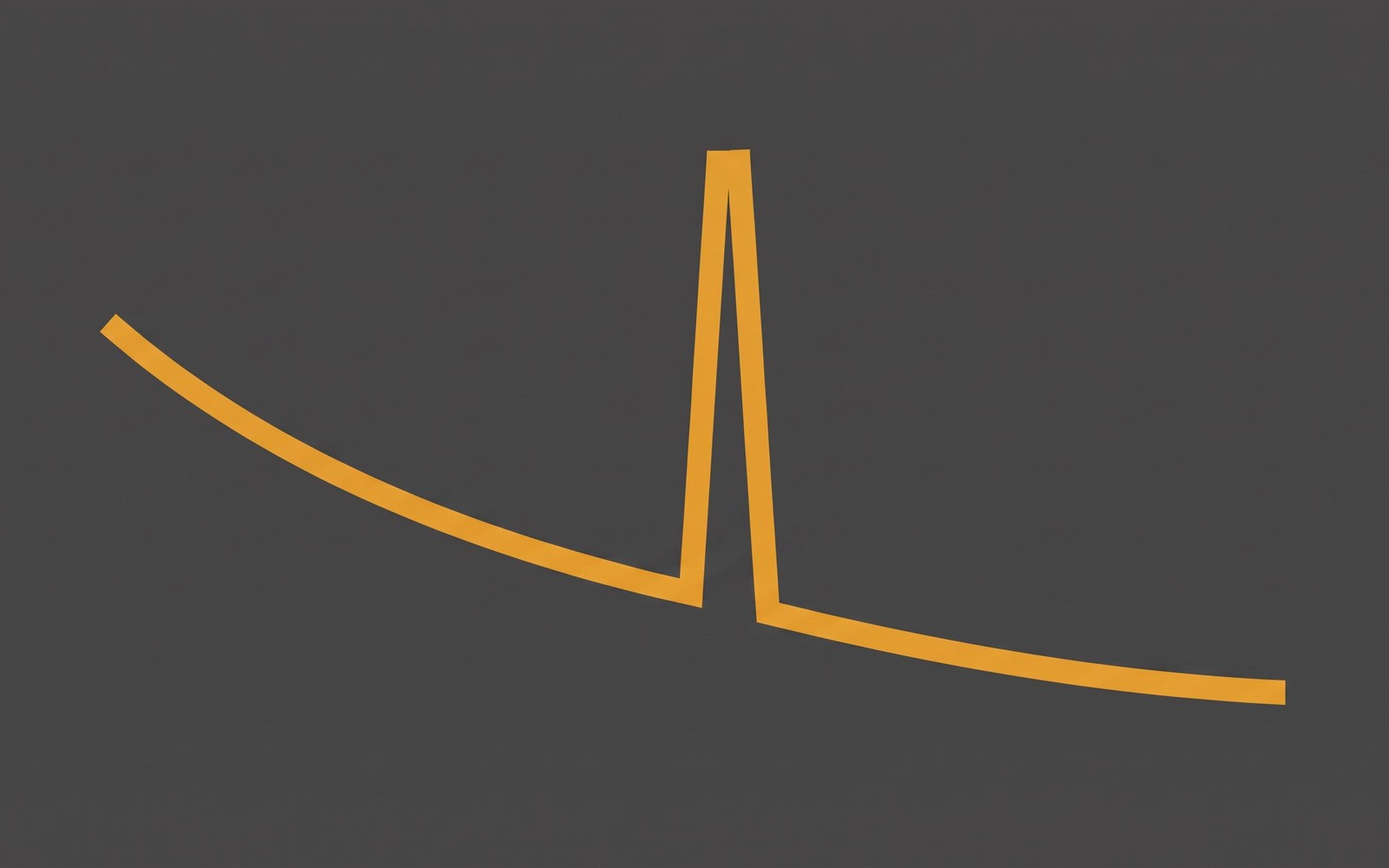
There is a famous little experiment that anyone who prices anything should have to sit with for a minute. People were offered a choice between two chocolates: a fancy Lindt truffle for fifteen cents, or an ordinary Hershey’s Kiss for one cent. Most people, sensibly, took the truffle — for the money, it was clearly the better chocolate. Then the researchers dropped both prices by exactly one cent. The truffle now cost fourteen cents; the Kiss cost nothing. The relative deal was untouched — you saved a single penny either way. But the choices lurched: now most people walked past the better chocolate and grabbed the free one.
Nothing about the value changed. One number crossed zero, and behavior jumped.
Why zero breaks the arithmetic
The everyday way to think about price assumes a smooth line. A dollar is a little worse than free; ten dollars a little worse than nine. On that model, “free” is just the leftmost point on the line — the cheapest of the cheap. But the brain does not seem to file it there. Zero looks less like a number and more like a feeling: there’s nothing to subtract, no cost to weigh, no chance of turning out to be the sucker. Any price at all, however small, forces a calculation — is this worth it to me? Free deletes the calculation. And deleting the calculation turns out to be worth far more than the penny you saved.
Economists draw a tidy demand curve and call the slope “price sensitivity.” The zero-price effect is that curve jumping off its own tracks right at the end.
What this does to a build decision — in two directions
First, your free tier. Its power is not that it’s your cheapest plan. It’s that it’s free — a categorically different offer that recruits people who would never have run the “is it worth it?” calculation at any positive price. Swap “free” for “just $1/month, to keep out the tire-kickers,” and you haven’t made a cheap plan. You’ve re-introduced the calculation and forfeited the entire nonlinear jump. That dollar costs you far more than a dollar.
Second — and this is the trap — the same cliff runs in reverse. Introducing any price where there used to be none is not a small change your users will barely register. Turning a free feature into a two-dollar add-on, or metering something that was unlimited, provokes a reaction wildly out of proportion to two dollars — because you’ve marched people back across the line from “no decision” to “a decision.” (It’s a close relative of the pain of paying: the sting isn’t the amount, it’s being made to weigh it at all.) The lesson is not “never charge.” It’s that the boundary between free and not-free is a wall, not a step — so price on purpose on each side of it, and never cross it by accident.
The honest hedge
Free is a powerful stimulus, and powerful stimuli attract people who want the stimulus, not the product. The same nonlinear pull that fills your funnel also fills it with users who will never pay and were never going to — so the free/paid line isn’t only a pricing decision, it’s a decision about who you recruit and what “free” produces for you (a habit, a loop, a thing other people see) versus what it merely gives away. Zero is a magnet. The whole game is pointing it at the right filings.
The science, to look up: the zero-price effect (Shampanier, Mazar & Ariely, 2007, “Zero as a Special Price,” Marketing Science; popularized in Dan Ariely’s Predictably Irrational); related, the pain of paying (Prelec & Loewenstein, 1998).
Sources
- Shampanier, Mazar & Ariely 2007
- Prelec & Loewenstein 1998
Liked this? Get the next one in Working Theory.
Going weekly in August (it's in beta now). One genuinely interesting read on building, the brain, and the science most people missed.
Subscribe →