Ten days is not a long time to change your mind, and I don’t think anyone did.
Around the middle of this month, Dario Amodei published an essay called We Must Pace the Frontier — a serious, carefully argued case that the AI industry is moving too fast and should deliberately slow down, with a three-part plan and Anthropic volunteering to go first on one of the steps. Roughly ten days later, Anthropic shipped Claude Opus 5.5, its most capable model yet, faster and cheaper than the one before it.
It would be easy, and lazy, to call that hypocrisy. I don’t think it is. I think it’s the most ordinary thing in the world, and the fact that it happens to the person most publicly committed to the opposite is the whole point. The distance between what we sincerely intend and what we actually do isn’t a character flaw. It’s a structural feature of how brains — and the organizations built out of them — work. And if you build products, it is quietly setting fire to your roadmap.
The most replicated disappointment in behavioral science
Psychologists have a boring name for this: the intention–behavior gap. When you measure how much someone wants to do something and then measure whether they do it, the two are related — but far more weakly than anyone expects. In a large meta-analysis of experiments that successfully changed people’s intentions, a sizable shift in intention produced only a modest shift in actual behavior. People updated what they meant to do. Most of them did not update what they did.
This is not the same as people lying, and it’s not the same as people being unable to articulate what they want. Those are real problems too, but they’re different problems. Here the person is being honest, is self-aware, means it completely — and still doesn’t act. The intention was genuine. It just wasn’t in charge.
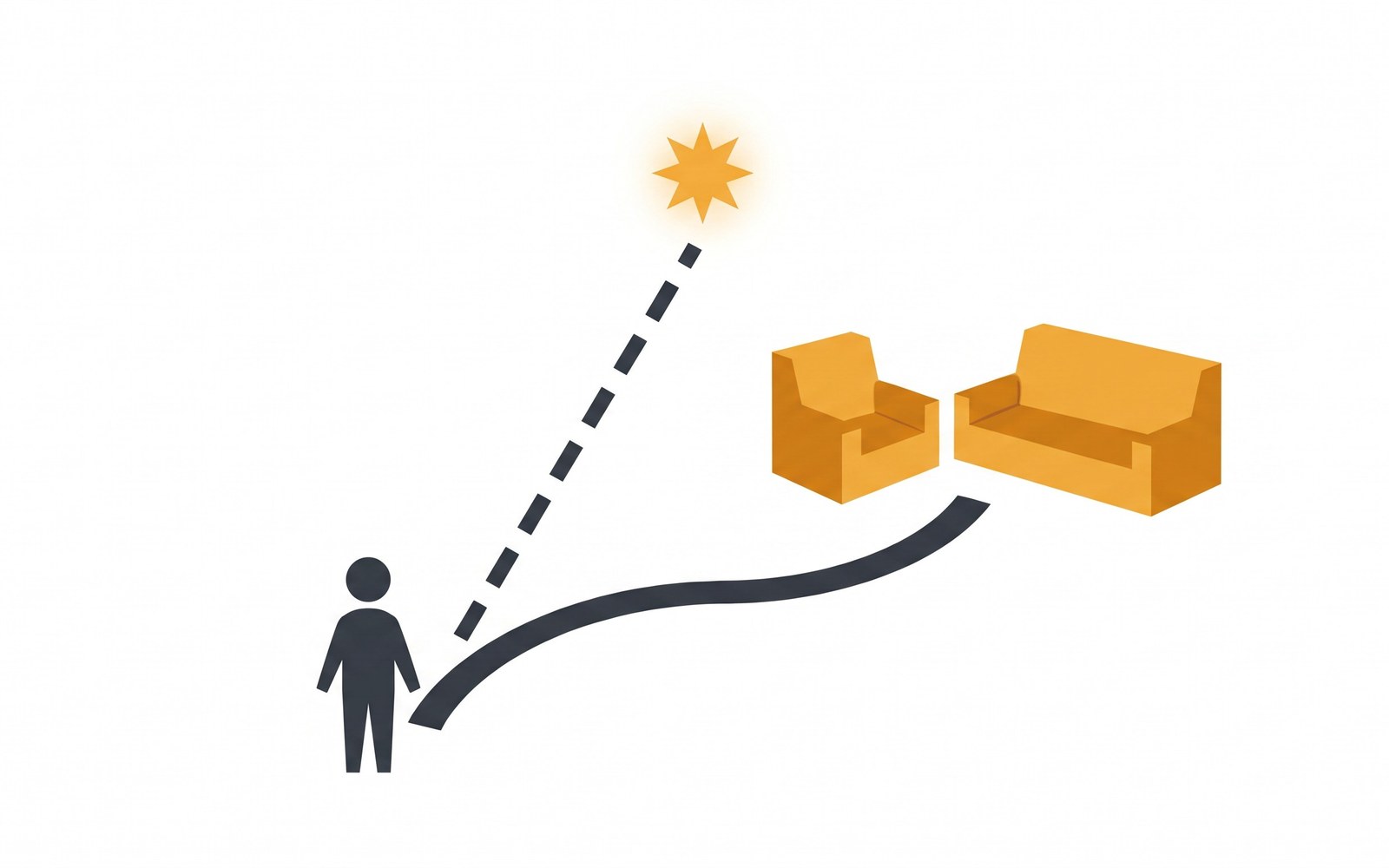
Why not? Because intentions live in a reflective, verbal, future-facing part of cognition, and behavior is mostly driven by the immediate situation: what’s in front of you, what’s easy, what the default is, what it costs right now. The essay is written by the planning self. The next model ships on the schedule the acting self was already on. Both are real. Only one of them touches a keyboard.
What this quietly does to your product
Almost every product is designed for the intending self, because the intending self is the one you talk to. They’re who answers your survey (“yes, I’d definitely use a weekly digest”). They’re who shows up in the sales call full of plans. They’re who signs up on Sunday night meaning to invite the whole team, configure the integrations, and journal every morning. You build the digest, the team invites, the integrations, the streak — a product perfectly shaped to a person who exists mostly on the day they sign up.
Then the acting self logs in on a Tuesday, tired, with eleven other tabs open, and does the one thing that is easiest.
The mistake isn’t building for good intentions. It’s trusting stated intentions as evidence. A survey that says 70% would use a feature is measuring intention, and you now know roughly how much of that survives contact with a Tuesday. If you let stated intent set your roadmap, you will keep building beautiful features for a person who meant to use them.
The build decision
Two moves, and they pull in opposite directions on purpose.
Instrument the acting self, not the intending self. Weight what people do over what they say they’ll do — not because users lie, but because even honest intentions predict behavior weakly. Treat “would you use this?” as a hypothesis, and go find the workaround, the repeated visit, the thing they already do the hard way. Behavior is the only survey that already accounts for the gap.
Then, where the intention is good, shorten the distance to the act. The most reliable lever anyone has found for the intention–behavior gap is embarrassingly small: attach the intended action to a specific cue — a when-and-where, a default already set, a single next step waiting on the screen. (Psychologists call the cue version implementation intentions; it helps, though modestly, and it’s no substitute for the thing being worth doing.) You are not trying to make people want it more. They already do. You’re trying to make the wanting reach the Tuesday.
Amodei meant the essay. Anthropic meant the model. Both are true, ten days apart, because meaning something and doing something run on different machinery. Your users are no different — and the product that remembers that stops designing for the person who signed up, and starts designing for the person who came back.
The science, to look up: the intention–behavior gap (Sheeran & Webb, 2016, Social and Personality Psychology Compass; Webb & Sheeran, 2006, Psychological Bulletin meta-analysis); implementation intentions (Gollwitzer, 1999). The news, to check: Dario Amodei, “We Must Pace the Frontier” (darioamodei.com; Axios, Sept 12, 2026); Anthropic’s Claude Opus 5.5 release (9to5Mac; Yahoo Finance, ~Sept 22, 2026).
Sources
- Sheeran & Webb 2016
- Webb & Sheeran 2006
- Gollwitzer 1999
Liked this? Get the next one in Working Theory.
Going weekly in August (it's in beta now). One genuinely interesting read on building, the brain, and the science most people missed.
Subscribe →