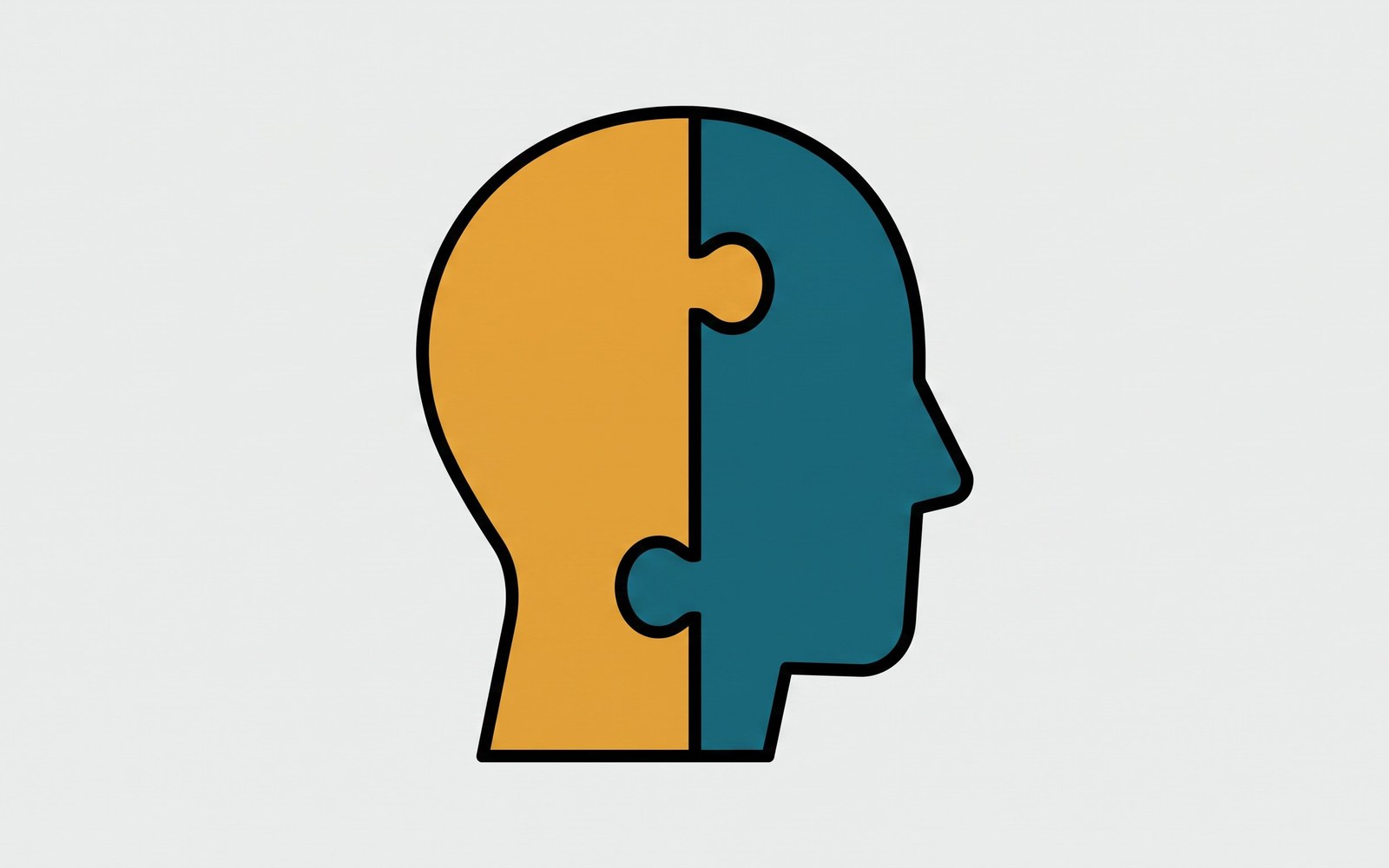
We talk about “the brain” the way we’d talk about a single machine — one organ, one designer, one plan. It’s a comforting picture, and this month it got a little harder to hold.
In September 2026, a Stanford Medicine–led team reported something that sounds almost too tidy to be new: the brain doesn’t grow from one starting point. It grows from two. Working mostly in mouse embryos and tracing the pattern back across an astonishing sweep of evolution, the researchers found that the front of the brain — the forebrain and midbrain, the parts we associate with thinking, seeing, deciding — and the back of the brain — the hindbrain, which runs the machinery of staying alive — descend from two different founding populations of cells. One group switches on a gene called Otx2; the other switches on Gbx2. And here’s the part that made people reach for the phrase “two separate organs”: from the very earliest moments, those two populations never mix. They’re not one sheet of tissue that later specializes into regions. They’re two lineages that grow toward each other and meet.
Before that phrase runs away with us, it’s worth being precise, because the finding is interesting enough without the hype. This is a claim about developmental and evolutionary origins, not about two minds rattling around in your skull. You do not have two consciousnesses. The forebrain/hindbrain divide itself has been in the textbooks for a long time; what’s new is the evidence that the two divisions come from distinct cell lineages, with distinct genetic programs, walled off from each other from the start — a pattern the team traced across roughly 550 million years of animals. It’s a story about how the thing was built, and about how deep the seam runs.
But the seam is the whole point, and it generalizes past this one paper.
Evolution is not an architect. An architect starts with a blank sheet and a single intention. Evolution starts with whatever already worked and bolts the next thing onto it, because a lineage that stops working to redesign itself from scratch doesn’t get to have descendants. So the organs that result aren’t clean designs; they’re accretions — layers and modules and old parts repurposed, joined at seams that hold well enough to survive. The eye has a blind spot because of how it was wired up. The recurrent laryngeal nerve takes a famously absurd detour. And the brain, it increasingly seems, is less a unified command center than a coalition of parts with separate births, negotiating in real time and mostly agreeing.
What’s uncanny is that you can’t feel any of it. From the inside, there’s just one smooth stream of being you — one voice, one point of view, one continuous “I” that seems to have been there all along and to be running the show. That felt unity is doing a lot of work to paper over a system that is, structurally, a committee. Neuroscience keeps finding this pattern from different angles: the two hemispheres that will each confidently narrate actions the other one took; the specialized modules that can be knocked out one at a time, taking a single capacity with them and leaving the rest of “you” intact. The self isn’t the thing underneath the parts. It’s the story the parts tell together, well enough that you never notice it’s a story.
Which is the quietly humbling takeaway, and a very on-brand one for anything that lives in a skull: the seamlessness is the illusion, not the machinery. You are not a single elegant design that happens to have regions. You are a coalition old enough to have forgotten it was ever more than one thing — running so smoothly that the member you experience as “me” has no idea it’s outnumbered.
The science, to look up: the two-lineage / dual-origin brain finding (Nature Neuroscience, 2026; the Otx2 vs Gbx2 progenitor split and the midbrain–hindbrain boundary); and, for the broader pattern, the modularity of mind, hemispheric specialization and the “interpreter,” and evolution as tinkerer rather than engineer (François Jacob’s “bricolage”).
The news, to check: Stanford Medicine, “Human brain is two separate organs, Stanford Medicine–led research finds” (med.stanford.edu, Sept 18 2026; Kyle Loh lab, co-first authors Carolyn Dundes and Rayyan Jokhai), with corroborating coverage at medicalxpress.com and ScienceDaily. Read the “two organs” framing as two developmental origins, not two minds.
Sources
- Nature Neuroscience 2026 (Otx2 vs Gbx2 progenitor split)
- modularity of mind
- hemispheric specialization
- evolution as tinkerer (François Jacob's bricolage)
Liked this? Get the next one in Working Theory.
Going weekly in August (it's in beta now). One genuinely interesting read on building, the brain, and the science most people missed.
Subscribe →