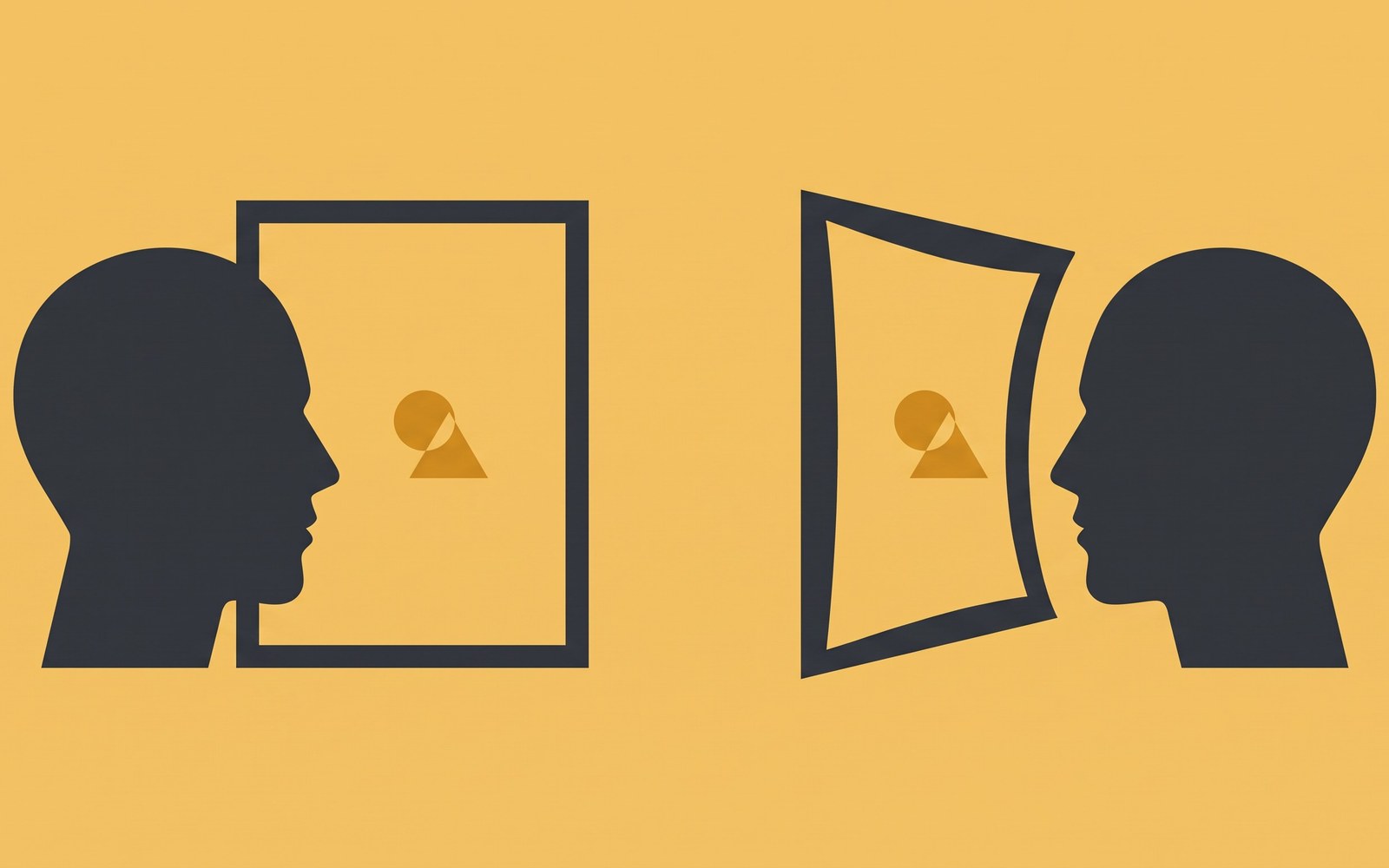
Here is a conviction you almost certainly hold without noticing you hold it: that you see the world roughly as it is. Not perfectly — you’d grant that you have blind spots in the abstract. But in any specific disagreement, the feeling is unmistakable. You’re looking at the facts. The facts point one way. And the person across from you, looking at the same facts and reaching the opposite conclusion, must be doing something you are not — being biased, being emotional, being misinformed, having an agenda.
Psychologists call this naive realism, and the unsettling part isn’t the first belief. It’s the second one. It’s not just that we think we see reality clearly. It’s that we treat our own view as the neutral baseline, so anyone who diverges from it isn’t offering a different reasonable reading — they’ve been distorted away from the obvious truth we can plainly see.
The experiment where both sides saw bias against them
The cleanest demonstration is decades old and still a little uncanny. Researchers showed the same news coverage of a real, bitter conflict to partisans on both sides. Then they asked each group how fair the coverage was. Both sides — watching the identical footage — concluded the coverage was slanted against them and tilted in favor of the other side. The same neutral tape read as hostile to whichever side was watching.
That result, later called the hostile media effect, is naive realism caught in the act. If you believe you’re seeing the situation straight, then coverage that doesn’t match your view can’t be balanced — it must be biased. Both groups ran that logic flawlessly. Both concluded the referee was against them. They couldn’t both be right, but they could both be certain, and they were.
Why the brain builds it this way
Some of this is just how perception works. You never experience raw reality; you experience your brain’s finished construction of it, delivered seamlessly, with none of the assembly showing. Your interpretation of a situation doesn’t feel like an interpretation. It feels like looking. And it’s hard to be humble about a conclusion when the machinery that produced it hid all its work and handed you what looks like a direct feed from the world.
There’s a cousin worth naming. When researchers asked people whether they, personally, were susceptible to various well-known biases, most people rated themselves as less biased than the average person — including on biases they’d just demonstrated. This is the bias blind spot: we detect distortion easily in others and almost never in ourselves, partly because we judge others by their behavior but judge ourselves by our intentions, which always feel reasonable from the inside. So naive realism gets a second layer of armor: not only do I see clearly, but I’ve checked, and I’m one of the unbiased ones.
A couple of honest caveats. Naive realism is a tendency, not a constant — people can and do hold their views tentatively, especially outside heated disagreements, and the effect varies with how much a topic matters to your identity. And noticing the pattern doesn’t dissolve it; you can know all of this and still feel, in the next argument, that you’re simply looking at the facts.
Which is the strangely useful takeaway. The feeling of obviousness — how can they not see it? — is not evidence that you’re right. It’s the exact sensation naive realism predicts you’d have whether you were right or wrong. The other person is having it too, with equal force, pointed at you. Neither of you can feel your own pane of glass. The most you can do is remember it’s there.
The science, to look up: naive realism (Ross & Ward, 1996; Lee Ross); the hostile media effect (Vallone, Ross & Lepper, 1985); the bias blind spot (Pronin, Lin & Ross, 2002).
Sources
- Ross & Ward 1996
- Vallone, Ross & Lepper 1985
- Pronin, Lin & Ross 2002
Liked this? Get the next one in Working Theory.
Going weekly in August (it's in beta now). One genuinely interesting read on building, the brain, and the science most people missed.
Subscribe →