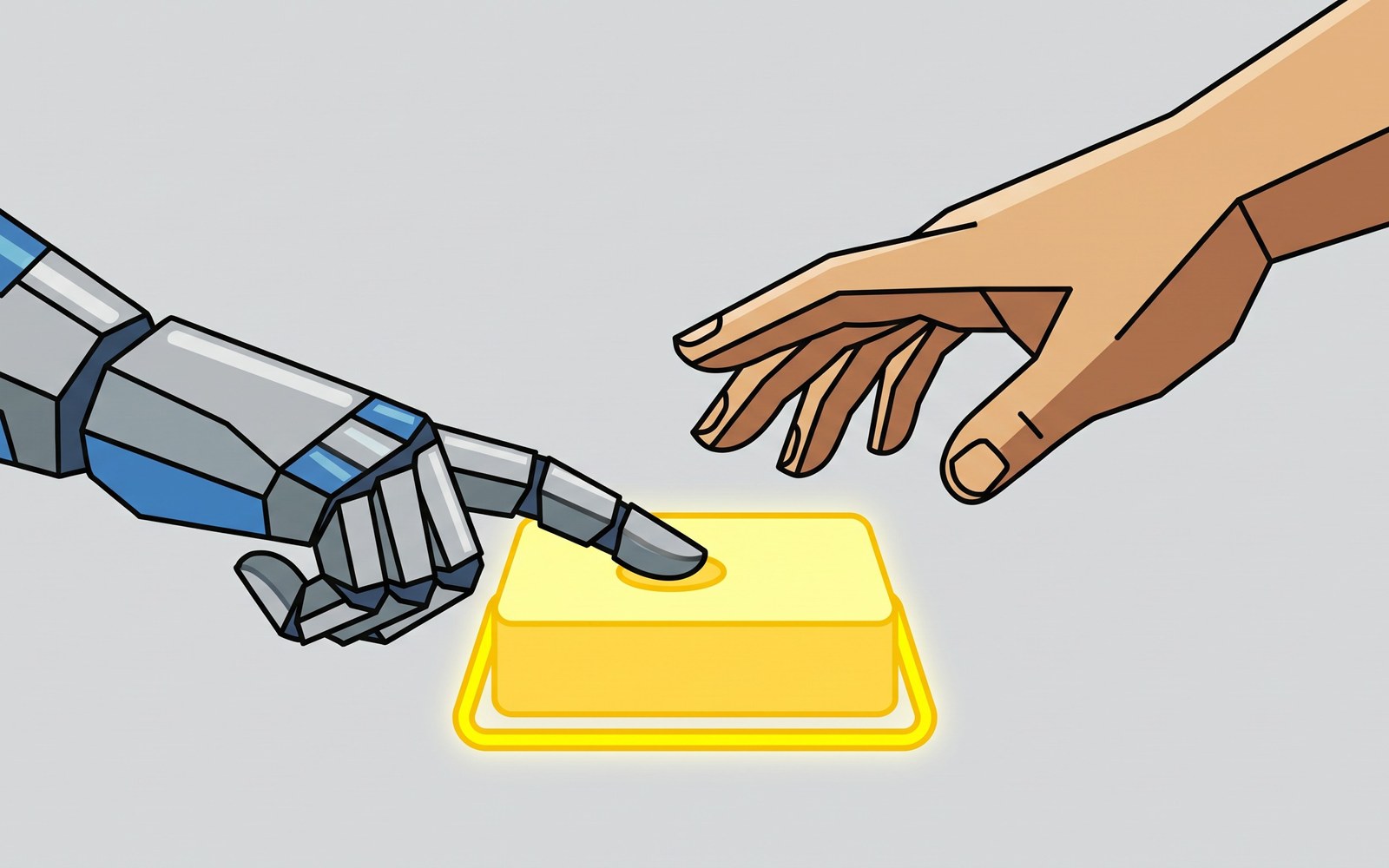
On September 8, Meta launched Muse, a personal AI agent that will read your email, plan your trip, turn a recipe into a grocery order, and — through a Stripe checkout wired to about a million merchants — actually buy the thing. TechCrunch ran it under a question rather than a headline: will consumers trust it? Three days later Fortune answered with the part builders should sit with: people are curious about the agent, and most of them still don’t want it touching their money.
It’s tempting to file that under safety. Passwords, fraud, a bot going rogue in your cart. Those are real, and Meta clearly knows it — Muse runs in a walled-off browser and, by their account, can’t see your passwords or payment details. But safety doesn’t fully explain the flinch. You’ll let a stranger at a restaurant run your card through a machine you can’t see. The discomfort with the agent is a different animal, and it lives in a corner of the brain most product conversations never reach: the sense of agency.
The brain keeps a “was that me?” tag
Your brain does not just track what happened. It tracks, moment to moment, whether you made it happen. That tag — the felt authorship of your own actions — is the sense of agency, and it has a measurable fingerprint. When you voluntarily cause something, your brain compresses the felt time between your action and its result: the two events feel pulled together, closer than a stopwatch says they were. Patrick Haggard and colleagues named this intentional binding in the early 2000s, and it’s become one of the cleaner behavioral markers of agency we have. Cause an outcome yourself and the gap shrinks. Watch the identical outcome happen without your command and the gap stays wide — the binding weakens or vanishes.
The leading explanation is a prediction machine. When you decide to act, your brain sends the command and a copy of it, and uses that copy to predict the sensory consequences — the click, the confirmation, the charge going through. When the world matches the prediction, the brain stamps the result: I did that. No command, no prediction, no stamp. The outcome may be identical. The ownership is not.
This is why a tool feels like an extension of you and an agent can feel like a stranger doing your errands. A tool waits for your command and gives you back exactly the consequence you predicted — high agency, tight binding, mine. A full-autopilot agent runs the whole arc — notice, decide, act, check out — and hands you a finished outcome your brain never predicted and never caused. It happened to you. Even when it’s the outcome you wanted, some part of you doesn’t take credit for it. And you don’t fully trust what you don’t feel you authored.
The build decision: reserve the causal moment
The reflex when you build an agent is to automate the whole path — every hop you leave for the human looks like friction you failed to remove. The sense of agency says the opposite for one specific hop: the consequential, hard-to-undo step is not friction to remove, it’s the moment that lets the user own the outcome. Automate the tedium — the searching, the comparing, the form-filling, the forty tabs. Reserve the one action that causes the thing that can’t be easily unwound: the purchase, the send, the booking, the irreversible commit. Let the user’s own finger close that loop.
Notice this lands on the same spot as two ideas already in this series. It’s the irreversible step from the two-way-doors piece — the rare one-way door you should slow down at. And it’s where the post-completion research says attention is thinnest right after the goal feels met. Agency, reversibility, and error all point at the same place in the flow: put the human’s hand exactly where the consequence is heaviest.
One caution, because it’s easy to cargo-cult. Binding needs a real, felt cause, not a rubber stamp. A confirmation modal the user swats away without reading gives no agency — it’s a speed bump, not an act of authorship. The approval has to feel like the deed itself: placed at the moment of consequence, showing what’s about to happen in terms the user actually predicts, singular enough that pressing it means something. One deliberate “yes, buy this” beats ten reflexive “OK”s. You’re not adding a gate. You’re handing back the command.
The agents are going to get good enough to run the whole errand. The ones people actually let near their money will be the ones that still let them feel like the author of what got done.
The science, to look up: the sense of agency and intentional binding (Haggard, Clark & Kalogeras 2002; review by Moore & Obhi, Consciousness and Cognition, 2012); the comparator / forward model account of agency (Frith, Blakemore & Wolpert). Effect sizes and the exact mechanism are still debated — treat binding as a robust marker of agency, not a settled formula.
The news, to check: Meta’s Muse launch, September 8 2026 — TechCrunch, “Meta debuts its Muse AI agent. Will consumers trust it?” (Sept 8); Fortune, “Meta’s new AI can shop, choose and check out. Most people don’t want it touching their money” (Sept 11); corroborated by Quartz and TechRepublic (Sept 8-9).
Sources
- Sense of agency and intentional binding (Haggard, Clark & Kalogeras, 2002)
- the comparator / forward-model account (Frith, Blakemore & Wolpert). News: Meta's Muse launch, reported by TechCrunch and Fortune, Sept 8-11 2026
Liked this? Get the next one in Working Theory.
Going weekly in August (it's in beta now). One genuinely interesting read on building, the brain, and the science most people missed.
Subscribe →