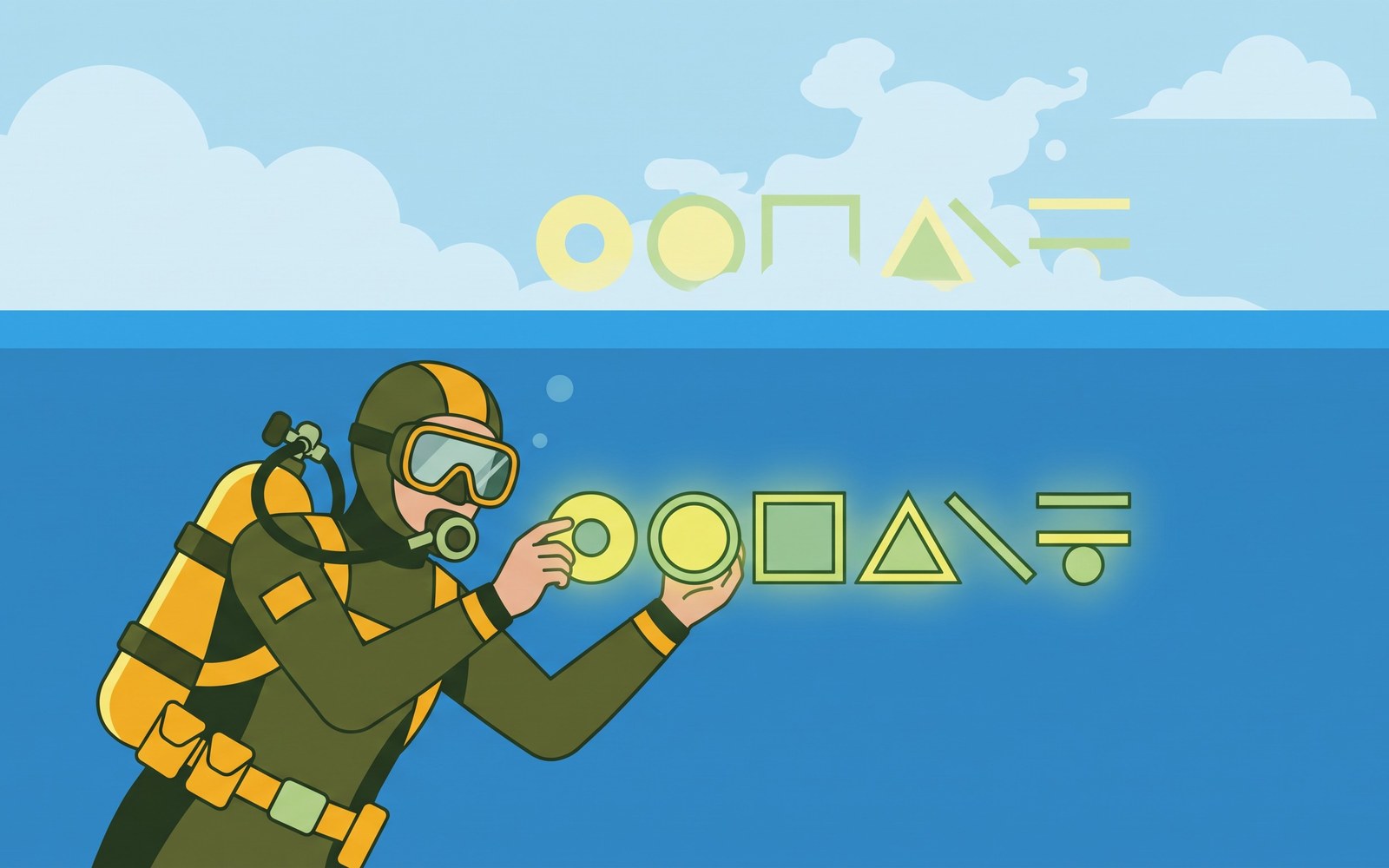
In 1975, Duncan Godden and Alan Baddeley talked a club of deep-sea divers into an experiment that sounds like a prank. The divers learned lists of words in one of two places: on dry land by the water, or fully submerged about twenty feet down, breathing from tanks. Then each of them tried to recall the words — sometimes back in the same place they’d learned them, sometimes in the other one.
The pattern was stark. Words learned underwater came back best underwater. Words learned on the beach came back best on the beach. Move a diver from where they’d studied to the other environment and a good chunk of what they’d learned — a sizeable fraction, though the exact number wobbles across conditions — simply didn’t surface. Nothing about the words changed. Nothing about the divers’ brains changed in the swim from shore to seabed. All that changed was the place they stood in while trying to remember, and it reached into their memory and pulled a lever.
The context is part of the memory
The tidy way to think about memory is a filing cabinet: you put a fact in, you take the same fact out. Godden and Baddeley’s divers point at something stranger. When a memory forms, your brain doesn’t just record the thing you meant to learn. It bundles in the surroundings — the room, the light, the background hum, the smell, even your mood and internal state — and stores them together, whether you asked it to or not. The context becomes part of the trace.
Endel Tulving and Donald Thomson gave this its name a couple of years earlier: encoding specificity. Retrieval, they argued, isn’t a matter of the memory being strong or weak in the abstract. It’s a matter of match. A memory comes back most easily when the cues present at the moment you try to recall it line up with the cues that were present when it went in. Reinstate the original context and you hand the brain a set of keys. Change the context and the same memory is still in there — it just lost its keys.
This isn’t only about physical places. The internal version — state-dependent memory — is just as real and even odder. Things learned in a particular mood come back more readily in that mood. There’s a well-worn line of (carefully hedged) research on substances: people who learned material after a drink tended to recall it slightly better after another drink than stone sober, which is the sober scientific cousin of the folk story about the drunk who hides his keys and can only find them once he’s drunk again. The state you’re in is a context too, and your brain files it alongside everything else.
Why this quietly runs your day
Once you see encoding specificity, small mysteries start to explain themselves.
It’s why walking back into the kitchen retrieves the thought you lost on the way there — you’re reinstating the context it was born in. (That’s a close relative of the doorway effect: crossing from one room to another swaps out the cues that were propping up the thought, and it collapses.) It’s why an exam in an unfamiliar hall can feel harder than the practice tests at your own desk — the room you studied in was silently doing part of the remembering, and now it’s gone. It’s why witnesses are sometimes walked back through a scene, and why a song from one specific summer can dump a whole season back into your lap: the memory was filed with all of it.
There’s even a practical trick buried in here. If a memory is only tied to one context, it has exactly one set of keys. Study the same thing in several different places, in different states, at different times, and you give it many sets — more independent routes back in, fewer of them tied to a room you might not be standing in when you need the answer. The single most cue-rich place to remember something is right where you learned it. The most portable memory is one you deliberately learned in more places than one.
A fair caution before you over-fit it: the effect is strongest for open-ended recall, where you’re fishing with few cues. For recognition — where the thing itself is put back in front of you to say yes or no — the item supplies its own keys, and the surrounding context matters far less. Godden and Baddeley themselves found the underwater gap mostly for free recall, not recognition. Magnitudes vary, replications argue over the size, and lab word-lists aren’t life. But the core is solid and a little humbling: some of what you call your memory isn’t filed in your head alone. It’s filed in the world you were standing in — and the world has to be there to help you read it back.
The science, to look up: context-dependent memory — Godden & Baddeley, “Context-dependent memory in two natural environments” (the divers study), 1975; encoding specificity — Tulving & Thomson 1973; state-dependent memory — Goodwin et al. 1969 (the alcohol studies, held loosely) and Eric Eich’s mood work; context-reinstatement research by Steven M. Smith. Effect sizes are condition-dependent and stronger for recall than recognition — a real phenomenon, not a formula.
Sources
- Context-dependent memory — Godden & Baddeley (1975)
- encoding specificity — Tulving & Thomson (1973)
- state-dependent memory — Goodwin et al. (1969), Eric Eich
Liked this? Get the next one in Working Theory.
Going weekly in August (it's in beta now). One genuinely interesting read on building, the brain, and the science most people missed.
Subscribe →