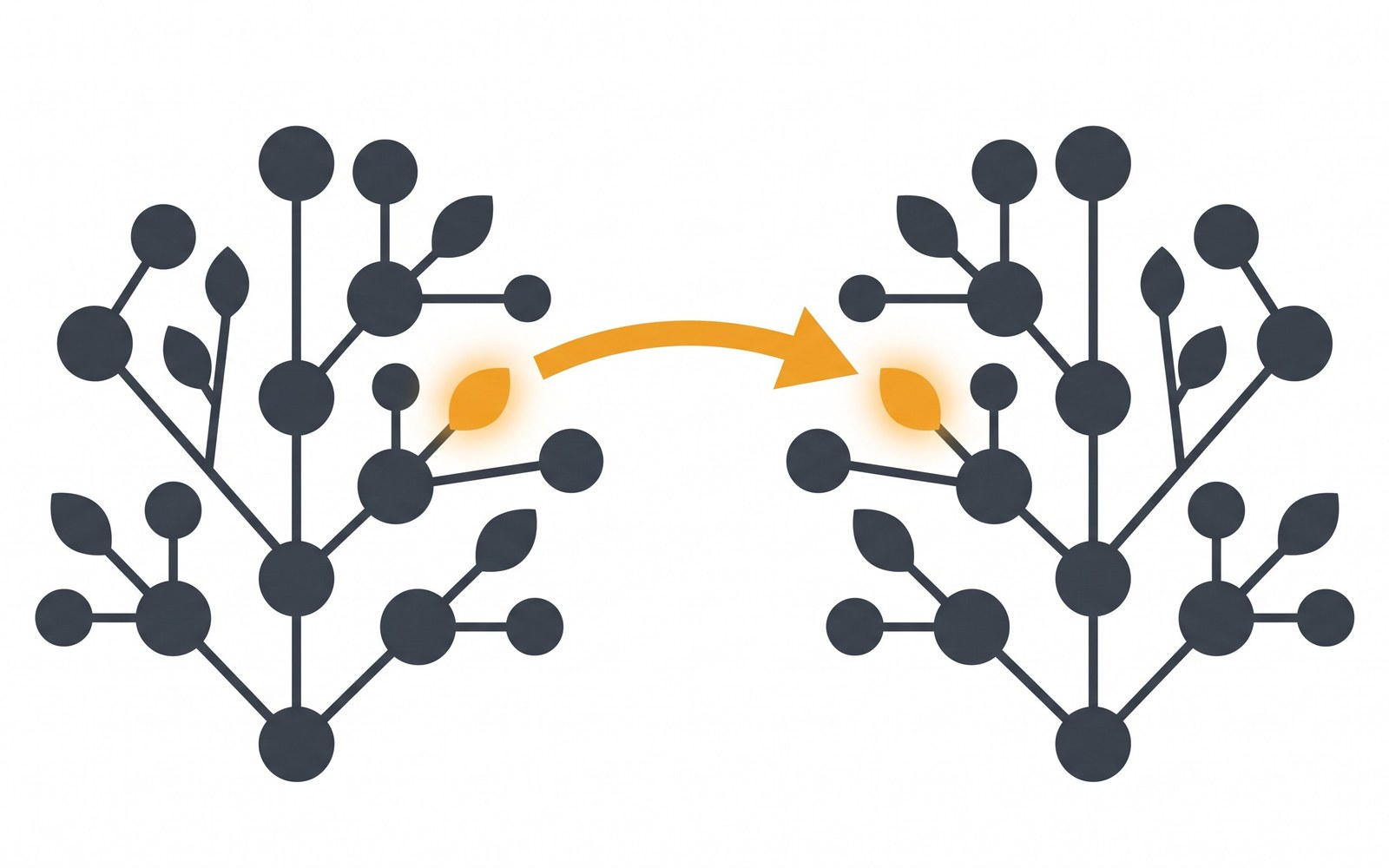
In a distributed database that keeps several copies of your data, something quietly uncomfortable is always true: the copies disagree. Not because anything is broken — because that’s the normal state of a system where writes arrive over an unreliable network, a node was briefly unreachable, a packet got dropped, a replica fell behind. If you could freeze the whole thing and line up the three machines that are supposed to hold the same row, you’d often find they don’t quite.
The interesting question was never how to prevent that. You can’t, not without paying latency costs that would sink the product. The interesting question is how the system notices and fixes the drift — with no human in the loop, no downtime, while everyone’s asleep. Two mechanisms do most of that work, and both are worth understanding even if you never build a database, because they’re a template for anything that has to stay correct without ever stopping to check.
Read-repair — fix it when someone happens to look
When a read comes in, the coordinator doesn’t ask one replica. It asks several. Usually they agree, and it returns the answer. But sometimes they don’t — one replica is holding a stale version. So the coordinator returns the newest value to the user and, in the same breath, quietly writes that correct value back to the replica that was behind. The repair rides along on a request that was going to happen anyway. It’s cheap and opportunistic: data that gets read gets healed as a side effect of being read.
The limitation is sitting right there in the description. Data that nobody reads never gets repaired this way. Your hot rows stay consistent precisely because they’re hot; the cold, untouched corners of the dataset are free to keep drifting, unseen.
Anti-entropy — go looking on purpose
So you need the other half: a background process that periodically compares replicas and reconciles their differences with no user request required at all. The naive version — ship everything to a neighbor and diff it — would be ruinously expensive, so real systems reach for a lovely structure called a Merkle tree: a tree of hashes where every node summarizes everything beneath it.
Two replicas compare their root hashes first. If the roots match, everything below matches too, and they’re done in a single comparison. If the roots differ, they walk down only the branches that disagree, narrowing as they go, until they’ve isolated the handful of records that actually diverged — and they ship just those. It’s a way to find the needle without moving the haystack.
“Anti-entropy” is an honest name for it. Left alone, the copies tend toward disorder; this is the process that continuously spends a little energy pushing them back toward agreement.
The idea underneath — why a builder should care
Both mechanisms share a philosophy that reaches far past databases: don’t assume correctness — continuously restore it. Rather than trying to guarantee that nothing ever diverges (expensive, brittle, and finally impossible over a network you don’t control), you accept that divergence happens and build a cheap, always-running process that pulls the system back toward truth. Read-repair does it lazily, along the paths people actually use. Anti-entropy does it deliberately, everywhere, on a schedule. You want both, because each one covers exactly the other’s blind spot.
That pattern shows up any time you keep two things in sync that are free to drift: a cache and its source of truth, a search index and the database behind it, a mobile client and a server. The question is always the same — heal on read, sweep in the background, or both? — and for anything that matters, the honest answer is usually both.
The trade, as always, gets named out loud: this is eventual consistency. For a window, a reader can see a stale value; the system is correct over time, not at every instant. For some data — a bank balance mid-transaction — that window is unacceptable, and you pay for stronger guarantees. But for a great deal of what we actually build, “wrong for a few hundred milliseconds, then quietly and automatically right, forever, with nobody paged” isn’t a compromise. It’s the only kind of correctness that survives contact with a real network.
The craft, to look up: read-repair and anti-entropy / Merkle-tree reconciliation (Amazon’s Dynamo paper — DeCandia et al., 2007; the design lives on in systems like Cassandra and Riak; Merkle trees, Ralph Merkle, 1987).
Sources
- DeCandia et al. 2007 (Amazon Dynamo)
- Merkle 1987
Liked this? Get the next one in Working Theory.
Going weekly in August (it's in beta now). One genuinely interesting read on building, the brain, and the science most people missed.
Subscribe →