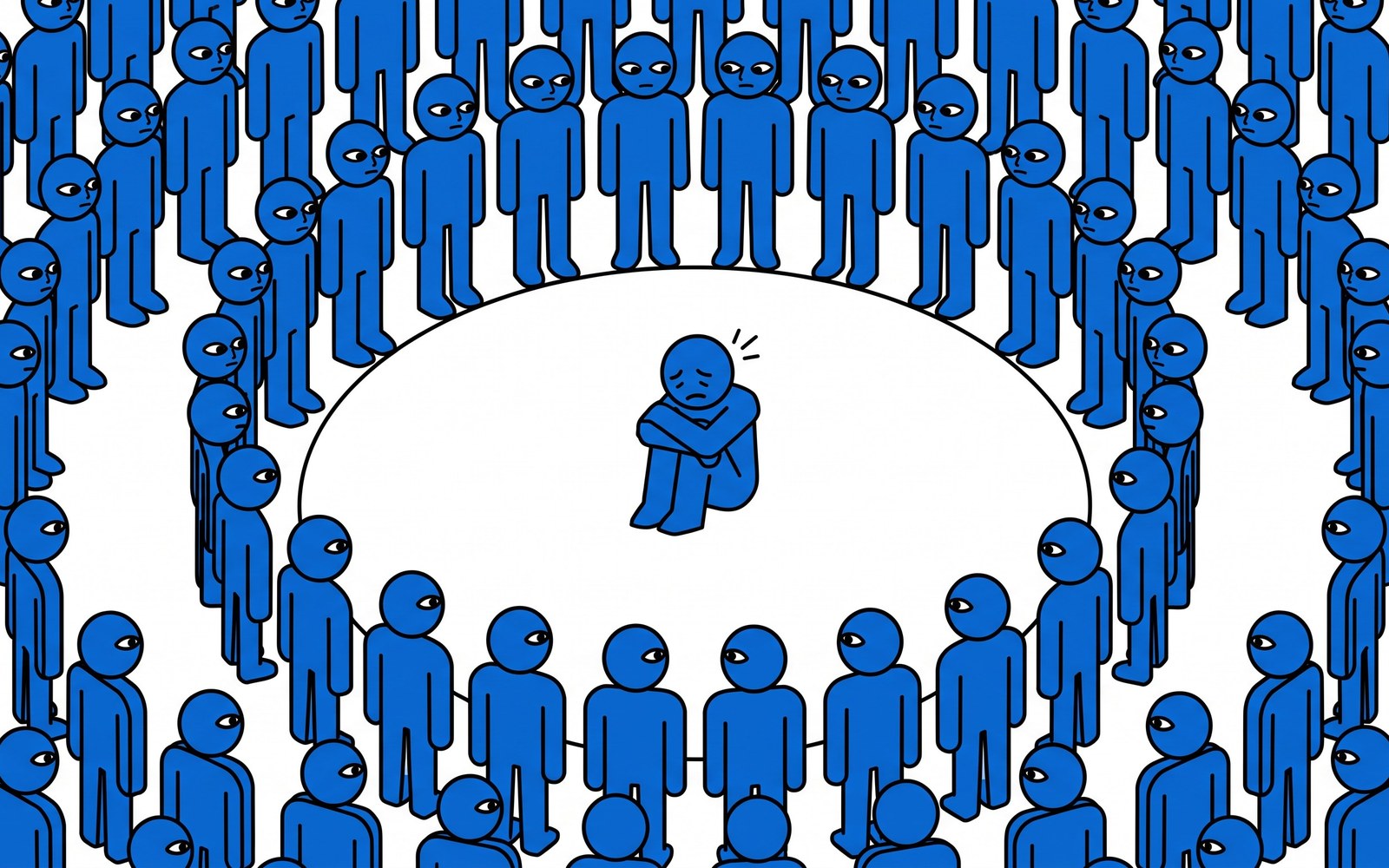
Here is a fact that refuses to sit comfortably: your odds of getting help in a crisis can go down as the number of people around you goes up. Not because crowds are cruel. Because responsibility divides.
The story everyone half-remembers is the wrong version, so let’s clear it first. In 1964 a woman named Kitty Genovese was murdered in Queens, and a newspaper ran the line that thirty-eight witnesses watched and did nothing. That framing, it turned out, was substantially false — a 2007 reappraisal in American Psychologist (Manning, Levine and Collins) showed the true number of witnesses was far smaller, that some did call, and that one neighbor held her as she died. The myth outran the facts. But the myth also sent two social psychologists, Bibb Latané and John Darley, into the lab — and what they found there is real.
Two experiments carry the idea. In the first, a participant fills out a questionnaire when smoke starts seeping under the door. Alone, most people get up and report it. Seated among a few others who stay calm, most sit there and breathe the smoke. In the second, a participant hears — over an intercom — another student apparently having a seizure. When they believe they’re the only one listening, roughly 85% go for help, fast. When they believe four others are also listening, far fewer move, and the ones who do are slower.
The mechanism has two gears. One is diffusion of responsibility: with N people present, each carries only 1/N of the felt duty to act, and 1/N of the blame for failing to. The other is pluralistic ignorance: everyone reads everyone else’s outward calm as evidence that nothing is wrong, so a room can talk itself into stillness by mutual reassurance — each person quietly comforted by the composure of people who are, in turn, watching them.
The unsettling elegance is that each individual is being locally reasonable. If nobody else looks alarmed, maybe it’s nothing. If ten people could call, surely one already has. Sensible at the scale of one mind; catastrophic at the scale of the group — a coordination failure wearing the face of calm.
Now the honest modern hedge — which is the interesting part, not a footnote. The bystander effect is one of the most replicated results in social psychology; a 2011 meta-analysis (Fischer and colleagues) confirms it. But it shrinks, and can even flip, when the emergency is unambiguous and genuinely dangerous. When the stakes are plainly high, more people can actually mean more help — more chances that someone competent steps up, and no “maybe it’s nothing” ambiguity to hide behind. Real-world studies of street conflicts caught on CCTV (Philpot and colleagues, 2019) found that someone intervened in the large majority of cases. So the durable truth is narrower and sharper than the headline: diffusion bites hardest when the situation is ambiguous — when the first thing your brain has to do is decide whether this even counts as an emergency.
Which makes the whole thing almost practical, and genuinely a fact about how minds work under other minds. The reason the old advice — “you, in the blue jacket, call for help” — works so well is that it dismantles both gears at once. It removes the ambiguity (this is an emergency) and it un-divides the responsibility (it is yours now, specifically).
We like to think we’d be the one who acts. Maybe we would. But the lab’s quiet lesson isn’t that people are bad. It’s that a mind reads the room before it reads the emergency — and a calm room is a very persuasive argument that nothing is wrong.
The science, to look up: the bystander effect and diffusion of responsibility (Bibb Latané & John Darley, 1968-1970 — the smoke-filled-room and intercom-seizure studies); pluralistic ignorance; the Kitty Genovese reappraisal (Manning, Levine & Collins, 2007, American Psychologist); the meta-analysis on when the effect attenuates (Fischer et al., 2011); and the real-world CCTV work (Philpot et al., 2019). Effect sizes vary with ambiguity and danger — hold the numbers loosely.
Sources
- The bystander effect and diffusion of responsibility (Latané & Darley, 1968-1970)
- pluralistic ignorance
- the Kitty Genovese reappraisal (Manning, Levine & Collins, 2007)
Liked this? Get the next one in Working Theory.
Going weekly in August (it's in beta now). One genuinely interesting read on building, the brain, and the science most people missed.
Subscribe →