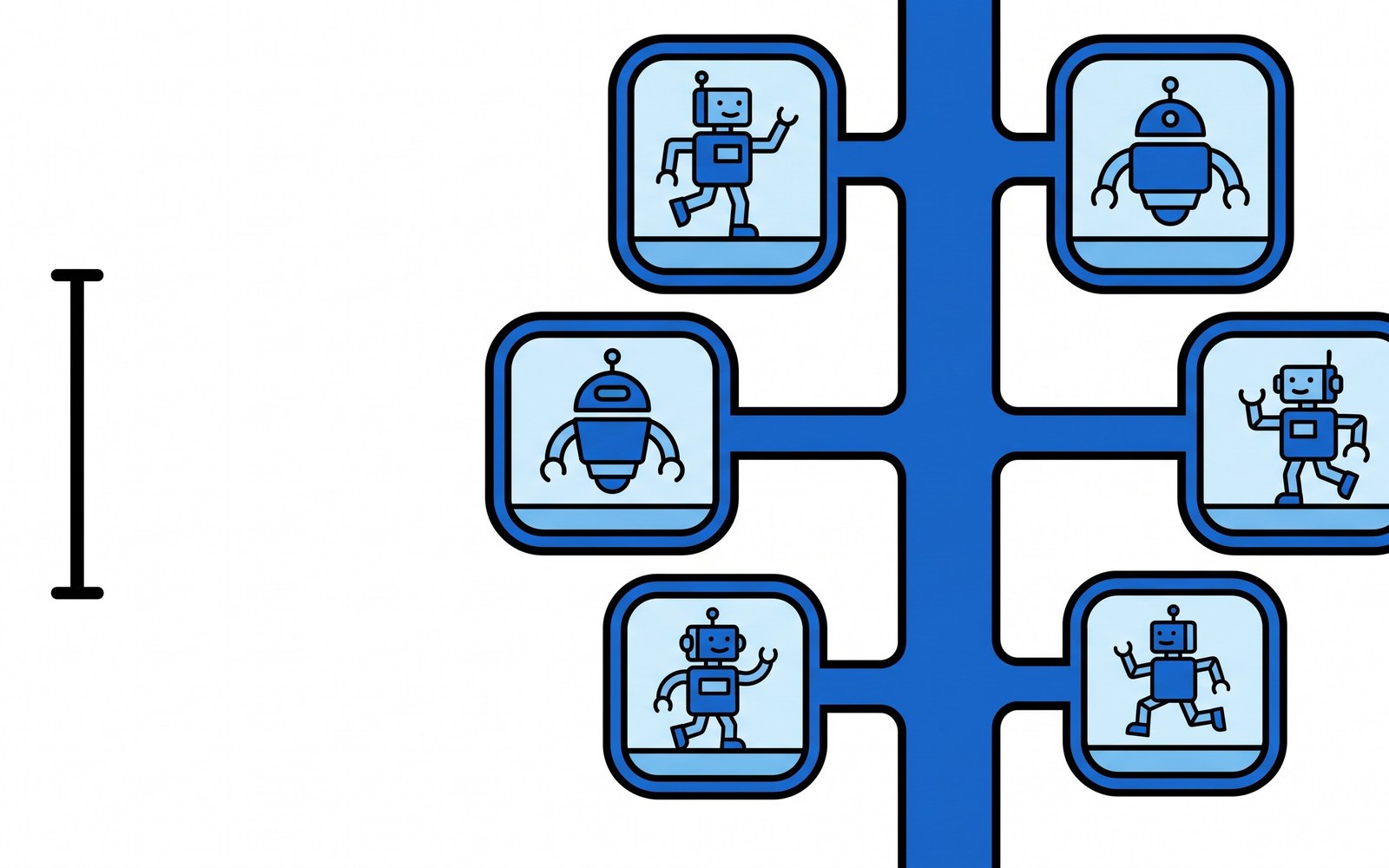
In early August, Meta shipped Muse Code, a terminal coding agent that — in Mark Zuckerberg’s framing — handles “complete software engineering tasks across large repos,” planning changes, writing code, and validating the results. The detail worth stopping on isn’t the benchmark. It’s the plumbing: Muse Code fans out parallel sub-agents into isolated worktrees so they never touch your working copy.
Set the leaderboard aside. What’s interesting is the shape. The AI left the editor.
For three years the default form of AI-in-code was autocomplete — the model finishing your sentence, inline, one grey suggestion at a time. Muse Code, and the wave around it, is a different animal: you hand it a task and walk away. That is not a bigger autocomplete. It’s a different product with a different bottleneck, and conflating the two is exactly where teams building agent tooling go wrong.
Autocomplete is synchronous assistance. You are the author; the model rides shotgun. Review is free and continuous — you read every token as it lands, because your eyes are already on the line. The scarce resource is keystrokes, and autocomplete spends them for you. The blast radius is one line. If it’s wrong, you hit Escape.
A background agent is asynchronous delegation. You are no longer the author — you’re the reviewer of work you didn’t watch happen. And the instant review stops being continuous, it stops being free. It batches. It arrives all at once, as a diff across forty files you didn’t type, and you have to reconstruct an intent you were never present for. The scarce resource is no longer typing. It’s reviewable output and bounded blast radius.
So the design work moves — and Muse Code’s own choices point right at where it goes.
The handoff. A synchronous tool needs almost no spec; you’re steering in real time. An async agent runs on the brief you gave it and nothing else, so the task description becomes load-bearing in a way a prompt never was. The interface for delegation is the brief, not the cursor. (This is the same lesson as writing an explicit, testable spec.)
The isolation. This is why “isolated worktrees” is the most important phrase in the announcement. An autonomous thing editing across your whole repo is a new principal with real authority, and the sane response is to give it a box it can’t corrupt you from — a branch, a worktree, a copy — so a wrong run gets thrown away instead of cleaned up. Reversibility stops being a nicety and becomes the containment wall. Fanning out parallel agents only works because each one is sandboxed.
The diff. Since review is now the tax you pay, the output has to arrive in a shape a human can check quickly. The unit of an async coding agent isn’t a suggestion — it’s a reviewable change: a diff, a passing test, a plan you can skim before you read the code. “Validates the results” is doing quiet work in Zuckerberg’s sentence. An agent that hands you unverified edits across forty files hasn’t saved you effort; it’s shoved the effort downstream and made it heavier.
The durable lesson under the headline: synchronous help and asynchronous delegation are not two points on one slider. They are two products. Autocomplete optimizes the author. An agent optimizes the task and demotes the human to reviewer — a fine trade, but only if you rebuild the workflow around the brief, the sandbox, and the diff. Bolt an async agent onto a synchronous interface — drop a “do the whole feature” button into the editor and expect the old review economics — and you get the worst of both: work you didn’t watch, arriving somewhere you can’t review it, touching a tree it can corrupt.
The shift isn’t that the model got smarter. It’s that it stopped sitting at your cursor and got a desk of its own. Design for the teammate, not the suggestion.
The systems, to look up: git worktrees (isolated working copies); the principle of least authority (Saltzer & Schroeder, 1975); compensating transactions / the saga pattern (Garcia-Molina & Salem, 1987); and the old HCI distinction between synchronous and asynchronous interaction.
The news, to check: Meta’s Muse Code launch, Aug 5 2026 — TechCrunch, “Meta launches Muse Code, an AI agent for large code bases” (Aug 5 2026), corroborated by Yahoo Tech, Techzine Global, Notebookcheck, ITdaily, and Gulf News. The isolated-worktree / parallel-sub-agent detail and the Zuckerberg quote are from the TechCrunch report. Muse Code is a different product from the consumer “Meta Muse” agent.
Sources
- Git worktrees
- the principle of least authority (Saltzer & Schroeder, 1975)
- the saga pattern (Garcia-Molina & Salem, 1987). News: Meta's Muse Code launch, Aug 5 2026
Liked this? Get the next one in Working Theory.
Going weekly in August (it's in beta now). One genuinely interesting read on building, the brain, and the science most people missed.
Subscribe →