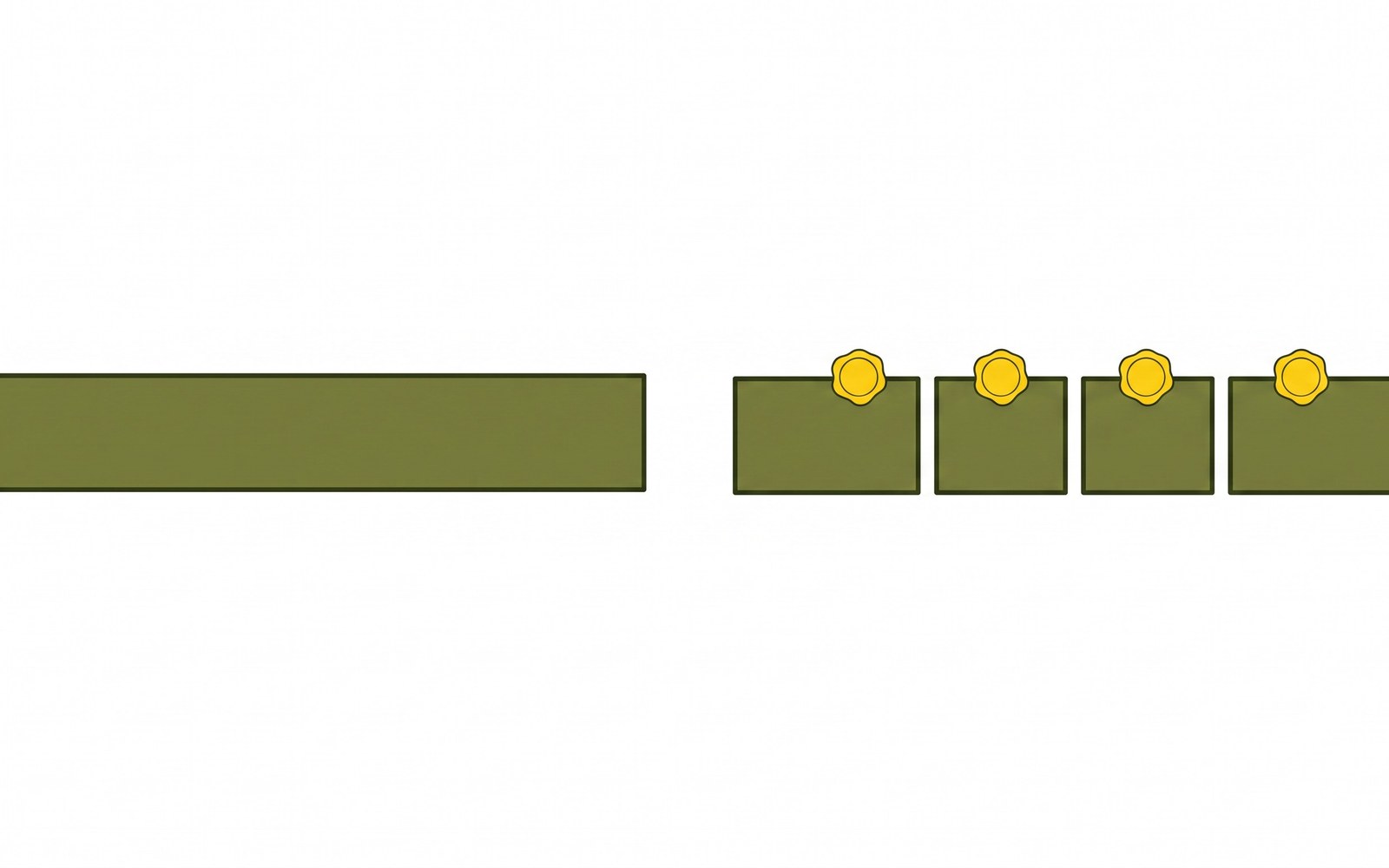
Here is a setup screen at exactly 60% complete, shown two ways. One is a single bar, a little over halfway to a distant “finished.” The other is five checkboxes with three of them ticked. Same account, same remaining work, same instant in time. The second one feels better — more moving, more winnable, more likely to get finished. Nothing changed except how big you made one unit of progress.
That’s the whole lever, and it’s easy to walk past because it looks like decoration. It isn’t. Deciding how to slice a fixed amount of work into countable units is a design choice that changes behavior, and most products make it by accident.
Why a completed unit punches above its weight
Finishing a unit — any unit — delivers a small, real hit of done. Karl Weick made the case decades ago that “small wins” are motivationally disproportionate: a modest, concrete completion moves people more than its size warrants, because the mind treats finished as a category, not a quantity. Teresa Amabile’s diary research on knowledge workers landed in the same place from the other direction — the single biggest day-to-day driver of good inner work life was simply making progress, and even small steps counted. And the goal-gradient idea (which this series has visited before) adds the kicker: the closer a marked goal feels, the harder people push toward it.
Stack those together and something almost arithmetic falls out. If a completed unit is worth a hit of momentum, then more completed units means more hits — for the exact same underlying work. Ten checkboxes hand out ten little dones; one bar hands out one, at the very end, after a long stretch of feeling like nothing is happening. The work is identical. The felt progress is not.
It’s worth separating this from its better-known cousin. There’s a well-documented unit bias — people treat “one unit” as the right amount to consume regardless of how big that unit is, which is why a bigger plate or a bigger default portion quietly gets eaten. That’s about consumption: how much. This is the mirror image on a non-consumption surface — a setup flow, a profile meter, a checklist, a course, an onboarding — where the unit isn’t something you use up but something you complete. There, the size of the unit doesn’t set how much gets consumed; it sets how many wins you mint from a fixed amount of effort.
The build decision: size the unit to the smallest earned win
So slice finer? Only to a point — there are two walls.
The floor is that a unit has to feel earned. This series has a piece on the just-noticeable-difference — the smallest change your senses will register. Accomplishment has the same floor. Below some size, a completed “unit” doesn’t read as a win; it reads as busywork, or worse, as the product padding a checklist to look generous. Ticking “you entered your name” fools no one and can insult a little. The rule of thumb: make one unit the smallest chunk that still feels like a real thing done — and no smaller.
The ceiling is the dead middle. When the real work is one big, genuinely indivisible task — a long import, a review, a single hard form — a single bar leaves a long stretch where nothing completes and people quietly leave. There the move is to invent legible sub-units: named checkpoints, an autosaved draft that counts, “step 2 of 4” over one screen, a milestone at the halfway mark. You’re not faking progress; you’re making real progress countable so the brain can collect its wins along the way. (And if you can start people a little past zero — an endowed head start — the first unit is already halfway to done before they lift a finger.)
The number on the screen is doing more than reporting status. It’s deciding how often your user gets to feel like they finished something. Choose the unit on purpose.
The science, to look up: small wins (Karl Weick, “Small Wins,” American Psychologist, 1984); the progress principle (Amabile & Kramer, The Progress Principle, 2011); the goal-gradient effect (Hull; Kivetz, Urminsky & Zheng 2006); unit bias as the consumption-side contrast (Geier, Rozin & Doros 2006); and the just-noticeable difference / Weber’s law for the floor. These are motivation findings, not laws — the direction is robust; exact magnitudes depend on the surface.
Sources
- Small wins (Karl Weick, 1984)
- the progress principle (Amabile & Kramer, 2011)
- the goal-gradient effect (Kivetz, Urminsky & Zheng, 2006)
- unit bias (Geier, Rozin & Doros, 2006)
Liked this? Get the next one in Working Theory.
Going weekly in August (it's in beta now). One genuinely interesting read on building, the brain, and the science most people missed.
Subscribe →