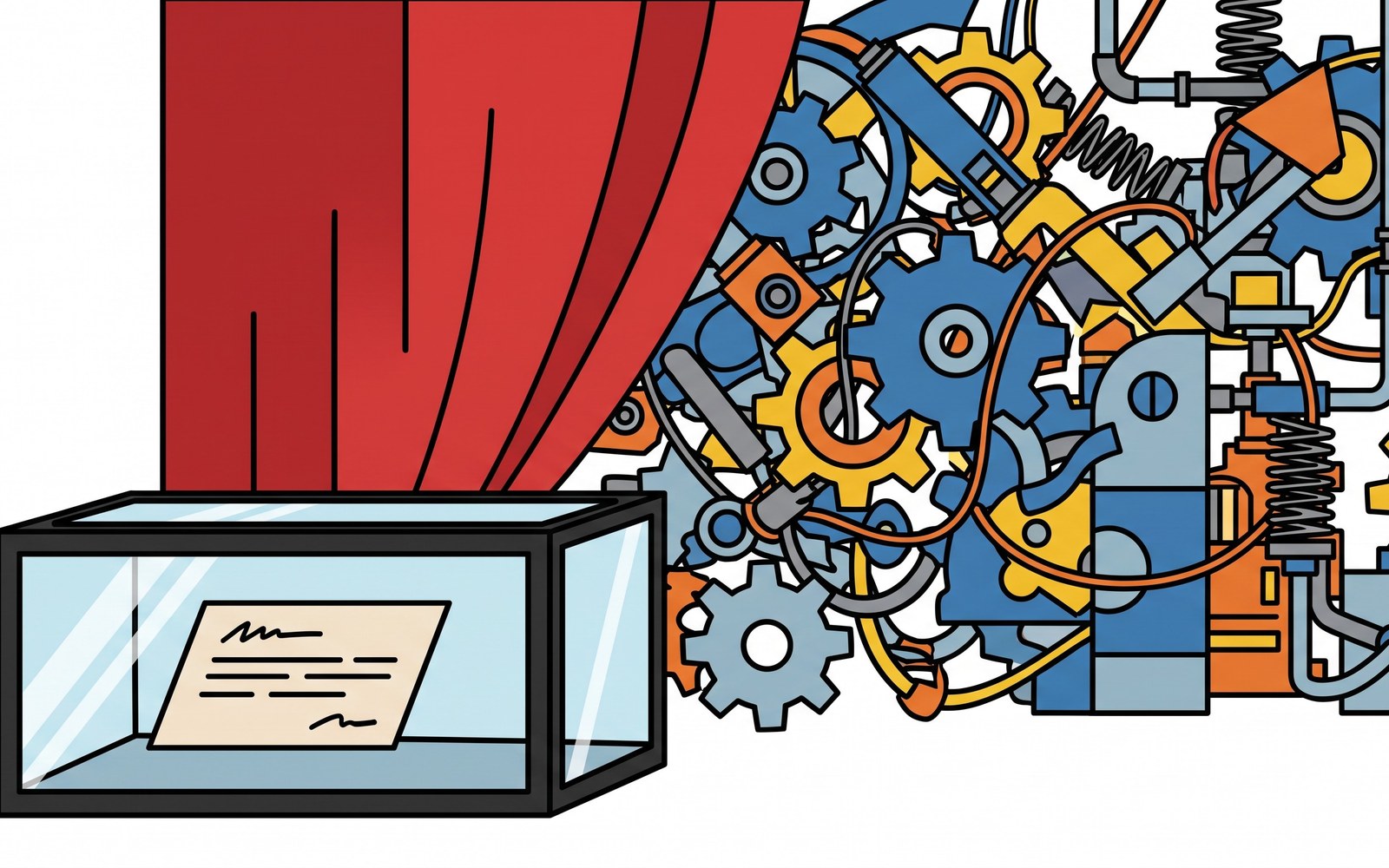
On September 3rd, OpenAI launched its most powerful model yet — Astra, which most of the coverage is calling GPT-6 — and buried in the launch was a line that mattered more than the benchmarks. Astra uses a reasoning technique the company calls “opaque recurrence,” and one consequence is that its chain of thought is harder to read. OpenAI’s own chief scientist put it plainly: as capability goes up, monitorability gets harder. The window we’d gotten used to — watch the model think, step by step, and catch it when it goes wrong — is fogging over.
The instinct is to treat this as pure loss. And there’s a real safety story there. But there’s also a builder’s lesson underneath it that’s older than any model, and it cuts the other way: a readable chain of thought was never proof of the real reason in the first place. Not for machines, and — this is the uncomfortable part — not for us.
Start with the humans, because we’ve known this longer. In 1977, Richard Nisbett and Timothy Wilson published a paper with the almost rude title “Telling More Than We Can Know.” Across study after study, people confidently explained why they’d made a choice — and the explanations were demonstrably not the causes. Shoppers picked the rightmost item in a row and then invented reasons about quality; the position drove the choice, the reason was written afterward. The mind, it turns out, runs a narrator. It watches what you did and composes a plausible account, delivered with total sincerity and no privileged access to the machinery that actually produced the behavior. You are not lying when you explain yourself. You’re reconstructing.
Models do a version of the same thing. There’s a growing body of work on what researchers call unfaithful chain of thought: a model can produce clean, convincing step-by-step reasoning that isn’t what actually drove its answer — the “reasoning” is partly a story generated alongside the output, not a transcript of the computation. So the honest picture is symmetrical. The explanation you can see, human or machine, is a surface. Sometimes it tracks the real cause. Sometimes it’s a well-formed after-the-fact narration. And you usually can’t tell which from the surface alone.
For anyone building on top of these systems, that reframes a design decision most teams are making by reflex right now: show the model’s reasoning to the user. It feels responsible, and often it’s genuinely useful — a visible rationale helps a person understand, correct, and steer. But it quietly does something else too. A plausible, well-laid-out explanation makes people trust the answer more, whether or not the explanation is faithful. You’re not just informing the user; you’re manufacturing confidence, sometimes in an answer that doesn’t deserve it. (This is the shadow side of “show your work”: shown work builds trust, which is exactly why shown work that’s really theater is dangerous.)
So separate the two surfaces on purpose. Treat the explanation as an aid to understanding — helpful, steerable, worth showing. But anchor trust to something you can actually check: the outcome, the behavior, a verifiable result at the consequential step. Don’t let a clean rationale substitute for a real check, and put the check where an error would cost something, not on the paragraph that describes the reasoning. Astra’s fogged-over chain of thought just makes explicit what was always true — the reasoning was never the guarantee. If your product’s trust rests on a story the system tells about itself, you were exposed before the window closed.
The same discipline pays off with your users, not just your models. When you research why someone did something, their answer is a narration too. Build on what they did, not on the reason they hand you for it — and hold the reason lightly, as a hint, never as the cause.
You will rarely get to watch the real reason, from a mind or a machine. Build as if you can’t, and instrument the one thing you can: what actually happened.
The science, to look up: Nisbett & Wilson (1977), “Telling More Than We Can Know: Verbal Reports on Mental Processes”; confabulation and the left-hemisphere “interpreter” (Gazzaniga); and the AI work on chain-of-thought faithfulness (e.g. Turpin et al., 2023, “Language Models Don’t Always Say What They Think”). Effect sizes and how far the human findings generalize are still debated — hold the mechanism, not a number.
The news, to check: OpenAI’s Astra / GPT-6 launch and its “opaque recurrence” / monitorability caveat — TechCrunch (Sept 3 2026, “OpenAI launches Astra, its powerful (and controversial) new model”), corroborated by CNBC (Sept 3 2026) and Al Jazeera (Sept 4 2026); the model is widely referred to as GPT-6 (“GPT-6 Astra”).
Sources
- Nisbett & Wilson (1977), Telling More Than We Can Know
- confabulation and the interpreter (Gazzaniga)
- unfaithful chain-of-thought (Turpin et al., 2023). News: OpenAI's Astra / GPT-6 launch, Sept 3 2026
Liked this? Get the next one in Working Theory.
Going weekly in August (it's in beta now). One genuinely interesting read on building, the brain, and the science most people missed.
Subscribe →