Last time: Japan's formal surrender was signed aboard USS Missouri in Tokyo Bay on September 2, 1945, and every front this series has followed had gone quiet. So what did that surrender actually settle? Less than it looked like from the deck of the Missouri. The zones that would carve up occupied Germany had already been agreed on paper back in February, at Yalta, before the war in Europe had even ended. No war-crimes tribunal had yet convicted anyone. No international body existed yet to hold the peace together. And the wartime alliance that had just finished defeating two of the most destructive regimes in history was already arguing, at Potsdam that same July, about what the peace should actually look like — an argument this part follows all the way to the point where "wartime allies" stops being an accurate description of Washington and Moscow.
On April 20, 1945 — Hitler’s birthday, and the day Soviet artillery began falling inside Berlin’s city limits — a thirty-three-year-old German journalist named Marta Hillers started keeping a diary in a half-wrecked apartment building on the city’s east side. She kept writing through the Red Army’s arrival two weeks later and on through eight more weeks of occupation, recording in short, dated, unsentimental entries what she and the women sheltering around her actually did to survive it: the alliances they formed with individual Soviet officers for a measure of protection, the food they hid, the systematic sexual violence they lived through and, in her writing, refused to soften or leave out. The manuscript was published anonymously, in English translation, in 1954; it did not appear in German, her own language, for another five years, and no one connected it to Hillers by name until after her death in 2001, when historian Antony Beevor and researcher Walter Kempowski independently checked her account against outside records and found it held up, detail by painful detail.
Hillers’s diary covers eight weeks. This part covers about four years — the strange, underexamined stretch of time right after the guns stopped in 1945, when the war this series has followed for nineteen parts was militarily finished and almost nothing else about it was.
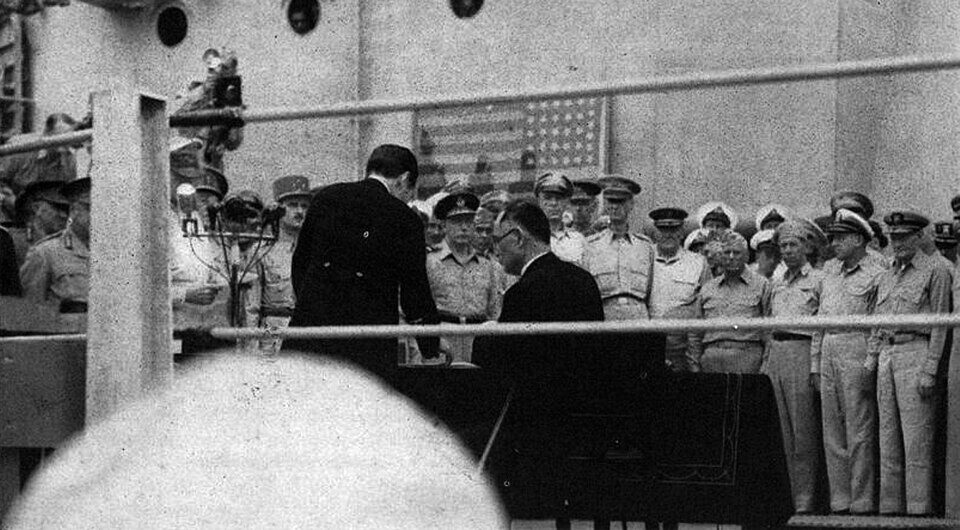
"The thoughts and hopes of all America — indeed of all the civilized world — are centered tonight on the battleship Missouri. There on that small piece of American soil anchored in Tokyo Harbor the Japanese have just officially laid down their arms."
The war’s two military endings landed eleven weeks apart: Germany’s unconditional surrender took effect May 8, 1945 (V-E Day), and Japan’s formal surrender was signed aboard the Missouri on September 2 (V-J Day). Within days of V-E Day, Germany stopped existing as a sovereign state. It was divided into four occupation zones — American, British, Soviet, French — governed jointly through an Allied Control Council, a plan agreed in outline at Yalta back in February and finalized at Potsdam that July. Austria got the identical four-zone treatment. In the Pacific, General Douglas MacArthur became Supreme Commander for the Allied Powers and ran occupied Japan almost entirely through the existing Japanese government bureaucracy and, controversially, the retained emperor, an arrangement that lasted until 1952.
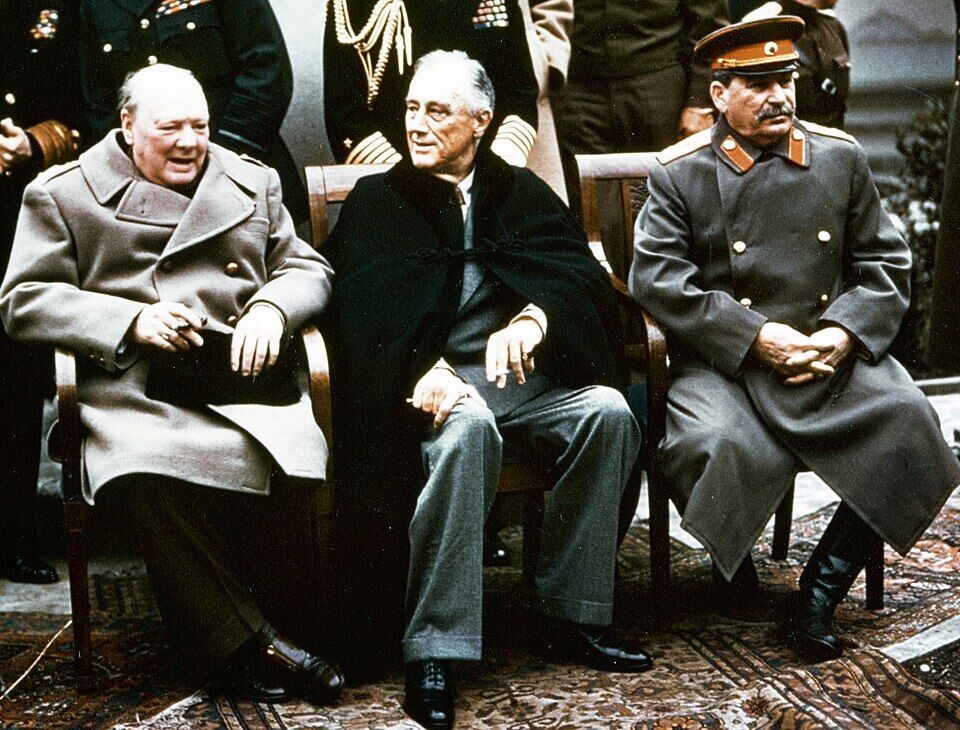
Two documented facts show how much daylight there was between “the war ending” and “the peace settling.” First: no treaty ever fixed Germany’s postwar borders in 1945. The Oder-Neisse line that the Allies agreed on at Potsdam — the new boundary between Germany and Poland — was written into the conference protocol as explicitly provisional, “pending the final delimitation of Poland’s western frontier.” It stayed provisional, on paper, for forty-five years, only becoming permanent international law with the 1990 treaty that accompanied German reunification. Second: at Potsdam, the Allies who had just finished jointly destroying Nazi Germany were already disagreeing, within days, about what came next. Harry Truman — sworn in as president after Roosevelt’s sudden death that April, and attending his first and only wartime summit — privately judged Stalin’s occupation of Eastern Europe to be “aggressive expansionism” that broke the spirit of what had been agreed at Yalta. Stalin, for his part, regarded the same occupation as legitimate security after a war that had just killed something on the order of 27 million Soviet citizens. Both readings are real, documented, and held by the people who held them at the time. Neither is this part’s verdict.
The record shows that dispute breaking into the open fastest over one country in particular: the trials meant to hold individuals, not just nations, accountable for what the war had actually been.
Benjamin Ferencz was twenty-seven years old in the spring of 1946, a U.S. Army war-crimes investigator with a law degree and no courtroom experience, when he personally uncovered captured reports from the Einsatzgruppen — the mobile SS killing squads that had shot more than a million people, mostly Jewish civilians, across the occupied Soviet Union. Ferencz flew the documents to Nuremberg and volunteered to prosecute the case himself. It was the first trial he had ever argued as a lawyer, of any kind. All twenty-two defendants were convicted. He went on to become, decades later, the last surviving Nuremberg prosecutor, and gave extensive recorded testimony late in his life about discovering the evidence and building the case largely from the documents alone.
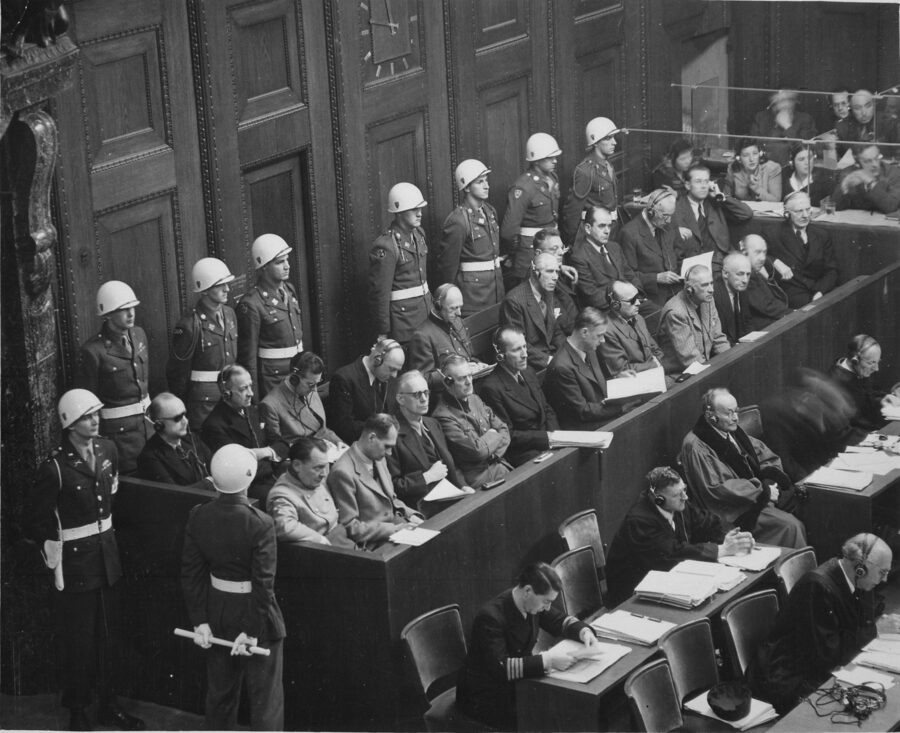
Ferencz’s Einsatzgruppen case was one of twelve “subsequent” Nuremberg trials that followed the main International Military Tribunal, which ran from November 20, 1945, to October 1, 1946. In the Pacific, a parallel body — the International Military Tribunal for the Far East, the Tokyo Trial — ran from April 1946 to November 1948. Together they established something with no real precedent in international law: that individual people, not only the states they served, could be held criminally responsible for launching a war of aggression and for crimes against humanity. Both tribunals could, in principle, acquit — and at the main Nuremberg trial, three defendants actually were acquitted outright, on the evidence presented, a genuine outcome nobody could guarantee going in.
The Tokyo Trial’s Nanjing Massacre count draws directly on evidence this series has already handled once. The reports the International Committee for the Nanking Safety Zone filed at the time — the same committee this series followed through its chairman, John Rabe, in Part 4, “China’s War” — became part of the documentary and eyewitness record entered at Tokyo: contemporaneous cables, casualty estimates, and testimony from committee members, including missionary and university administrator Miner Searle Bates, who testified in person. Rabe’s own private diary is a separate document from those committee reports; it stayed in his family’s possession, unpublished and essentially unknown, until a researcher rediscovered it in 1996 — fifty years after the Tokyo Trial that used his committee’s contemporaneous filings had already opened, and decades after Rabe himself had died. The documentation this series traced through one German businessman’s diary in Part 4 was never, itself, courtroom evidence. The institution he ran, and the records it filed while the killing was still happening, was.
You are the Allied leadership, still fighting the war, already arguing over what happens to the senior Nazi leadership once captured. Churchill has pushed since 1944 for a short list of named leaders to be identified and executed by military order within hours of capture — no trial required. Stalin has separately floated a tribunal whose verdict would essentially be agreed among the Allies beforehand, a formal process without real suspense. Washington, through Secretary of War Henry Stimson, is arguing for something closer to untested: a real international tribunal, bound by rules of evidence, where guilt has to be proven with documents and testimony a skeptical observer could actually examine — and which could, in theory, acquit.
The American position prevailed. The London Charter, signed August 8, 1945, created the International Military Tribunal on exactly that basis: crimes against peace, war crimes, and crimes against humanity, tried on documents and testimony, individuals in the dock rather than nations. It was not theater with a predetermined outcome — three of the men tried at the main Nuremberg proceeding, Hjalmar Schacht, Franz von Papen, and Hans Fritzsche, were acquitted on the evidence presented, over strong Soviet objection. Twelve more went to the gallows. Ferencz's Einsatzgruppen case, one of twelve subsequent trials built on the same evidentiary standard, is what option (c) actually looked like in practice: a twenty-seven-year-old with no trial experience, winning a conviction on captured paperwork alone.
The tribunals convicted the people who had run the killing. They did almost nothing for the millions the war had displaced and left with nowhere to go.
In the summer of 1946, a Latvian-American psychology professor named David Boder traveled through France, Germany, Switzerland, and Italy for nine weeks carrying a wire recorder — an early, bulky recording technology, magnetic wire instead of tape — and recorded more than 120 hours of interviews with over a hundred displaced persons: Holocaust survivors, former forced laborers, refugees with nowhere yet to return to. It is the earliest systematic recorded oral-history project of what would only later be called the Holocaust, made before that word was in common use at all. Boder didn't interview officials or generals. He sat down, one at a time, with people who had survived the thing the Nuremberg dock had just finished being tried for, and let the wire recorder run while they talked in their own words, in real time, only months after it had ended. The recordings and full transcripts are archived and freely browsable today through the Illinois Institute of Technology's "Voices of the Holocaust" project.
Boder’s subjects were part of a much larger population the trials never addressed directly: displaced persons camps across Europe held well over a million people through the late 1940s, some of them for years, with resettlement negotiated country by country, case by case, long after the courtroom in Nuremberg had emptied out.
Two institutions built in parallel, mostly without waiting for the trials to finish, were meant to make sure the next global catastrophe would have somewhere to be argued out short of another war. The Bretton Woods Conference, held at the Mount Washington Hotel in New Hampshire from July 1 to 22, 1944 — while the war in Europe was still very much underway — brought together delegates from forty-four Allied nations and created the International Monetary Fund and the World Bank, institutions meant to stabilize currencies and finance postwar reconstruction so the kind of economic collapse that had helped produce fascism in the 1930s (Part 1 of this series, “The Hangover”) wouldn’t get a second chance. The San Francisco Conference, April 25 to June 26, 1945, brought fifty nations and roughly 850 delegates together to draft and sign the Charter of the United Nations — replacing the League of Nations that this site’s WW1 series watched fail to prevent the war that followed it.
Both institutions were built on the working assumption that the wartime coalition which had just defeated fascism together would keep cooperating to run the peace. That assumption did not survive contact with Poland.
This gauge shows where historians' debate actually sits — not a simulated probability. It never invents a number; it points at a real argument.
This is a genuine, decades-long, three-school argument over where the Cold War's origins actually lie — not a dispute about whether it happened. The traditionalist school, led by Thomas A. Bailey (America Faces Russia, 1950) and Herbert Feis (From Trust to Terror, 1970), placed the responsibility on Soviet expansion into Eastern Europe, reading Stalin's occupation as a violation of the spirit of Yalta and the Truman Doctrine and Marshall Plan as defensive responses to it — the dominant American view through the 1950s. A revisionist school, emerging after Vietnam, pushed back hard: William Appleman Williams (The Tragedy of American Diplomacy, 1959), Walter LaFeber (America, Russia, and the Cold War, 1972), and Gar Alperovitz (Atomic Diplomacy: Hiroshima and Potsdam, 1965) argued American economic expansionism, and in Alperovitz's case atomic intimidation, shifted real responsibility — or at least co-responsibility — onto Washington. A post-revisionist school then tried to find a structural middle ground: John Lewis Gaddis, in The United States and the Origins of the Cold War, 1941–1947 (1972), argued neither side bore sole responsibility, emphasizing real constraints on both governments, while Thomas G. Paterson (On Every Front, 1979) and Melvyn Leffler (A Preponderance of Power, 1992) built related structural arguments around economic interest and national-security reasoning rather than either side's simple bad faith. Gaddis's own later book, We Now Know (1997), written after Soviet archives opened, shifted back toward holding Stalin more directly accountable — a move Leffler himself has noted looks a lot like a partial return to the traditionalist reading. All three schools are argued today by named historians working from real, often newly available archives. None of them has settled it.
What that gap produced took about two years to fully surface, and about two more to harden into something that would last for the rest of the century. On March 12, 1947, Truman announced what became known as the Truman Doctrine, committing the United States to support “free peoples” resisting subjugation — aimed immediately at Greece and Turkey, but understood on all sides as a general policy. On June 5, 1947, Secretary of State George Marshall announced a massive American aid program for European recovery, signed into law the following April; the Soviet Union barred every country in its sphere from accepting it, turning an economic aid offer into a dividing line. And on June 24, 1948, the Soviet Union cut all road, rail, and canal access into the Western-occupied sectors of Berlin — a city sitting entirely inside the Soviet zone of Germany, itself divided into four sectors the way the whole country was — in an attempt to force the Western powers out of the city altogether. The Western response was the Berlin Airlift: nearly eleven months of American and British aircraft flying food, coal, and medicine into a blockaded city around the clock, until the Soviet Union lifted the blockade on May 12, 1949, having failed to dislodge anyone.
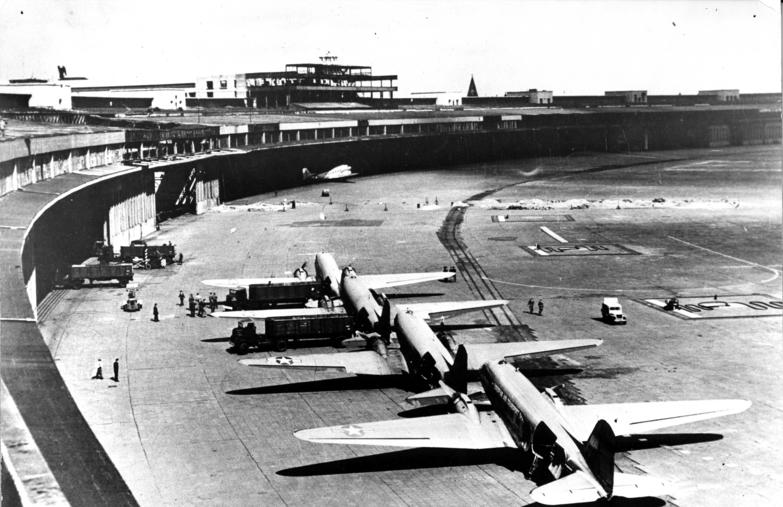
By the time the airlift ended, the wartime coalition that had jointly destroyed Nazi Germany four years earlier had split, in practice, into two competing blocs — one built around Washington and Marshall Plan aid, the other around Moscow and single-party governments installed the way Poland’s had been. Neither side declared this a new war. Nobody at Potsdam had signed anything committing them to stay allies once the shooting stopped, and once it stopped, the alliance’s actual purpose stopped along with it.
Marta Hillers put down her pen sometime in June 1945, once conditions in her sector of Berlin had stabilized enough that daily survival no longer needed daily documenting. Benjamin Ferencz won his first case at twenty-seven and spent the rest of a very long life talking about it. David Boder came home with 120 hours of wire recordings nobody quite knew what to do with yet, and left them for later historians — and for anyone today who wants to listen — to actually use. None of them got to see how the story they were each documenting a piece of would eventually turn out. Neither, in the strictest sense, does this part: 1949 is where this series stops, not where the argument it’s describing does.
In one sentence, to close a war this series has followed for twenty parts, and a whole project — WW1 and WW2 together — that has run thirty-nine: was the peace that followed this war actually a peace, or just a pause between two different kinds of conflict, fought with different weapons?
Both, honestly — the historians' meter above is this series' way of admitting that rather than picking a side. The shooting stopped in 1945; that mattered enormously to the tens of millions of people who got to survive because of it. But the argument the shooting had been settling by force — about borders, about who governs whom, about which system gets to define "freedom" for someone else's population — didn't end with the surrender documents. It changed weapons: armies to currencies, alliances, foreign aid, blockades. Yalta's ambiguous language was a real document, written by real people making a real, high-stakes bet on each other's good faith. Whether that bet was betrayed, misunderstood, or simply overtaken by two systems that were never going to want the same things once the shared enemy was gone is the argument three schools of real historians are still having — and this series isn't going to pretend it's been settled just because the story has to end somewhere.
Twenty parts, four Acts, one war — and, with the nineteen parts of The Machine Nobody Could Stop before it, thirty-nine parts and two wars this site has now followed start to finish. There is no Part 21, and no third series waiting to pick up the thread the way this one picked up Versailles. What's waiting instead is this site's Geopolitics section, already publishing: not a sequel to the wars, but dispatches from the world they actually built — contested islands surfacing out of melting ice, a repossessed passport market, a shipping lane that runs on a private promise, a state's power measured in whose clock its citizens are made to keep. Different names, same argument this part just finished describing at Yalta and Potsdam: who gets to decide, and what happens to the people who don't get asked.
Both series have now told their own version of this, in full, with citations. Laid side by side, on the same track width, they turn out to be almost opposite shapes.
Both tracks span the same width on this page; only the real time behind each one differs. One crisis outran anyone's ability to stop it inside five weeks. The other handed four separate, years-apart chances to answer it — Part 5's ratchet mechanism walks through the German side of those same five points — and each one passed with less resistance than the last.
Nothing in either series was written as a warning about the present — every claim in both thirty-nine parts is tied to a dated citation, and this closing note isn't going to start making claims it can't back the same way. But there's a real difference between "did this happen," which the parts above already answer, and "would I recognize it starting" — and historians who study how these situations actually begin, not this site, keep pointing at a short list of mechanisms this project has now shown working in real, dated cases.
None of that requires a villain twirling a mustache. It mostly requires an ordinary institutional habit, repeated by enough people for long enough, that a preventable thing stops being prevented. And what the record suggests actually helps, when it's tried early — independent reporting that keeps functioning when a story is unpopular to tell; enforcement mechanisms with real teeth behind a signature, not just the signature itself, which is the entire lesson of this part's own Yalta section above; a habit of treating a small, reasonable-sounding concession as worth questioning rather than assuming the next one is where the line finally gets drawn; and simply staying engaged with a slow-moving problem before it becomes an undeniable one, since every single crisis this project covered gave the people living through it years, not days, of visible warning before the part where the shooting actually starts.
That's not a prediction about anything happening anywhere today, and this isn't the place to make one — that would be a different, weaker kind of claim than the dated, cited ones the other thirty-nine parts spent themselves making. It's just what's actually in the record, available to check against whatever anyone reading this is currently watching happen, anywhere, to anyone.
Sources
- Foreign Relations of the United States: Diplomatic Papers, The Conferences at Malta and Yalta (1945) and The Conference of Berlin (Potsdam) (1945), U.S. Department of State; Avalon Project primary texts (avalon.law.yale.edu)
- John Lewis Gaddis, The United States and the Origins of the Cold War, 1941-1947 (Columbia University Press, 1972); We Now Know: Rethinking Cold War History (Oxford University Press, 1997)
- William Appleman Williams, The Tragedy of American Diplomacy (World Publishing, 1959)
- Walter LaFeber, America, Russia, and the Cold War (Wiley, 1972)
- Gar Alperovitz, Atomic Diplomacy: Hiroshima and Potsdam (Simon & Schuster, 1965)
- Herbert Feis, From Trust to Terror: The Onset of the Cold War, 1945-1950 (Norton, 1970)
- Thomas A. Bailey, America Faces Russia (Cornell University Press, 1950)
- Thomas G. Paterson, On Every Front: The Making of the Cold War (Norton, 1979)
- Melvyn P. Leffler, A Preponderance of Power: National Security, the Truman Administration, and the Cold War (Stanford University Press, 1992)
- Antony Beevor, Berlin: The Downfall 1945 (Viking, 2002)
- Marta Hillers, A Woman in Berlin, trans. James Stern, intro. Antony Beevor (Metropolitan Books, 2005 ed.)
- Telford Taylor, The Anatomy of the Nuremberg Trials: A Personal Memoir (Knopf, 1992)
- Rebecca West, A Train of Powder (Viking, 1955)
- John W. Dower, Embracing Defeat: Japan in the Wake of World War II (Norton, 1999)
- David P. Boder recordings and transcripts, “Voices of the Holocaust,” Illinois Institute of Technology (voices.library.iit.edu)
- United States Holocaust Memorial Museum Encyclopedia, “Displaced Persons” (encyclopedia.ushmm.org)
- Benjamin Ferencz oral history, USHMM, and 60 Minutes interview (2017)
- Benn Steil, The Battle of Bretton Woods: John Maynard Keynes, Harry Dexter White, and the Making of a New World Order (Princeton University Press, 2013)