Last time: Germany surrendered unconditionally on May 8, 1945, after Allied armies fought from the Normandy beaches to the Elbe and opened the gates of camps that made the war's purpose impossible to argue with. So what was actually left unresolved when the fighting in Europe stopped? Almost everything east of Europe. Japan hadn't surrendered, and American planners were already sketching an invasion of the home islands they expected to cost more lives than Normandy, the Bulge, and Okinawa combined. And one project Germany's surrender never touched at all: a secret weapons laboratory that had been running on its own clock in the New Mexico desert since 1942, regardless of what happened on any other front.
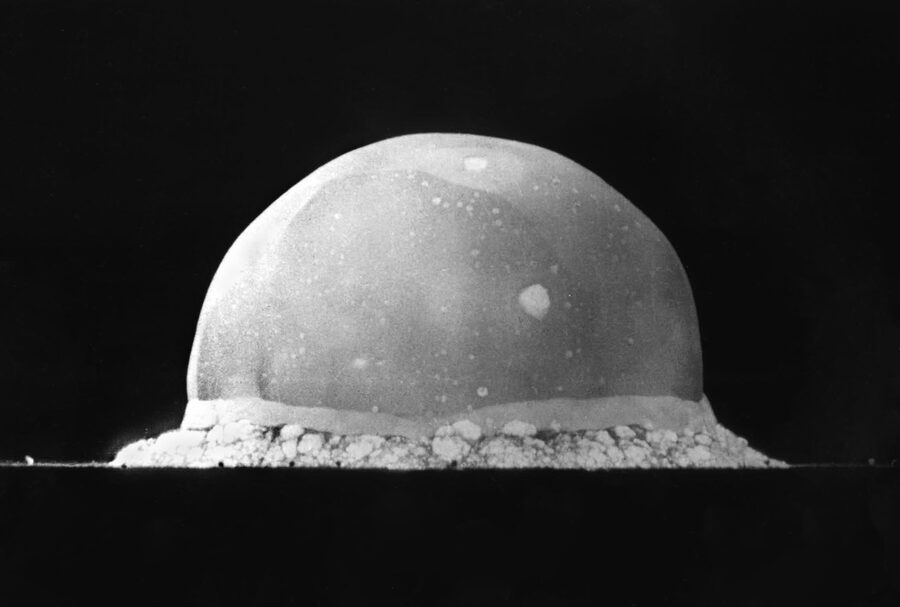
At 5:29:21 a.m. Mountain War Time on July 16, 1945, in a stretch of New Mexico desert the Spanish had named the Jornada del Muerto — the journey of the dead man — a device suspended atop a hundred-foot steel tower released roughly the energy of 25,000 tons of TNT in well under a second. About 425 people were on the ground to see it, watching from bunkers and hillsides miles out, most of them under orders to lie face-down with their backs to the tower until the flash had passed. Physicist Enrico Fermi was there. So was General Leslie Groves, the Army officer who had run the project that built the thing, and J. Robert Oppenheimer, the physicist who had run the laboratory that designed it. Test director Kenneth Bainbridge stood beside Oppenheimer in the control bunker. When the fireball had faded and the shockwave had rolled past, Bainbridge turned to him and said, “Now we are all sons of bitches.” It is one of the most exactly documented sentences of the entire war — who said it, to whom, and roughly what second. Oppenheimer, recalling the moment decades later, said a line from the Bhagavad Gita had come to him: “Now I am become Death, the destroyer of worlds.” That is his own later account of a private thought, not a line anyone remembers him saying out loud that morning — worth keeping straight, because this part is going to insist on that kind of precision throughout. The test had a name, borrowed by Oppenheimer from a John Donne poem: Trinity. It worked. Three weeks later, weapons built from the same design went to war.
Getting to that morning had taken three years, roughly $2 billion in 1945 dollars — on the order of $28 billion today — and, at its peak, nearly 130,000 employees spread across a continent. The Manhattan Project, run by Groves with Oppenheimer directing the weapons-design laboratory at Los Alamos, New Mexico, was really three projects stitched together. Oak Ridge, Tennessee, enriched uranium-235 through three different industrial processes running in parallel, its population peaking around 75,000 people by May 1945. Hanford, Washington, built and ran the reactors that produced plutonium, briefly the third-most-populous town in the state. Los Alamos designed and assembled two different bombs from two different fuels: “Little Boy,” a uranium gun-type design, and “Fat Man,” a plutonium implosion design that had to solve a harder engineering problem — compressing a sphere of plutonium symmetrically enough, in millionths of a second, to force it past criticality.
None of that answers the question this part actually has to sit with: given a working bomb, who decided to use it, on what reasoning, and against what?
That decision did not belong to any one person, and it was not made all at once. In May 1945, with Germany already defeated and Trinity still two months off, Secretary of War Henry Stimson convened the Interim Committee — a small group of officials and military leaders — to recommend how the weapon should be used once it existed. Its Scientific Panel, four physicists including Oppenheimer, Fermi, Ernest Lawrence, and Arthur Compton, considered and rejected the idea of a demonstration: detonating the bomb somewhere visible but unpopulated, to force a Japanese surrender without killing anyone. The panel’s report concluded it saw “no acceptable alternative to direct military use” — worried a demonstration might fail to impress, or fail outright, and cost the surprise the weapon depended on. A separate Target Committee, meeting the same month, worked from a different set of criteria: cities large enough and militarily significant enough to show the weapon’s effect clearly, and — this was stated directly in the committee’s own minutes — not yet damaged by conventional bombing, so the new weapon’s effect could be measured against an undamaged baseline. Hiroshima, headquarters of the Japanese Second General Army and a port with real military value, and Kokura, home to one of Japan’s largest arsenals, made the short list; so, eventually, did Nagasaki, a shipbuilding and armaments center.
Not every scientist inside the project agreed with the Scientific Panel’s conclusion. On June 11, 1945, physicist James Franck and six colleagues at the University of Chicago’s Metallurgical Laboratory submitted what became known as the Franck Report, arguing for a demonstration over an undisclosed island or desert, before international observers, rather than a surprise attack on a city — warning that using the bomb without warning would damage American standing and accelerate a postwar arms race no one had any way to control once other nations built the weapon themselves. The report reached Stimson’s committee and was set aside. In July, physicist Leo Szilard circulated a petition among Manhattan Project scientists urging the President to consider Japan’s terms for surrender before authorizing the bomb’s use; roughly seventy scientists signed it. It went through appropriate channels toward the White House and, by most accounts, never reached Truman’s desk before Hiroshima. Both documents survive complete in the archival record — real, dated, unambiguous evidence that the decision to use the bomb the way it was used was contested from inside the project itself, not a step nobody with relevant expertise questioned at the time.
Physicist Otto Frisch, who had helped work out the theoretical basis for a fission bomb years earlier in Britain and was at Los Alamos for Trinity, wrote in his memoir decades later of watching the test from a slit trench some ten miles out. He recalled the flash as brighter than anything he had ever seen — bright enough, he wrote, that for an instant the desert around him looked lit by an unnatural, second sun, before the light collapsed inward into color and the shockwave arrived, long seconds after the silent flash, as a physical blow rather than a sound. He remembered turning to a colleague afterward, only half joking, and suggesting they'd all better start thinking hard about what came next — because whatever they had just built could not, after that morning, be unbuilt.
Truman’s own Potsdam diary, held today at the Truman Library, records his July 25, 1945 decision in his own hand — including a note that the bomb should be used “so that military objectives and soldiers and sailors are the target and not women and children.” That sentence sits uneasily against the Target Committee’s actual criteria, agreed weeks earlier: whole cities, chosen partly for their lack of prior damage. Whatever Truman privately hoped the weapon’s use would look like, the plan already in motion beneath him did not distinguish combatants from the civilians living around them — it could not, given what the weapon actually was. The order authorizing use went out July 25, worded to leave the exact timing and targets to military judgment once weather allowed. Truman did not, in a meaningful sense, choose a single moment to “drop the bomb.” He approved a plan that had already been built, by committees that had already met, against targets that had already been picked, and then let the military carry it out on its own schedule.
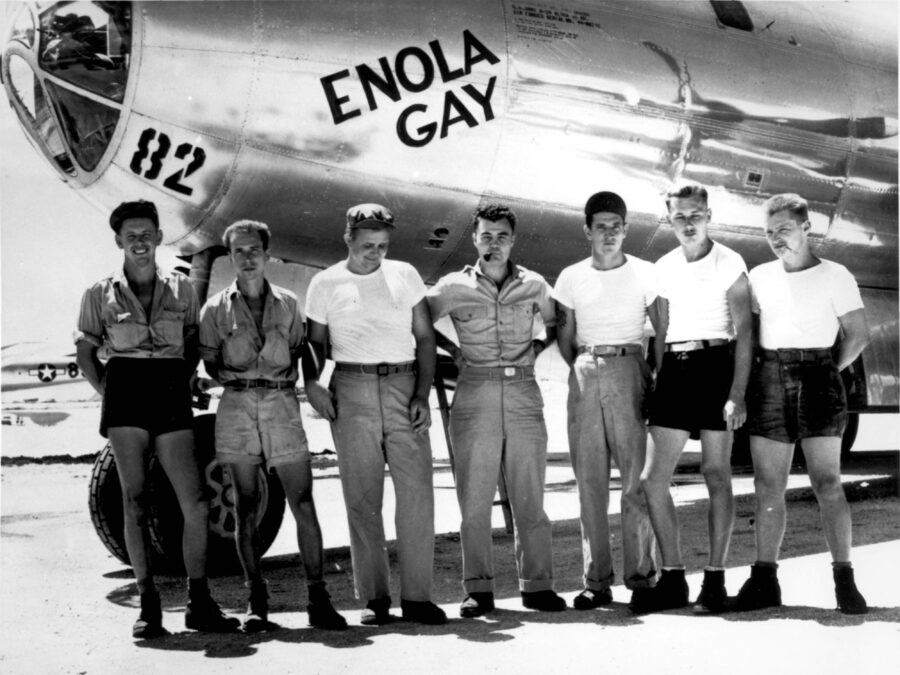
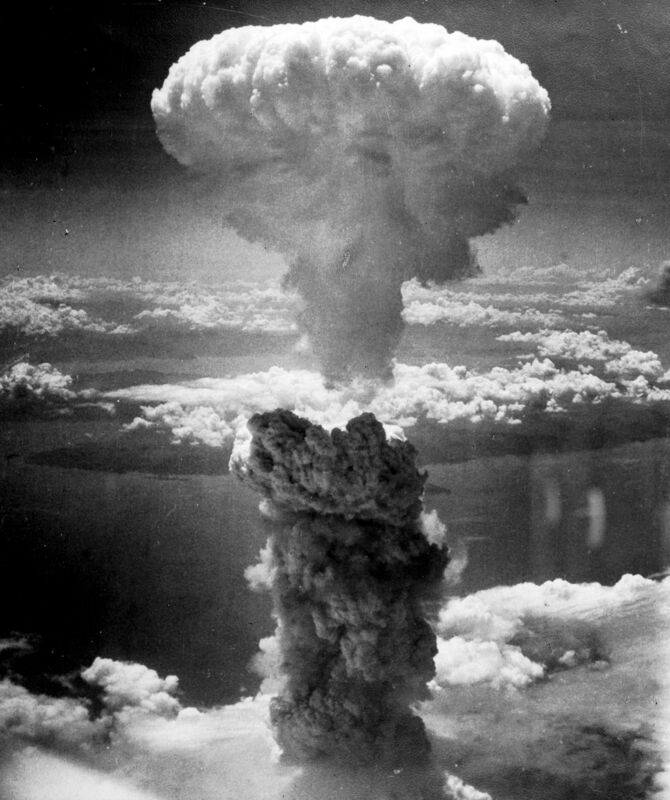
That schedule reached Hiroshima first. At 8:15 a.m. local time on August 6, 1945, the B-29 Enola Gay, piloted by Col. Paul Tibbets, released “Little Boy” over the city; it detonated roughly 580 meters above ground. Three days later, on August 9, the B-29 Bockscar, piloted by Maj. Charles Sweeney, carried “Fat Man” toward its primary target, Kokura — and found it hidden under cloud and drifting smoke from an unrelated firebombing raid the night before. After three passes and with fuel running critically low, Bockscar diverted to the secondary target, Nagasaki, and dropped the bomb there at 11:02 a.m., detonating around 503 meters up. That Nagasaki was bombed at all, rather than Kokura, turned on weather and a fuel gauge — a documented contingency of the mission that day, not a matter open to interpretation.
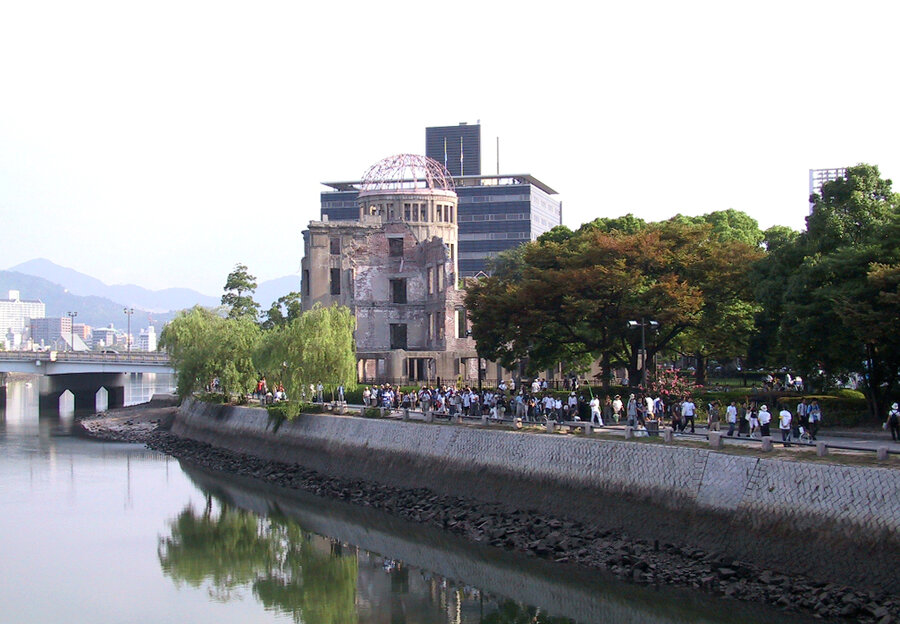
Casualty figures for both cities are, and will likely stay, estimates rather than exact counts — so much of the record-keeping apparatus that would normally produce a precise number was itself destroyed. Historians give ranges rather than false precision: roughly 90,000 to 166,000 dead in Hiroshima by the end of 1945, about 60,000 to 80,000 in Nagasaki over the same period, some 90 percent of Hiroshima’s dead civilians. Those figures already include the delayed toll — deaths through illness, burns, and radiation injury across the rest of that year — not only the immediate instant of detonation. Behind the ranges are individual, documented lives. John Hersey’s Hiroshima, published in The New Yorker in August 1946, reconstructed the bombing’s first days through six named survivors he interviewed directly, among them a young clerk, Toshiko Sasaki, pinned beneath a collapsed bookcase in her office and unable to free herself for hours while the building around her burned. Hersey wrote nothing invented into their accounts — only what each of the six told him, in their own words, about a morning that began like any other.
Setsuko Thurlow was thirteen years old and inside a building near central Hiroshima, mobilized with other students for wartime labor, when the bomb detonated. In her 2017 Nobel Peace Prize lecture, delivered in Oslo on behalf of the International Campaign to Abolish Nuclear Weapons, she described the structure collapsing around her in darkness and silence, and a man's voice she never saw a face to, close by in the wreckage, telling her not to give up — that he was trying to free her, and that she should keep moving toward the light he could see and she could not. She survived; many of her classmates in the same building did not. In the same lecture she recalled the courtyard of her old school, in the days afterward, filled with the bodies of people she could no longer recognize as the people she had known.
Nagasaki was not the only event of August 9. At 00:02 Tokyo time that day — hours before Bockscar even took off — the Soviet Union declared war on Japan and launched a massive invasion of Japanese-held Manchuria, honoring a commitment made to the Western Allies months earlier and, at the same time, ending any hope in Tokyo that Moscow might still broker a negotiated peace. Japan’s Imperial Conference met that same night and into August 10 to decide the country’s response — the seidan, the “sacred decision,” ultimately made personally by Emperor Hirohito after his ministers deadlocked. Hirohito recorded the surrender announcement on August 14; it aired to the Japanese public at noon the next day, August 15 — the first time most citizens had ever heard their emperor’s voice. That broadcast cited the bomb directly, describing “a new and most cruel bomb” as reason enough to end the war. A second address, delivered two days later specifically to the military, instead emphasized the Soviet invasion as an existential threat. The same decision, explained two different ways to two different audiences — a real, documented split worth sitting with, since it means even the people closest to the decision did not describe its cause identically. The formal surrender was signed aboard USS Missouri in Tokyo Bay on September 2, 1945.
"The world will note that the first atomic bomb was dropped on Hiroshima, a military base... The atomic bomb is too dangerous to be loose in a lawless world."
This gauge shows where historians' debate actually sits — not a simulated probability. It never invents a number; it points at a real argument.
This is a genuine, long-running, three-cornered debate over why the bomb was used — not a dispute over whether it was used, or what it did. The traditionalist view holds that the bombs ended the war quickly and forestalled an invasion of the home islands, Operation Downfall, that U.S. planners increasingly feared. Kyushu troop estimates rose from roughly 350,000 in the spring of 1945 to nearly 600,000 by August, later confirmed at over 735,000 at surrender — a real-time intelligence shock that pushed projected American casualties for the full invasion into the hundreds of thousands, and one Stimson-commissioned estimate toward 1.7 to 4 million total Allied casualties. The revisionist view, argued most influentially by Gar Alperovitz in Atomic Diplomacy: Hiroshima and Potsdam (1965), holds that senior U.S. and British military leaders already believed Japan's defeat was assured without an invasion, and that using the bomb — and using it before Soviet entry into the war rather than after — was substantially about establishing American leverage over Moscow in the postwar order. A later synthesis complicates both. Richard B. Frank, in Downfall: The End of the Imperial Japanese Empire (1999), used decrypted Japanese military intercepts unavailable to Alperovitz in 1965 to show a real, large-scale defense buildup underway on Kyushu and only unrealistic peace feelers toward Moscow — evidence against the idea that Japan was quietly ready to surrender. J. Samuel Walker, in Prompt and Utter Destruction (1997, rev. 2004), offers an explicit middle reading: some officials likely did weigh diplomatic advantage over the Soviets, but as a motive of, in his words, "decidedly secondary importance" next to ending the war. None of the three positions is this piece's verdict. All three are argued by named historians working from real archives, and the argument between them is still live.
None of the people at the center of this part got to revise what they had done afterward. Truman authorized a plan built by committees before he fully understood what he was authorizing. Bainbridge and Oppenheimer watched their own creation work exactly as designed and said, in their different registers, the same thing: that something had changed that could not change back. Franck and Szilard argued, in writing, for a different ending, and were overruled by people with more authority and, they believed, less information than they had. Stalin already knew the outcome of a test his own ally hadn’t yet told him about. And in two cities, on two mornings three days apart, tens of thousands of people who had made none of these decisions learned what all of them had amounted to.
In one sentence: what does it mean that the president who authorized the bomb's use had known of its existence for only three months, while the scientists who built it had argued about how to use it for six — and an adversary's spies had known its blueprints even longer?
That the decision to use the bomb was never really one person's decision in the moment — it was the accumulated output of committees, physicists, and military planners who had been shaping the choice for months before the man with the final authority to approve it had the standing, or the time, to fully weigh it himself.
Sources
- Richard B. Frank, Downfall: The End of the Imperial Japanese Empire (Random House, 1999)
- Gar Alperovitz, Atomic Diplomacy: Hiroshima and Potsdam (Simon & Schuster, 1965)
- J. Samuel Walker, Prompt and Utter Destruction: Truman and the Use of Atomic Bombs Against Japan (University of North Carolina Press, rev. ed. 2004)
- John Hersey, Hiroshima (Alfred A. Knopf, 1946; originally The New Yorker, August 31, 1946)
- William L. Laurence, Dawn Over Zero: The Story of the Atomic Bomb (Knopf, 1946)
- Otto Frisch, What Little I Remember (Cambridge University Press, 1979)
- Harry S. Truman’s Potsdam diary, Harry S. Truman Presidential Library and Museum
- The Franck Report (June 11, 1945), James Franck et al., Metallurgical Laboratory, University of Chicago
- Interim Committee minutes and Scientific Panel report (May-June 1945), National Archives / Truman Library
- Voices of the Manhattan Project oral history archive, National Museum of Nuclear Science & History (manhattanprojectvoices.org)
- Setsuko Thurlow, Nobel Peace Prize Lecture on behalf of ICAN, Oslo, December 10, 2017 (nobelprize.org)
- U.S. Strategic Bombing Survey, The Effects of the Atomic Bombings of Hiroshima and Nagasaki (1946), National Archives Record Group 243