Last time: this series followed how a state policy of exclusion, built through the 1930s, became the deliberate, industrialized murder of six million European Jews and millions of others the Nazi state judged unfit to live — so when Allied and Soviet armies fought their way across Europe in the war's final year, what did they actually find when they reached the places where that policy had been carried out? They found camps still running in occupied Poland as Soviet troops advanced in 1944 and 1945, and camps inside Germany itself the SS had not finished evacuating or destroying before Western Allied troops arrived that spring. What soldiers on both fronts found on the ground — not a report's statistics, but camps, survivors, and evidence, standing in front of them — is where this part picks up.
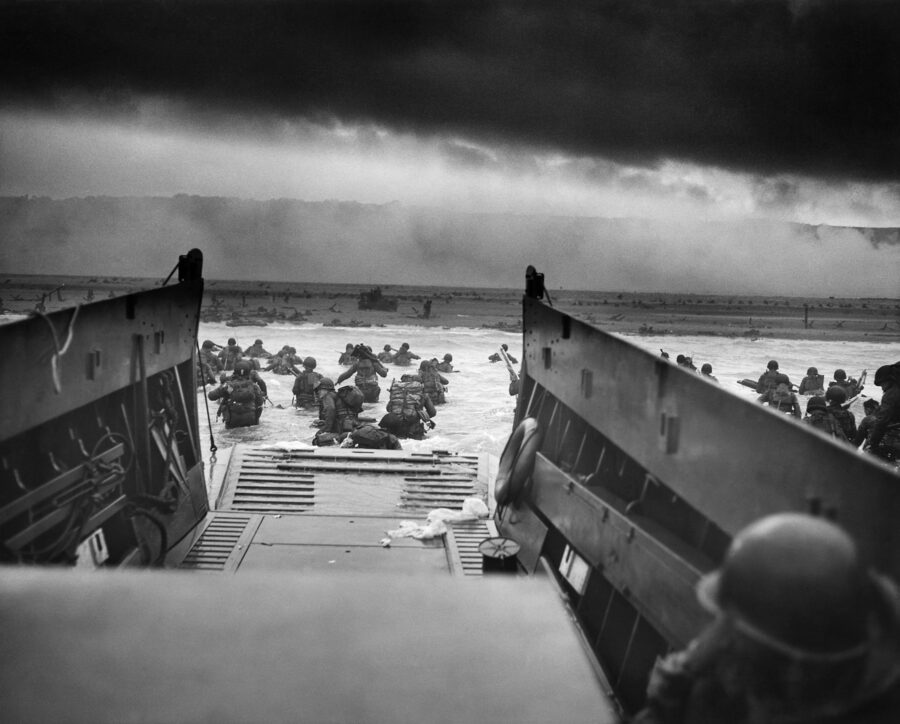
Harold Baumgarten was nineteen when the ramp of his landing craft dropped into the water off Omaha Beach, at roughly 6:30 on the morning of June 6, 1944. A private in the 116th Infantry Regiment, part of the first wave, he later gave an extensive recorded account to the National WWII Museum’s oral history program — an account catalogued informally as “Bloody Omaha,” because that is close to what the sector he landed in actually was. He was wounded three times before the day was over and kept moving anyway, because standing still on that beach, under that much fire, offered no better odds. He survived. Most of the men in his boat team did not.
That morning opened Operation Overlord — the largest amphibious invasion in history, and the start of the war in Europe’s last eleven months. This part covers those months: the beaches, the liberation of France and the rest of occupied Western Europe, Germany’s collapse, and — arriving at specific places on specific dates, found by specific named units — the liberation of the camps where the policy described in Part 17 had been carried out.
The longest day
Roughly 156,000 to 160,000 Allied troops landed across five beaches that morning — Utah and Omaha (American), Gold and Sword (British), Juno (Canadian) — after a night airborne drop of some 13,400 American paratroopers plus British 6th Airborne troops behind the coastline in the dark. First-day Allied casualties ran to at least 10,000, with 4,414 confirmed dead. Omaha took the worst of it, roughly 2,000 casualties on a beach German defenses dominated from high bluffs; Utah, by comparison, took 197. German losses are estimated at 4,000 to 9,000. By month’s end, 875,000 Allied personnel had come ashore. The invasion had been delayed a full day, from June 5 to June 6, waiting on weather — and that delay was not a formality.
You are General Dwight D. Eisenhower, at Southwick House on England's south coast. Nearly three million men and nine thousand ships are staged for an invasion that depends on a narrow window of moon, tide, and light — one that won't recur for weeks if missed. Your meteorologist, Group Captain James Stagg, says the storm battering the Channel will break for roughly 36 hours starting June 6, then close back in. Your own staff disagrees on how much to trust it. What do you do?
Eisenhower launched. Late on June 4, fleet already at sea, he polled his commanders and gave the order early on June 5: "OK, let's go." Waiting risked losing secrecy and the tidal window for weeks — and German meteorologists, working with less data, had already written off the Channel as uncrossable through the period, part of why the landing achieved surprise at all. He also wrote out, by hand, a statement taking full personal responsibility if the invasion failed — a note he never had to use.
None of it would have gone as well as it did without a deception German high command never fully saw through, even months afterward.
France, and the rest of Western Europe
The Normandy campaign ground through the summer of 1944 — hedgerow fighting that favored defenders, then an American breakout in late July and the closing of the Falaise pocket in mid-August. Then came Paris. The uprising began August 19, called by Resistance leader Henri Rol-Tanguy. For five days the city fought largely on its own against a German garrison ordered — and it did not carry out the order — to leave Paris in ruins rather than hand it over intact. On the night of August 24, the vanguard of General Philippe Leclerc’s 2nd French Armored Division reached the city: the 9th Company of the Régiment de marche du Tchad, made up largely of Spanish Republican exiles who had kept fighting fascism after losing their own war, nicknamed “La Nueve.” They reached the Hôtel de Ville at 9:22 p.m.; the German commander surrendered the next afternoon. Roughly 800 to 1,000 Resistance fighters died in the uprising. De Gaulle’s parade down the Champs-Élysées the next day drew a crowd estimated at up to two million — a city that had spent four years under occupation, out in its own streets again.
Belgium and most of the Netherlands were liberated that autumn; the airborne assault on Arnhem, Operation Market Garden, tried and failed in September to seize a Rhine bridge in one stroke. Germany’s last major western offensive, the Battle of the Bulge that December and January, briefly punched through Allied lines before running out of fuel and being pushed back — its defeat opened the final drive into Germany. Allied forces crossed the Rhine in force that March, helped by the surprise seizure of the Remagen bridge on March 7 before German engineers could destroy it.
On April 25, 1945, American and Soviet patrols made contact near Torgau on the Elbe River, cutting the remaining German-held territory in two. The formal handshake between American Lieutenant William Robertson and Soviet Lieutenant Alexander Silvashko, staged for cameras two days later, became the visual shorthand for what that contact meant: the two armies that had fought this war from opposite ends of the continent were now standing in the same place. Germany surrendered unconditionally on May 7-8, 1945 — eleven months, almost to the day, after Baumgarten’s landing craft dropped its ramp at Omaha Beach.
Baumgarten's account of that first morning, recorded for the National WWII Museum, doesn't read like a strategic summary — no fronts, no divisions, just what one soldier could see from inside it: a ramp dropping into fire already finding targets, the mechanics of staying alive on open sand with no cover, hit repeatedly and moving anyway because standing still didn't end better. He was one of the youngest men in his boat team, and one of a small number who lived to describe it.
What the armies found
This section is written differently than the rest of this part — not gamified, not built around a mechanism to admire, the way Part 17 held its hardest material with more restraint. What follows is a dated, factual account of specific places, found by specific units.
The first major camp reached by any Allied force was Majdanek, in occupied Poland, liberated by Soviet troops the night of July 22-23, 1944 — so quickly the SS hadn’t had time to destroy most of the physical evidence. Auschwitz-Birkenau followed on January 27, 1945, now observed internationally as Holocaust Remembrance Day; the SS had force-marched roughly 60,000 prisoners west in the days before, in what survivors and historians call the death marches. Western Allied forces reached camps inside Germany that spring, and Mauthausen, in Austria, in early May.
Eisenhower did not write for effect. His report to General George Marshall after the Ohrdruf visit described conditions there as beyond what words could adequately convey — his own recorded phrase was that what he saw "beggar[ed] description." He ordered nearby German civilians brought through the camp under guard, reasoning that a population claiming not to have known should be made to see what had been done in its name. His April 19 request that Congress and the press be brought to the camps directly reflects a considered judgment: the record needed independent witnesses beyond the soldiers who had already seen it, before anyone could be permitted to doubt it happened.
Two weeks after British troops reached Bergen-Belsen, BBC correspondent Richard Dimbleby recorded a broadcast from inside the camp — delayed several days before airing, because the BBC itself hesitated over whether the content was fit to broadcast. Dimbleby’s script described what he had walked through in plain, restrained, first-person terms: the dead and the dying laid out together on open ground, with no clear line, at a glance, between the two. It remains one of the primary, contemporaneous records of what British troops found at Belsen, made within days rather than reconstructed afterward.
None of the men who reached these camps discovered the Holocaust in the abstract. They found specific places, on specific dates, with specific units — and their own recorded words, at the time, are the clearest and most restrained way this series can convey what that meant, without describing, for its own sake, what they were describing.
The bombing, and a number that took sixty-five years to get right
The rest of the air war over Germany doesn’t require the same restraint, but it does require the same honesty about what is settled among historians and what is not.
Two disagreements run through this literature. The first is about effectiveness: did bombing German cities and industry actually shorten the war, and when did it start to matter. Richard Overy’s The Bombing War (2013) argues the payoff was real but slow — pointing to the Battle of the Ruhr in March 1943, when roughly 34,000 tons of bombs disrupted German steel production badly enough to force industrial dispersal, and to the US Strategic Bombing Survey’s own postwar finding that Rhine and Ruhr transport attacks from September 1943 had cut German rail shipments by more than half by early 1945. Overy’s case is that bombing became devastating in the war’s final eighteen months, not a knockout blow from the start.
The second disagreement is moral, and separable: even where bombing worked, was area bombing of civilians — as opposed to precision strikes on military targets — justified. A. C. Grayling’s Among the Dead Cities (2006) accepts the war itself was necessary but argues deliberately targeting German and Japanese civilians was a war crime, disproportionate to the military gain. That drew sharp pushback: David Cesarani argued Grayling had too shaky a grasp of the wartime military context, since precision targets were often too heavily defended to hit safely; Max Hastings dismissed his conclusions as out of step with more cautious historians and accused him of judging wartime decisions by standards nobody involved could have applied at the time. A genuine, ongoing argument among people who’ve read the same archives and reached different conclusions.
Dresden, February 13-15, 1945, is where both arguments meet, and it’s also its own case study in how a casualty figure gets manufactured, believed for decades, and slowly corrected. In March 1945, Goebbels’s propaganda ministry took an internal police report’s preliminary toll — roughly 20,204 — and, per historian Frederick Taylor’s research, appears to have doctored it with an extra zero for foreign consumption, producing the wartime claim of some 200,000 dead. The figure didn’t die with the government that invented it: in 1953, British writer David Irving’s The Destruction of Dresden argued for roughly 135,000 — later traced to unreliable and partly fabricated sources, but accepted internationally for decades regardless, used by both sides of the Cold War and later by neo-Nazi groups seeking a rough moral equivalence with Nazi atrocities.
This gauge shows where historians' debate actually sits — not a simulated probability. It never invents a number; it points at a real argument.
Two separable arguments, not one. Overy's case for bombing's slow but real payoff by 1944-45 sits opposite older airpower-advocate claims of a faster knockout. Grayling's case that area bombing of civilians was a war crime, regardless of effectiveness, drew genuine pushback from Cesarani and Hastings on military-context and presentism grounds — historians reading the same archives, disagreeing on the judgment. Dresden's casualty figure has its own, more resolved history: the city's Historikerkommission, working alongside Taylor's independent research, concluded in 2010 that the real toll was approximately 18,000 to 25,000 — close to the original, undoctored March 1945 police estimate, before Goebbels and then Irving distorted it for the following sixty-five years.
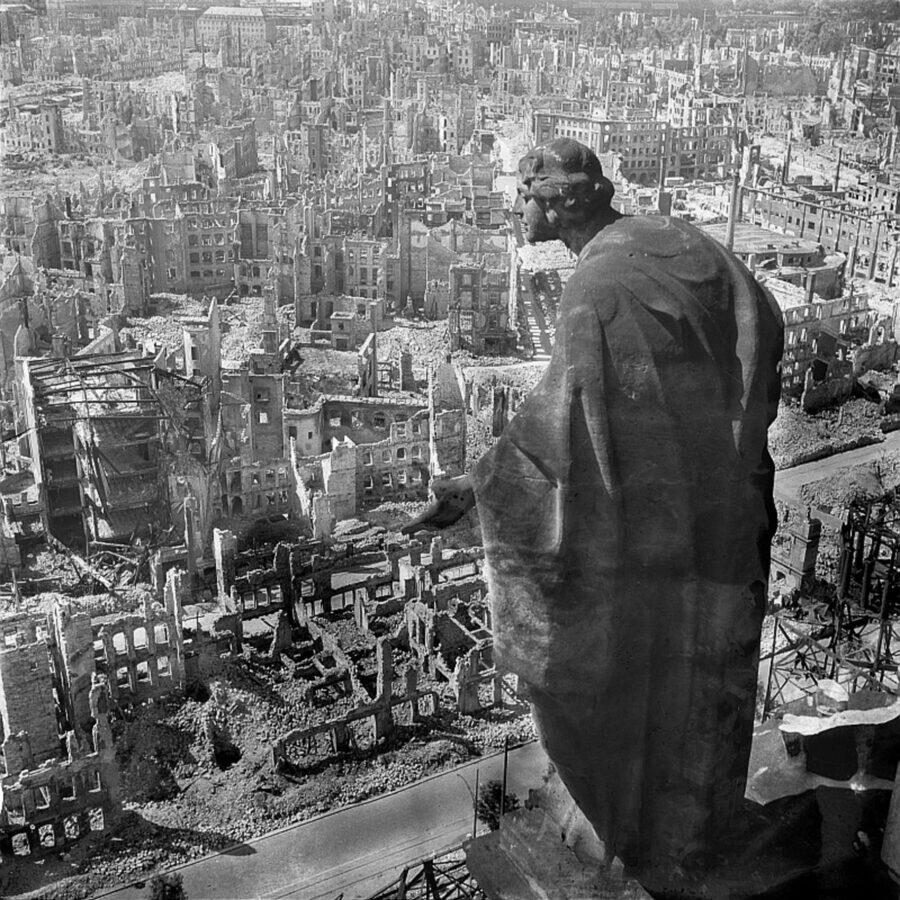
Frederick Taylor’s role in that correction is worth naming directly: a historian tracing one doctored document back to its original, honest number, and getting a city’s official history to accept the correction. That is most of what serious history actually is.
V-E Day
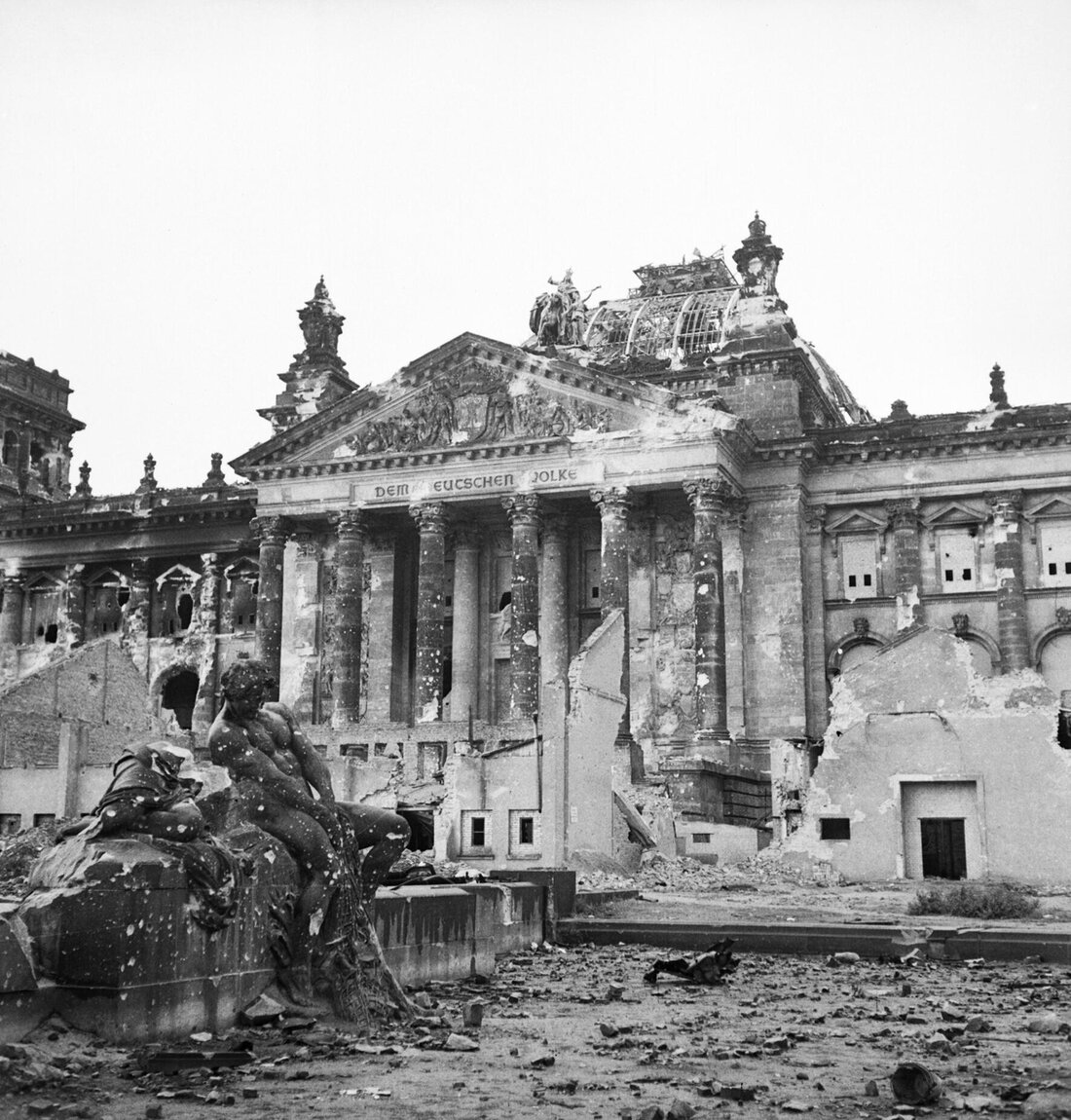
Germany’s surrender took effect at one minute past midnight on May 9, Central European Time — signed the previous day in Reims, and again, at Soviet insistence, in Berlin. Crowds filled the streets of London, Paris, Moscow, and New York. Hitler had killed himself in his Berlin bunker on April 30, as Soviet troops fought through the city above him; by the time the surrender was signed, no one remained in Berlin with the authority to argue about the terms.
"This is a solemn but glorious hour. General Eisenhower informs me that the forces of Germany have surrendered to the United Nations."
Baumgarten survived his wounds and lived to give his account, decades later, to an oral history program built so soldiers like him wouldn’t have to be summarized by someone else. Eisenhower’s request that Congress and the press see the camps directly was carried out within weeks. Frederick Taylor spent years tracing one doctored digit back to the truth it had buried. None of that is a story about a war that ended cleanly. It’s a story about what got found, what got recorded, and what took decades — in one case, still measured from a wartime lie — to get right.
In one sentence: why does it matter that Eisenhower asked for outside witnesses to see the camps, rather than simply reporting what his own soldiers had already found?
Because a single army's report, however honest, can be doubted or dismissed as one side's account of an enemy's crimes — Eisenhower understood the record needed witnesses with no stake in the war's outcome, seeing it firsthand, so that decades later no one could credibly claim it hadn't happened. The same instinct sits behind Frederick Taylor's smaller, later correction of a doctored casualty figure: get it independently verified, or someone eventually gets away with a lie.
Sources
- Antony Beevor, D-Day: The Battle for Normandy (Viking, 2009)
- Max Hastings, Overlord: D-Day and the Battle for Normandy (Michael Joseph, 1984)
- Roger Hesketh, Fortitude: The D-Day Deception Campaign (St. Ermin’s Press, 1999/2000)
- Mary Kathryn Barbier, D-Day Deception: Operation Fortitude and the Normandy Invasion (Praeger, 2007)
- Richard Overy, The Bombing War: Europe 1939-1945 (Allen Lane, 2013)
- A. C. Grayling, Among the Dead Cities: The History and Moral Legacy of the WWII Bombing of Civilians in Germany and Japan (Bloomsbury, 2006)
- Frederick Taylor, Dresden: Tuesday, 13 February 1945 (Bloomsbury, 2004)
- Dresden Historikerkommission, final report, City of Dresden (2010)
- US Holocaust Memorial Museum, Holocaust Encyclopedia — “Liberation of Nazi Camps” and individual camp entries (Ohrdruf, Buchenwald, Bergen-Belsen, Dachau, Auschwitz, Majdanek, Mauthausen), encyclopedia.ushmm.org
- National WWII Museum (New Orleans), Oral History Collection — Harold Baumgarten interview
- Imperial War Museum, oral history and sound archive, and No. 5 Army Film and Photographic Unit Bergen-Belsen material
- US Strategic Bombing Survey, published reports (1945-46)