Last time: this series closed on a detail already sitting inside the story of Midway — Navy cryptanalysts reading enough of Japan's naval code to tell Nimitz where the Japanese fleet would strike, before a shot was fired. If codebreaking could hand a battle to a side that hadn't even arrived yet, why hasn't this series told that story more often? Because it was invisible on purpose. The larger program this one sat inside — Britain's reading of German Enigma traffic, codenamed Ultra — was rationed through roughly forty liaison officers, laundered through fake "discoveries" before any commander could act on it, and kept officially secret for twenty-nine years after the war ended. This part tells that story directly: the machine, the mathematicians who broke it first, and the deception it made possible on D-Day.
In the 1960s, in the Polish city of Bydgoszcz, a man in his early sixties clocked in most mornings at a cable factory and kept its books. Colleagues knew him as a careful, quiet accountant — unremarkable in the way a person can stay unremarkable for twenty years running. None of them knew that this man, Marian Rejewski, had done something historians would later call the true starting point of the Allies’ greatest intelligence advantage of the war, or that he’d stayed deliberately silent about it ever since. He wasn’t sworn to secrecy by the British or the Americans — he was hiding from his own government. Poland by then answered to Moscow, and a wartime record of cooperating with British and French intelligence was reason enough not to bring it up.
The silence didn’t lift on his own schedule. Polish writer Władysław Kozaczuk published the first account of Rejewski’s work in 1967, inside Poland, with limited reach beyond it; the story that reached the wider world came seven years later, from a British book that got the Polish side wrong or left it out entirely. Rejewski spent much of what remained of his life, until his death in 1980, quietly correcting the record. This part is about the machine he broke and a secret that took decades to become a story anyone was allowed to tell in full.
A machine built to be unbreakable by force
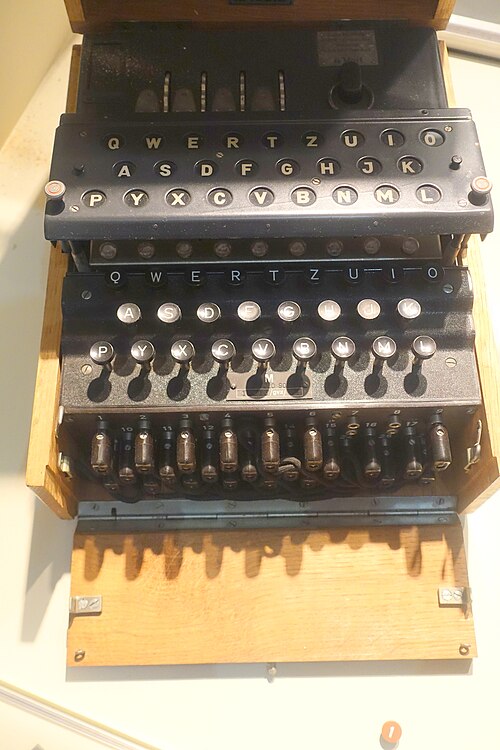
The machine at the center of all of it was never a military invention to begin with. German engineer Arthur Scherbius patented a rotor cipher machine in 1918 and began selling a commercial version, the Enigma, in the early 1920s — to banks and businesses, not to anyone’s army. Germany’s navy adopted a military version in 1926; the army and air force followed within a few years. By the war that would define its reputation, an estimated 40,000 Enigma machines were in German service.
The design was genuinely clever. A standard wartime Enigma used three interchangeable rotors, each wired to scramble a letter into a different one every keystroke, turning like an odometer so the same letter typed twice in a row usually encrypted differently each time. A reflector sent the current back through the rotors a second pass, making the machine reciprocal — the settings that encrypted a message could also decrypt it — but creating a fatal flaw too: no letter could ever encrypt to itself. From 1928 on, a plugboard let an operator swap up to thirteen letter pairs before a keystroke reached the rotors at all, adding more strength than an entire extra rotor. Multiply it out and a standard Enigma had roughly 159 quintillion possible daily settings. German cryptographic staff considered it unbreakable by brute force, and they were right — nobody ever broke it that way. It was broken by mathematics, captured material, and procedural habits Germany never fixed.
Poland breaks it first
Long before Britain solved Enigma, Poland already had. That fact spent decades being under-told, and it’s worth stating plainly: the foundation of everything that followed at Bletchley Park was Polish work, done years earlier, with far fewer resources.
Poland had the strongest reason of any country in Europe to want inside German communications — wedged between Germany and the Soviet Union, both of which had invaded or partitioned it within living memory. Its Cipher Bureau put real resources behind the problem, and in late 1932 a twenty-seven-year-old mathematician, Marian Rejewski, working largely alone, reconstructed the internal wiring of the military Enigma — using pure permutation theory, abstract mathematics historians have since half-jokingly called “the theorem that won World War II.” Its central insight, that two permutations share a pattern if they share a cycle structure, was exactly the leverage German operating procedure was quietly handing away every day.
Rejewski didn’t do it with mathematics alone — French intelligence, through officer Gustave Bertrand, had passed Poland Enigma operating documents supplied by a German traitor, Hans-Thilo Schmidt, codenamed “Asché.” Combined with Rejewski’s reconstruction, that let his small team, joined by fellow mathematicians Jerzy Różycki and Henryk Zygalski, turn a theoretical solution into a running operation, building the cyclometer for cataloguing rotor patterns, the bomba kryptologiczna — six linked Enigma replicas that could recover a day’s key in about two hours — and Zygalski sheets, a manual paper method. By the mid-1930s, years before Britain or France had solved Enigma at all, the Polish Cipher Bureau was routinely reading German military traffic.
It couldn’t last on Poland’s resources alone — Germany kept adding complexity faster than a small Warsaw bureau could match. So Polish intelligence made a decision that mattered as much as the mathematics: on 25 July 1939, five weeks before the invasion, Polish officers met their British and French counterparts in the Pyry forest outside Warsaw and handed over everything — the wiring, a working Enigma replica, full blueprints for the bomba. Britain’s codebreakers did not start from nothing in 1939. They started from a solved problem.
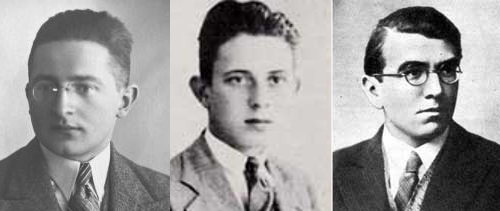
Poland’s team kept working even after their country fell — Rejewski codebreaking for the Allies from a French station where Turing himself visited in early 1940, then from a secret Franco-Polish post until November 1942, before a wartime road to Britain that ran through a Spanish prison cell.
Britain builds on it: Turing, Welchman, and the Bombe
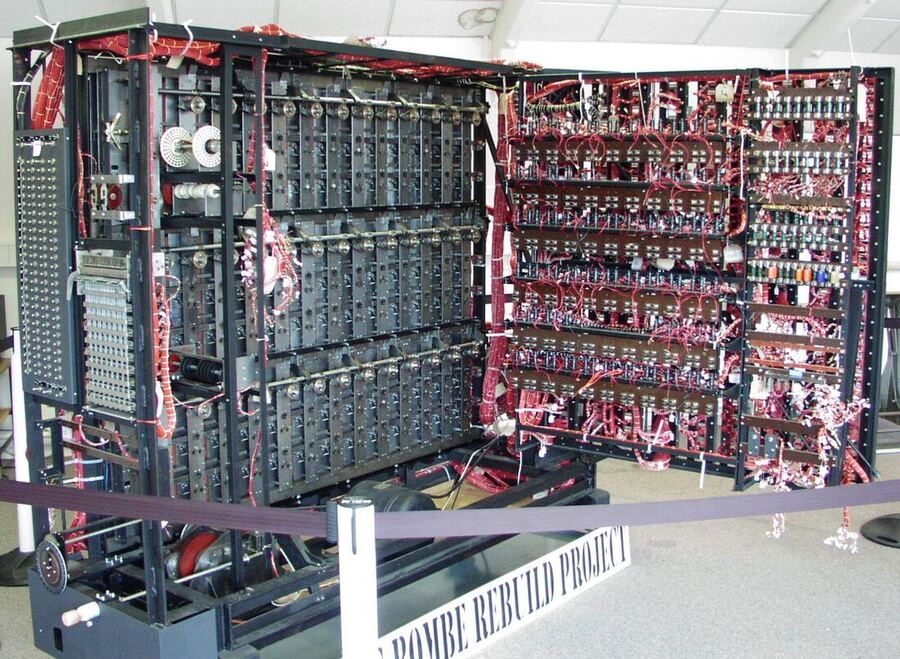
At the Government Code and Cypher School, relocated for secrecy to a Buckinghamshire estate called Bletchley Park, Cambridge mathematician Alan Turing took the Polish handoff and generalized it. Germany had fixed the doubled-indicator habit that gave Rejewski his opening, breaking the original Polish method. Turing’s 1939 answer didn’t need that habit: his Bombe worked from a crib — a guessed fragment of plaintext, since German operators opened messages predictably — testing settings at electromechanical speed far faster than any human could. Colleague Gordon Welchman added a key refinement in 1940, the diagonal board, exploiting the plugboard’s own symmetry to eliminate most false stops. By May 1945, around 155 Bombes ran across Bletchley Park and its outstations, most operated by roughly 700 Wrens — Women’s Royal Naval Service — who kept the machines fed around the clock. Hut 6 handled Army and Air Force Enigma; Hut 8, which Turing led, the far harder naval version.
None of this ran on a handful of geniuses in a hut. At its January 1945 peak, Bletchley Park and its outstations employed 9,000 to 10,000 people, roughly three-quarters of them women — many with degrees in mathematics, physics, or languages, doing everything from indexing traffic to running the Bombes to translating what came out the other end. Ultra was, in real measure, produced by a workforce of young women whose labor went unrecognized during the war by design, and for decades afterward by continued secrecy.
What Ultra was actually worth, and what it cost to protect
The decrypted product of all this was classified under the name Ultra starting in June 1941, above even Britain’s existing “Most Secret” grading. Ultra was never one triumphant break — it was a continuous, contested process. Naval Enigma alone went dark for roughly ten months in 1942, after the German Navy added a fourth rotor that February, a blackout that lines up, grimly, with a spike in Atlantic shipping losses. It ended only when HMS Petard captured code material from the sinking U-boat U-559 that October, letting Hut 8 back into naval traffic by December — about as clean a before-and-after as this war offers of what the intelligence was worth.
It was protected almost as fiercely as it was produced. Access ran through roughly forty Special Liaison Units — an officer would hand a commander a decrypt, stand there while it was read, then take it back and destroy it. No copies, no notes. Some senior figures were kept out entirely: Bomber Command’s Arthur Harris was never cleared for Ultra despite commanding one of the war’s largest forces. Every operational use, as the decision below shows, had to be laundered through a cover story first. A 1942 Bletchley security notice put the culture in one line: Do not talk at meals. Do not talk in the transport. Do not talk travelling. Do not talk in the billet. Do not talk by your own fireside.
An SLU officer has just shown you a decrypt, then taken it back. It names the exact position, six hours out, of a U-boat wolfpack sitting across your route. Doctrine says you cannot simply order the course change it tells you to make. What do you do?
Standard SLU doctrine was option b: request a cover sighting first, whatever delay it cost, and act only once a plausible non-Ultra explanation was on record — attributed, if it had to be attributed to anything, to a fictional master-spy network the British invented and codenamed Boniface. If German intelligence ever concluded interceptions were failing too precisely, too often, to be coincidence, they could change the entire Enigma system overnight, and every Allied command reading Ultra would go dark with it. A commander wasn't just protecting his own ships; he was protecting a source Eisenhower's headquarters would depend on, months later.
Mavis Batey, recruited at nineteen in 1940 as assistant to cryptanalyst Dilly Knox, broke Italian Naval Enigma traffic that fed directly into the British ambush at Cape Matapan in March 1941 — and, separately, an Abwehr Enigma message that let Bletchley confirm the Germans genuinely believed Britain’s Double-Cross deception was real. In books published once declassification let her speak, she described the work less as a flash of genius than as sustained, exhausting attention to small inconsistencies most people would never notice.
Bodyguard: lying to Germany about where D-Day would land
Everything so far was about reading what the enemy actually said. The other half of the intelligence war was making the enemy believe things that weren’t true — and its largest single application was Operation Bodyguard, the umbrella deception plan built around the 1944 Normandy invasion.
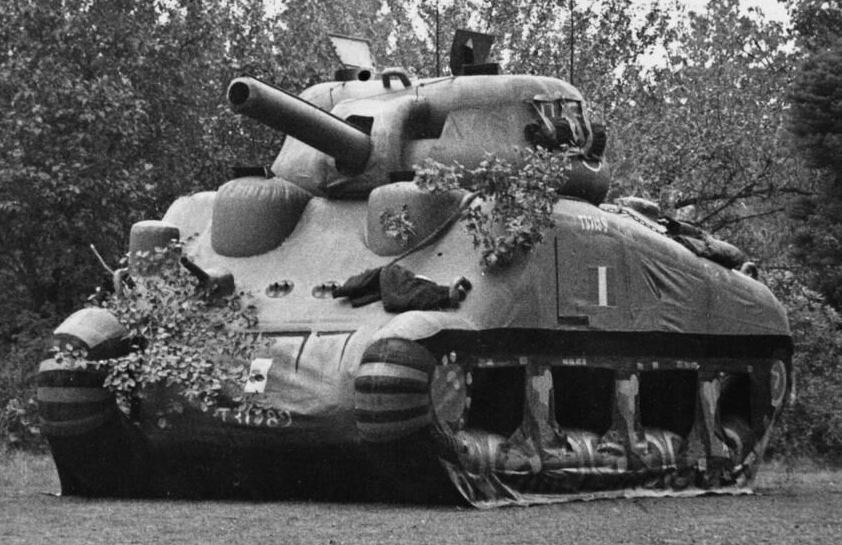
Bodyguard’s core problem was geography Germany could reason about on its own: the Channel is shortest at the Pas-de-Calais, so any sane planner would land there. Fortitude leaned into that logic rather than fighting it — inventing a fictional First US Army Group under George Patton, stationed convincingly in southeast England, complete with fake radio traffic, dummy landing craft, and inflatable equipment built to look real from the air. That last part was the job of the 23rd Headquarters Special Troops, a roughly 1,100-man unit better known by the nickname it earned once declassified: the Ghost Army. Its soldiers inflated rubber Sherman tanks, broadcast recorded engine noise, and impersonated whole divisions’ worth of radio chatter with a fraction of the real manpower — several went on to notable postwar careers, including fashion designer Bill Blass and painter Ellsworth Kelly, both of the unit’s camouflage engineers.
Fortitude’s most important asset wasn’t rubber, though — it was a person. Juan Pujol García, a Spaniard who had failed to volunteer as a spy for the British before talking his way into German intelligence’s confidence instead, became the double agent codenamed Garbo, running a fictional network of roughly two dozen invented sub-agents “reporting” to Germany through him — mixing accurate, low-value detail with the false claims Fortitude needed believed. Weighed against Ultra decrypts showing what the Germans actually concluded, Garbo’s reports let British intelligence check its own deception in something close to real time: reading German assessments confirming the fake Army Group was believed real, before the invasion had even happened.
Ruth Bourne was recruited into the WRNS at seventeen and served as a Bombe operator from early 1944 through the war's end — turning drums, plugging boards, then helping dismantle the machines once V-E Day made the work obsolete. In interviews given decades later, after 1974 finally let veterans speak, she has described how completely the habit of saying nothing took hold — being suddenly allowed to talk about what she'd done felt disorienting rather than freeing, because she'd genuinely stopped expecting to say it out loud.
The secret that took decades to become a story
Almost nothing in this part was a matter of interpretation. It was a matter of access — information genuinely withheld, in real time, from people who had every reason to want it, for exactly as long as the people holding it decided.
This gauge shows where historians' debate actually sits — not a simulated probability. It never invents a number; it points at a real argument.
Nobody credible argues Ultra didn't matter — the documented episodes here (Cape Matapan, the 1942 naval blackout's end, Fortitude's confirmed effect on German assessments) aren't in dispute. What's contested is putting a global number on it. Sir Harry Hinsley, the wartime Bletchley officer who became official historian of British Intelligence in the Second World War, said in a widely quoted 1993 lecture that without Ultra the war "would have been something like two years longer, perhaps three years longer, possibly four years longer than it was" — the figure most accounts repeat. Later historians pushed back: John Keegan and Jeffrey Richelson each argued the real shortening was likely far smaller, closer to the few months it took to ready the atomic bombs; Guy Hartcup went further, arguing it's flatly impossible to calculate at all. This part takes no side; it's a live disagreement among serious historians, not a settled number dressed up as one.
An accountant in Bydgoszcz kept two decades of silence about the theorem that started all of it. Nearly ten thousand people at Bletchley Park kept a secret so completely that some of their own families never learned what they’d done. A fictional army made of rubber and recorded engine noise helped convince German reserves to wait in the wrong place while the real invasion landed elsewhere. None of it worked because any single piece was clever alone. It worked because the people running it organized a war’s worth of behavior around one rule: the value of knowing something is destroyed the moment the other side learns you know it.
In one sentence: why did protecting the secret that Enigma was broken sometimes matter as much as the codebreaking itself?
Because the intelligence was only useful as long as the Germans didn't know they'd lost it — a single careless action that looked too precise to be coincidence could have driven them to change the whole Enigma system overnight, and every front reading Ultra, not just the one that made the mistake, would have gone dark with it. The codebreaking created the advantage. The secrecy was the only thing keeping it real.
Sources
- F.W. Winterbotham, The Ultra Secret (Weidenfeld & Nicolson, 1974)
- Harry Hinsley et al., British Intelligence in the Second World War (HMSO, official history, 1979-1990); Hinsley’s “two to four years” estimate from his 1993 Cambridge lecture
- Władysław Kozaczuk, Enigma: How the German Machine Cipher Was Broken, and How It Was Read by the Allies in World War Two (Polish orig. 1967; English ed., University Publications of America, 1984)
- John C. Masterman, The Double-Cross System in the War of 1939 to 1945 (Yale University Press, 1972)
- John Keegan, Intelligence in War: Knowledge of the Enemy from Napoleon to Al-Qaeda (Knopf, 2003)
- Ben Macintyre, Double Cross: The True Story of the D-Day Spies (Bloomsbury, 2012)
- Rick Beyer and Elizabeth Sayles, The Ghost Army of World War II (Princeton Architectural Press, 2015); Rick Beyer, The Ghost Army (PBS documentary, 2013)
- Mavis Batey, Dilly: The Man Who Broke Enigmas (Dialogue, 2009) and From Bletchley with Love (Bletchley Park Trust, 2008)
- UK National Archives (Kew), Security Service/Special Operations/Bletchley Park staged declassification releases
- Bletchley Park Trust (bletchleypark.org.uk), museum and veterans’ oral-history program
- Imperial War Museum Sound Archive, London
- Wikipedia cross-checked articles used to verify dates and figures: “Marian Rejewski,” “Enigma machine,” “Bombe,” “Ultra (cryptography),” “Bletchley Park,” “Operation Fortitude,” “Juan Pujol García,” “Double Cross System,” “Ghost Army” — each cross-referenced against the sources above