Last time: Part 14 closed with six brutal months on Guadalcanal — jungle fighting on land, repeated naval battles in a channel the sailors nicknamed "Ironbottom Sound" — and a lesson both sides drew the same conclusion from: this war would be decided as much by which side could keep replacing its ships, planes, and pilots as by winning any single battle. So where did that replacement race actually get decided? Not on any battlefield. In the factories, shipyards, and — on the German side — forced-labor camps standing behind every front this series has covered. By the time Guadalcanal ended in February 1943, American shipyards were turning out Liberty ships in weeks instead of months, the Soviet Union had rebuilt an entire evacuated industrial base beyond the Urals under fire, and Germany was leaning ever more heavily on millions of foreign forced and slave laborers to keep its own output climbing. This part is that hidden front: the one that decided how many replacement tanks, planes, and ships each side actually had to send back into the fights this series keeps returning to.
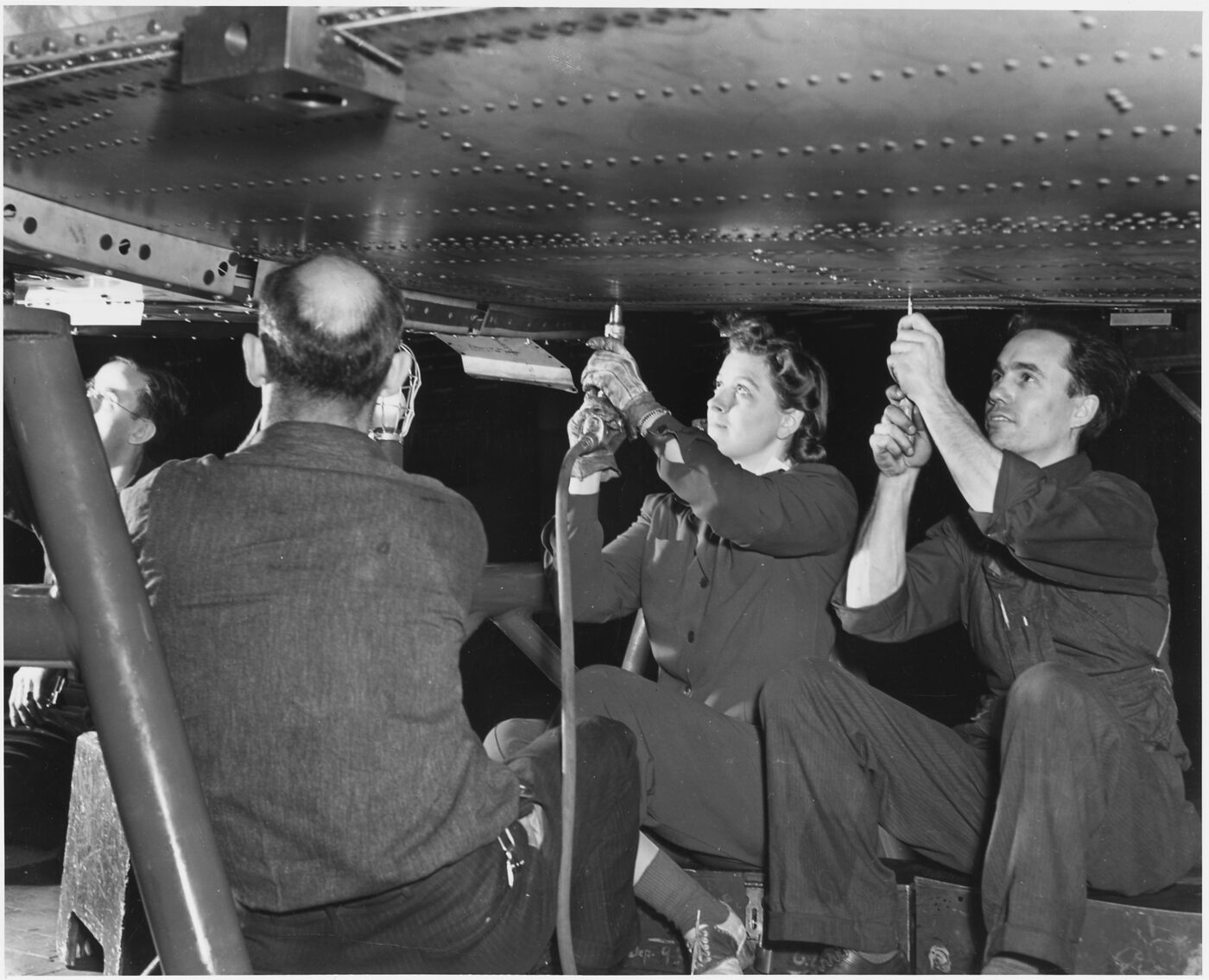
In the spring of 1944, a Kentucky-born widow named Rose Will Monroe was working the B-24 Liberator line at Ford’s Willow Run plant outside Detroit — riveting bomber fuselages, one of tens of thousands of women doing the same job across the American aircraft industry. A film crew shooting government promotional shorts came through the plant looking for a real riveter to appear on camera, and picked Monroe partly because her work was good and partly because of her name: a song called “Rosie the Riveter” was already climbing the charts, and a woman named Rose, actually riveting actual bombers, was too good a coincidence to pass up. She appeared in two wartime films, then went back to her regular shift and kept working the line until the war ended.
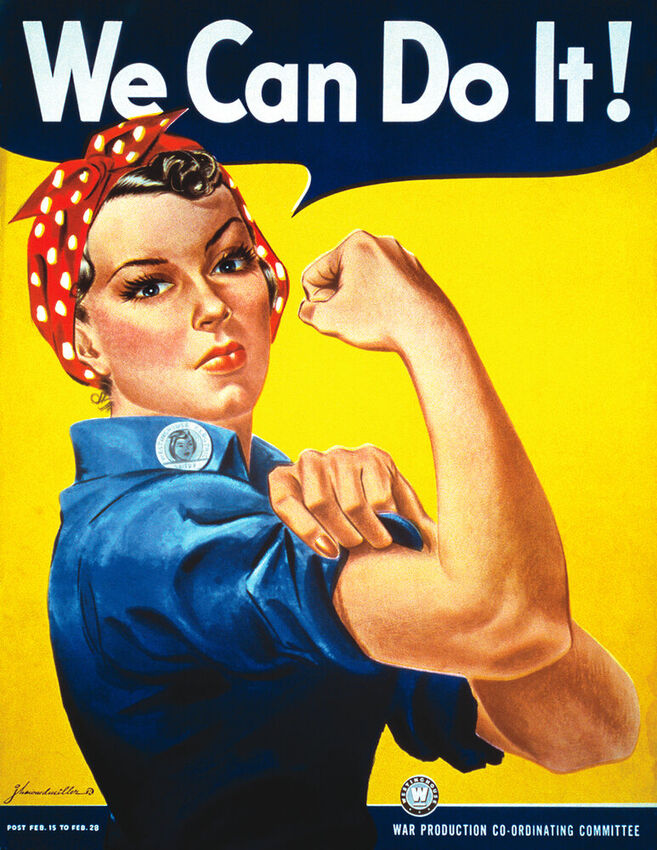
Monroe wasn’t the origin of the Rosie the Riveter image — that had already been circulating for a year, in a magazine cover and a Westinghouse poster meant for a different, narrower audience than the one that made it famous later. But she was a real person doing the real job the image stood for, on the specific line this part opens on: a Ford plant that, by the time Monroe stepped in front of the cameras, was finishing a four-engine bomber roughly every sixty-three minutes, around the clock. That plant, one shipyard in California, one relocated tank factory in the Urals, and one government ministry in Berlin are where this part spends its time — because by 1942, how fast a country could build weapons had become almost as decisive as how well it used them.
The arsenal: Detroit and the shipyards
Franklin Roosevelt called the United States “the arsenal of democracy” in a radio address on December 29, 1940 — a full year before Pearl Harbor, describing what American industry was already becoming for Britain before the US was even a combatant. After December 1941 that shift went into overdrive: civilian auto plants converted to war production almost overnight, and Detroit alone retooled from cars to tanks, jeeps, and aircraft parts within months. Willow Run, the plant Rose Will Monroe worked, was purpose-built for the job — a mile-long factory Ford’s production chief, Charles “Cast-Iron Charlie” Sorensen, is said by his own later account to have laid out on the back of an envelope during a 1941 flight. Envelope story or Ford company legend, the plant it describes was real, and for a while the largest factory under one roof in the world.
It built 6,972 complete B-24 Liberator bombers and knockdown kits for 1,893 more — close to half of every B-24 made anywhere — peaking in April 1944 at 428 aircraft, including a stretch of 100 bombers in three days. Getting there took real institutional resistance first: Henry Ford himself opposed hiring women on the line. The wartime draft settled the argument for him, pulling roughly 8,200 workers a month out of the plant’s labor pool until there was no workforce left to fill the gap except the one Ford had refused to hire.
The same shift played out at sea. Eighteen American shipyards built 2,710 Liberty ships between 1941 and 1945 — plain, welded cargo vessels built fast rather than beautifully — at a wartime average of roughly three every two days. Henry J. Kaiser’s yards at Richmond, California, and Vancouver, Washington, were among the most productive; a publicity-stunt hull, the SS Robert E. Peary, launched just over four and a half days after its keel was laid — a headline record never meant to represent normal production, which by 1943 ran closer to a 39-day median, still a fraction of prewar timelines.
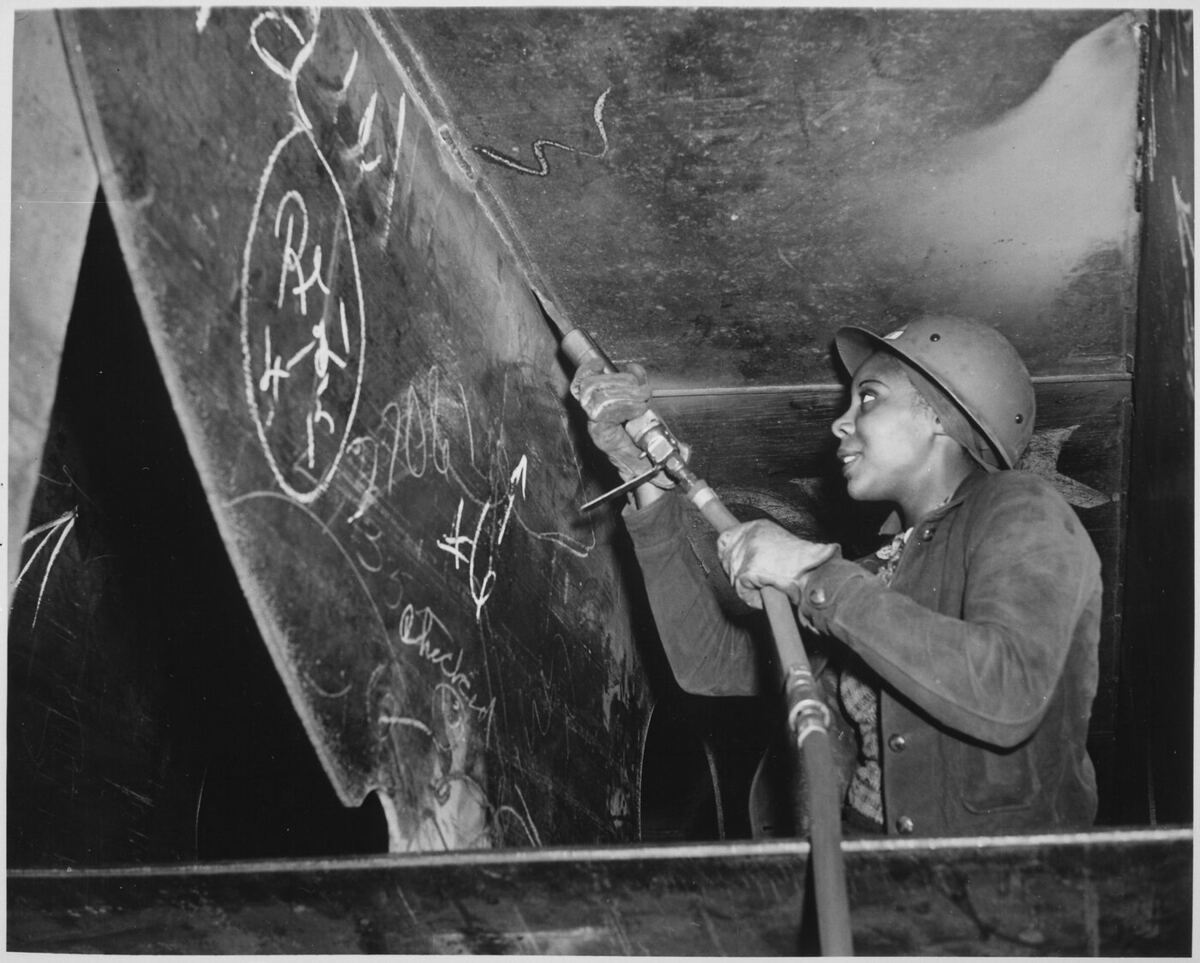
At Richmond’s Shipyard No. 1, nearly 1,000 African American women worked as welders, burners, and scalers by 1943 — among them Eastine Cowner, a former waitress, photographed helping build the Liberty ship SS George Washington Carver. Her story corrects a version of “Rosie the Riveter” that flattens into one image: the labor shortage pulled in women of every background, into jobs closed to most of them a year earlier, for reasons that had nothing to do with equality and everything to do with a country that had run out of any other source of hands.
The evacuation: an industrial base moved a thousand miles under fire
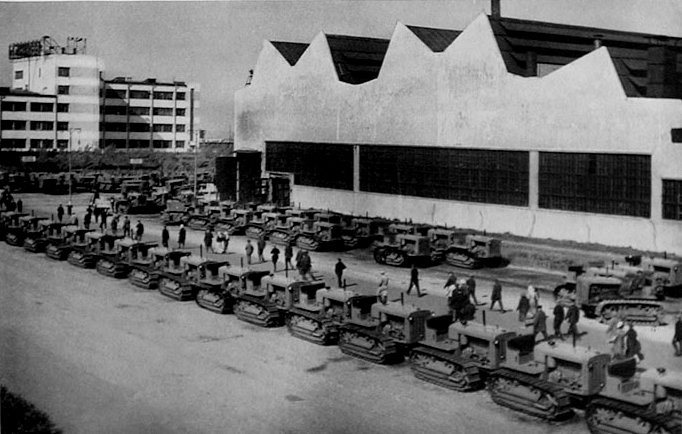
Nothing in the American story has a real counterpart to what the Soviet Union did in the second half of 1941, because nothing else in this war looked like it. As German forces advanced on the industrial heartland of Ukraine, Leningrad, and the Moscow region, the Soviet state ordered an emergency evacuation of entire factories — machinery, blueprints, and workers together — east beyond the Volga, into the Urals and Siberia. Commonly cited figures put the number at roughly 2,500 enterprises and millions of workers relocated in that single stretch of months; exact tallies vary by source and by what counts as one “enterprise,” but the scale, however it’s counted, has no equivalent among the other combatants in this part.
From threatened city to working tank line, in a matter of months — and in some cases, weeks.
The order to move
With Leningrad encircled and German forces driving on Moscow and Ukraine, Soviet authorities order key plants dismantled and shipped east — among them Leningrad's Kirov Plant, one of the country's most important tank works.
Trains east
Machine tools and roughly 15,000 Kirov Plant workers are loaded onto rail cars bound for Chelyabinsk, in the southern Urals, competing with troop and refugee trains for the same overloaded rail network.
Arrival, before there's a roof
Equipment reaches Chelyabinsk faster than buildings can house it. In documented cases, machinery runs outdoors, in a Ural winter, before walls exist around it — production resumes within weeks of arrival.
Tankograd at full output
The complex grows from about 25,000 workers to roughly 60,000 by 1944, building KV heavy tanks from 1941, T-34s from 1942, and KV-85s, IS heavy tanks, T-34/85s, and SU-85 self-propelled guns by 1943–44 — an estimated 18,000 tanks and 48,500 tank diesel engines over the war.
Isaak Zaltsman
Berlin: a “miracle” built partly on coercion
Germany’s answer to this same pressure had a different shape, and a darker one. Hitler appointed Albert Speer Reich Minister of Armaments and War Production on February 8, 1942, after his predecessor, Fritz Todt, died in a plane crash. German munitions output did rise sharply over the next two years — Speer himself later claimed roughly a sixfold increase in munitions, fourfold in artillery — and for decades that claim built Speer’s postwar reputation as the technocrat who nearly out-produced his way to a different outcome. Modern scholarship treats the “armaments miracle” label with real skepticism: the increases had already begun under Todt, comparable gains were happening in Luftwaffe and Navy production Speer didn’t control, and a large share of the real gain came from administrative reorganization and a shift toward quantity over engineering quality — and from something that has to be named plainly rather than folded into a story about efficiency.
German war production came to depend, to a very large and deliberately expanded degree, on forced and slave labor. This is not a side note to the industrial story this part is telling — it is one of the central facts of how Germany kept its factories running, and it is written here with the same weight the rest of this series has given to its worst chapters: no interactive devices built around it, nothing to click through, a record rather than an experience.
Roughly 12 million people were deported into forced labor in Germany from nearly twenty occupied and allied countries. Foreign forced laborers made up about 3 percent of the German war-industry workforce in 1940; by 1944 that figure had risen to roughly 29 percent, and by that summer German records counted some 7.6 million foreign civilian workers and prisoners of war inside the country. The categories were formal and administratively distinct: Ostarbeiter, several million Soviet and Polish civilians held under especially severe restriction; Zivilarbeiter, Polish civilians under a separate, somewhat less restrictive regime; military internee labor drawn from POWs, nearly two million strong by 1944; and, at the furthest extreme, concentration camp prisoners worked, in a documented number of cases, literally to death under an SS doctrine sometimes labeled “extermination through labor.”
Two sites make this concrete rather than abstract. Mittelbau-Dora, a concentration-camp subcamp complex, was built specifically to produce V-2 rockets, with a well-documented death toll among its prisoners. Monowitz — Auschwitz III — was built to supply forced labor to a synthetic-rubber and fuel plant run by the chemical conglomerate IG Farben, directly connecting a named company to a death camp. Well over 2,000 German companies are documented as having used forced or slave labor at some point, a list that includes major firms still operating today — Volkswagen, Siemens, Bosch, Daimler-Benz — as well as the German subsidiaries of American companies, Fordwerke and Adam Opel AG.
None of this is offered to editorialize past the record; the record carries its own weight. It sits directly beside the Liberty ships and the Willow Run line in this part because both are true about how nations armed themselves for total war, and this series’ rule on that hasn’t changed here: real numbers, named sites, no smoothing.
German output, built on this mixed foundation of reorganization and coercion, peaked in June and July of 1944 — and then collapsed through the rest of the year, driven above all by fuel shortages rather than a shortfall of finished tanks or aircraft sitting on factory floors with no way to move.
What the numbers actually say
Comparative wartime production totals are contested by exact count — historians differ on whether to include self-propelled guns alongside tanks, or every aircraft type alongside combat types only — but the broad picture, drawn from Harrison’s and Overy’s standard comparative tables, is not in serious dispute.
Full-war totals, not annual rates. Germany's lighter overlay is the real range historians report — the gap comes from whether self-propelled guns count as tanks and which aircraft types count as combat aircraft, not from an invented number.
Britain’s own mobilization deserves a line even though its factory floor doesn’t anchor this part the way the other three do: a smaller industrial base than any of the others, run at a more complete state of total mobilization, earlier, than any other combatant — women’s employment in war industry and the armed forces reached a very high share of the eligible female population by 1943.
THE VOICES
The Regional Oral History Office at UC Berkeley's Bancroft Library holds the Rosie the Riveter/WWII American Home Front Oral History Project — more than 200 recorded interviews with home-front workers, most of them women who moved into war production for the first time. The National WWII Museum in New Orleans holds a comparable American collection alongside its veteran interviews. Across both, a similar shape recurs: real pride in visibly skilled, physically demanding work most had been told they couldn't do, alongside a frank acknowledgment that the jobs, and the wages, were expected to end the moment the war did.
The Rosie the Riveter/WWII Home Front National Historical Park, sited by the National Park Service at the former Kaiser Richmond shipyards, maintains its own collection of site-specific worker testimony tied directly to the yard's production record — the same yard where Eastine Cowner and nearly a thousand other African American women worked as welders, burners, and scalers.
The Imperial War Museum's Sound Archive in London holds a large body of recorded interviews with British women who worked in munitions and aircraft factories during the war — long shifts, real workplace injuries, and a wartime economy that pulled women into industrial labor on a scale Britain's peacetime workforce had never approached.
Worth being honest here, the way this series has been about other gaps: individually attributed, English-language oral history of Soviet industrial — as opposed to combat — war workers is genuinely thin in accessible archives, a real gap rather than an oversight in this part's research. The closest widely available source is Svetlana Alexievich's Nobel-winning The Unwomanly Face of War, built from interviews with Soviet women who lived through the war. It leans toward front-line and support roles rather than factory-floor testimony, and should be read as a real, citable source for Soviet women's wartime experience broadly — not a direct substitute for the Tankograd worker's voice this part doesn't have.
The failure ran in the other direction too. German planners, and a good number of prewar American isolationists, assumed a civilian consumer economy built around cars and refrigerators couldn’t convert to war production fast enough to matter. Willow Run and the Liberty ship yards are the direct rebuttal, and the timeline is the whole argument: from a peacetime auto industry to a bomber every 63 minutes took roughly eighteen months, not the years everyone on the other side of that bet had assumed they had.
This gauge shows where historians' debate actually sits — not a simulated probability. It never invents a number; it points at a real argument.
This is really three separable arguments, and they shouldn't be collapsed into one. Harrison and Overy argue the outcome was set substantially by comparative economic scale and mobilization efficiency — above all American industrial capacity plus Lend-Lease, and Soviet re-mobilization of evacuated industry under fire. Adam Tooze, in The Wages of Destruction (2006) — the central book behind this part's account of Germany — goes further: Nazi Germany never had the resource base to outproduce the Anglo-American-Soviet bloc at all, and Speer's celebrated gains were substantially statistical framing, reorganization already underway under Todt, and the escalating use of forced and slave labor, not a real efficiency "miracle" — revising the more sympathetic earlier reading in Overy's own War and Economy in the Third Reich (1994). A third, narrower claim comes from Alfred C. Mierzejewski's The Collapse of the German War Economy, 1944–1945 (1988): that Allied bombing of German rail infrastructure specifically, not the earlier ball-bearing campaign or oil alone, delivered the single most decisive blow in the war's final year. The three positions aren't contradicting each other so much as answering different questions about which real lever mattered most.
What the factory floor decided
By the time this part’s arc closes, in the summer of 1944, the pattern is set on every side. American shipyards and aircraft plants are running at a pace their own prewar planners would have called impossible. Chelyabinsk is turning out heavy tanks by the thousand from a complex that didn’t exist in its wartime form three years earlier. Berlin’s output is peaking on paper, at the exact moment its fuel supply starts collapsing underneath it — and a large, coerced, and in places murderous labor force is what let that paper peak happen at all. None of the fighting fronts this series has covered, or the ones still ahead, can be fully explained without this one: the war’s outcome was decided, in real and measurable part, in places no soldier ever fired a shot.
In one sentence: was the Allied production advantage mainly a story of American and Soviet capacity being real and large, or of German capacity being smaller than it looked — and does the forced-labor record change which answer you'd give?
Both, and the forced-labor record doesn't split the difference — it removes some of the credit from the "German efficiency" side of the ledger entirely. American and Soviet capacity was real, large, and in the Soviet case demonstrated under conditions that should have made it impossible. German output did rise, but a meaningful share of that rise was coerced rather than engineered, which is a different kind of number than the tank and aircraft totals sitting next to it. A factory that runs faster because of forced labor isn't proof of superior organization. It's proof of what a state was willing to do once its actual capacity ran out.
Sources
- Adam Tooze, The Wages of Destruction: The Making and Breaking of the Nazi Economy (Allen Lane, 2006)
- Richard Overy, Why the Allies Won (Jonathan Cape, 1995)
- Richard Overy, War and Economy in the Third Reich (Oxford University Press, 1994)
- Mark Harrison, The Economics of World War II: Six Great Powers in International Comparison (Cambridge University Press, 1998)
- Alfred C. Mierzejewski, The Collapse of the German War Economy, 1944-1945: Allied Air Power and the German National Railway (University of North Carolina Press, 1988)
- United States Strategic Bombing Survey, summary reports (1945-46)
- Franz Halder, The Halder War Diary, 1939-1942, ed. Charles Burdick and Hans-Adolf Jacobsen (Presidio Press, 1988 English ed.)
- Svetlana Alexievich, The Unwomanly Face of War, trans. Richard Pevear and Larissa Volokhonsky (Random House, 2017; Russian orig. 1985)
- Regional Oral History Office, Bancroft Library, UC Berkeley, Rosie the Riveter/WWII American Home Front Oral History Project
- Rosie the Riveter/WWII Home Front National Historical Park, National Park Service
- Imperial War Museum Sound Archive, London
- National WWII Museum, New Orleans, oral history collection
- US Holocaust Memorial Museum, reference material on Mittelbau-Dora and IG Farben/Monowitz (Auschwitz III)
- German Federal Foundation “Remembrance, Responsibility and Future” (EVZ), Forced Labour Compensation Programme documentation