Last time: by August 1943, Kursk had broken the last major German offensive in the east, and Kharkov changed hands for a fourth and final time — the point after which every operation on the Eastern Front is a Soviet one. This part doesn't pick up there. It rewinds almost two years, to a Sunday morning in Hawaii, before most of Part 13 had even happened. Why go backward? Because the Pacific war was already running on its own clock the whole time — Pearl Harbor happened more than eight months before the siege of Stalingrad even began. This part goes back to December 1941 to tell that war from its own start, the same way Part 11 doubled back for North Africa; the two theaters converge again once Part 15 turns to the factories supplying both of them.
John Garcia was seventeen years old on the morning of December 7, 1941, working as a civilian boilermaker’s apprentice at the Navy Yard in Pearl Harbor, Hawaii. Sunday shift, ordinary weekend overtime, nothing about the day marked out in advance. He was walking toward the yard when the first Japanese aircraft came in low over Battleship Row. What he later described, in an interview recorded decades afterward, was not a single dramatic image but hour after hour of unglamorous, exhausting work: the water around the moored ships thick with fuel oil, sailors trapped inside capsized hulls, days spent afterward helping pull bodies out of the harbor. He was not a sailor, not a soldier, not anyone the war was supposed to have found yet. He just happened to be standing in the one harbor in the Pacific that mattered most that particular morning.
A clock nobody could stop, and a decision made under it
Japan’s war in China, grinding on since 1937, was the root problem — and Japan’s own escalation kept making it worse. When Japanese troops moved into northern French Indochina in September 1940 and then occupied the south in July 1941, Washington answered with tightening economic pressure: export restrictions on scrap iron and aviation fuel in 1940, then a full freeze of Japanese assets in July 1941, administered by August so tightly it amounted to a total oil embargo. Britain and the Dutch East Indies joined it — the “ABCD” encirclement, American-British-Chinese-Dutch, that Japanese planners talked about at the time, not a phrase invented later. Japan now had two paths off the clock: withdraw from China and get the embargo lifted, or seize the oil directly, by force, from the Dutch East Indies and British Malaya. The Imperial Conference of September 6, 1941 set a rough deadline for a diplomatic solution to work. It didn’t. By early November the decision for war was effectively made, and the Imperial Conference of December 1, 1941 confirmed it formally.
Command of how to actually fight that war, once the political decision was made, fell to Admiral Isoroku Yamamoto, commander of Japan’s Combined Fleet — and Yamamoto did not believe Japan could win a long one.
You are Isoroku Yamamoto. Japan's government has chosen war rather than withdrawal from China. You've told associates privately that against America's industrial base, you can promise results for perhaps a year — nothing beyond that. Given a war you don't expect to win outright, how do you open it?
Yamamoto threw out his own navy's prewar doctrine and pushed through option b, over serious internal resistance — reportedly threatening to resign if the Naval General Staff didn't approve it. It worked exactly as planned, tactically: the strike force reached Hawaii undetected and hit an unsuspecting fleet at anchor. What it didn't do — because it couldn't, and because the doctrine Yamamoto overrode had never accounted for it — was solve the actual problem. Not one American aircraft carrier was in port that morning, and the oil tank farm and repair yards that kept the whole Pacific Fleet running were barely touched. Yamamoto had bought time. He hadn't bought a way to win the year he thought he had.
Tora, Tora, Tora, and what six carriers didn’t hit
At 7:48 a.m. Hawaiian time on December 7, 1941, the first of 353 aircraft launched from six Japanese carriers — Akagi, Kaga, Sōryū, Hiryū, Shōkaku, Zuikaku — began their attack on Battleship Row. The strike leader, Commander Mitsuo Fuchida, radioed back the coded signal confirming total surprise had been achieved: “Tora! Tora! Tora!” Within two hours, USS Arizona, USS Oklahoma, and the target ship USS Utah were sunk, six more battleships damaged, and 2,403 Americans dead — 2,335 military personnel and 68 civilians. Japan lost 129 men and 29 aircraft. It was, by any tactical measure, one of the most lopsided naval strikes in history.
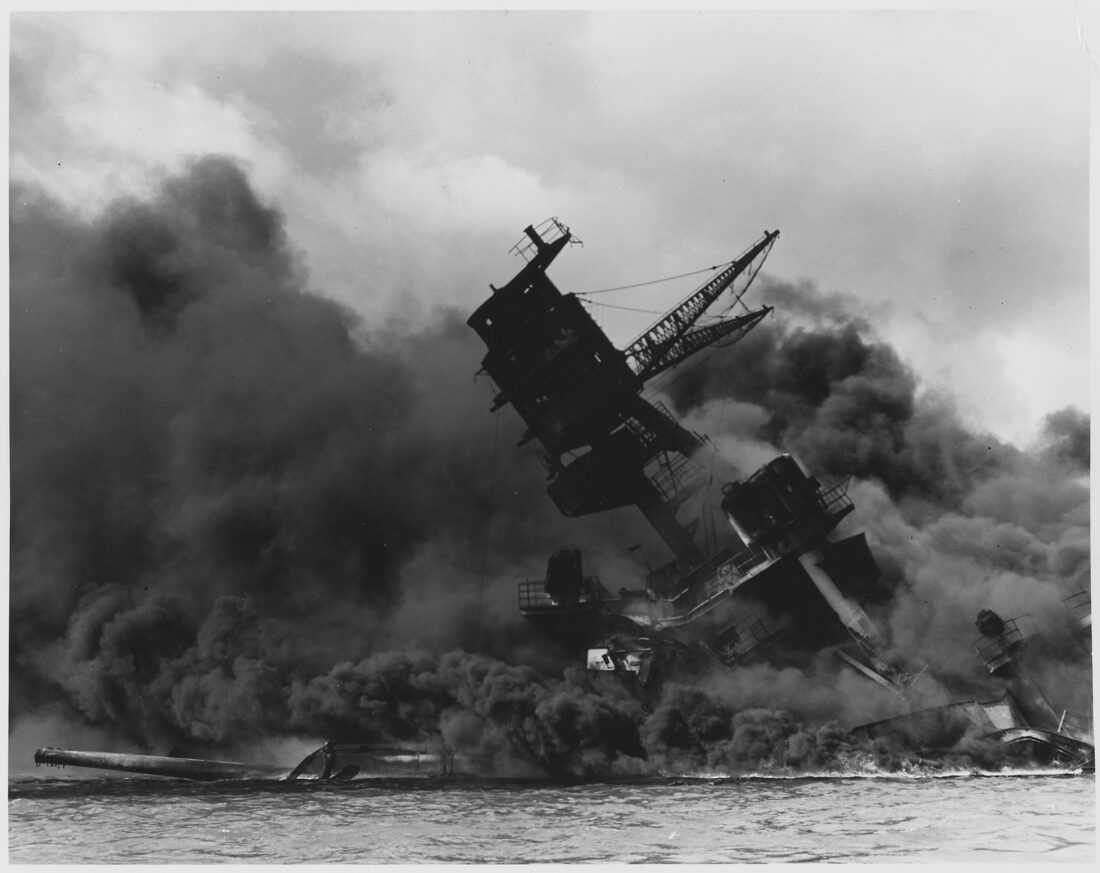
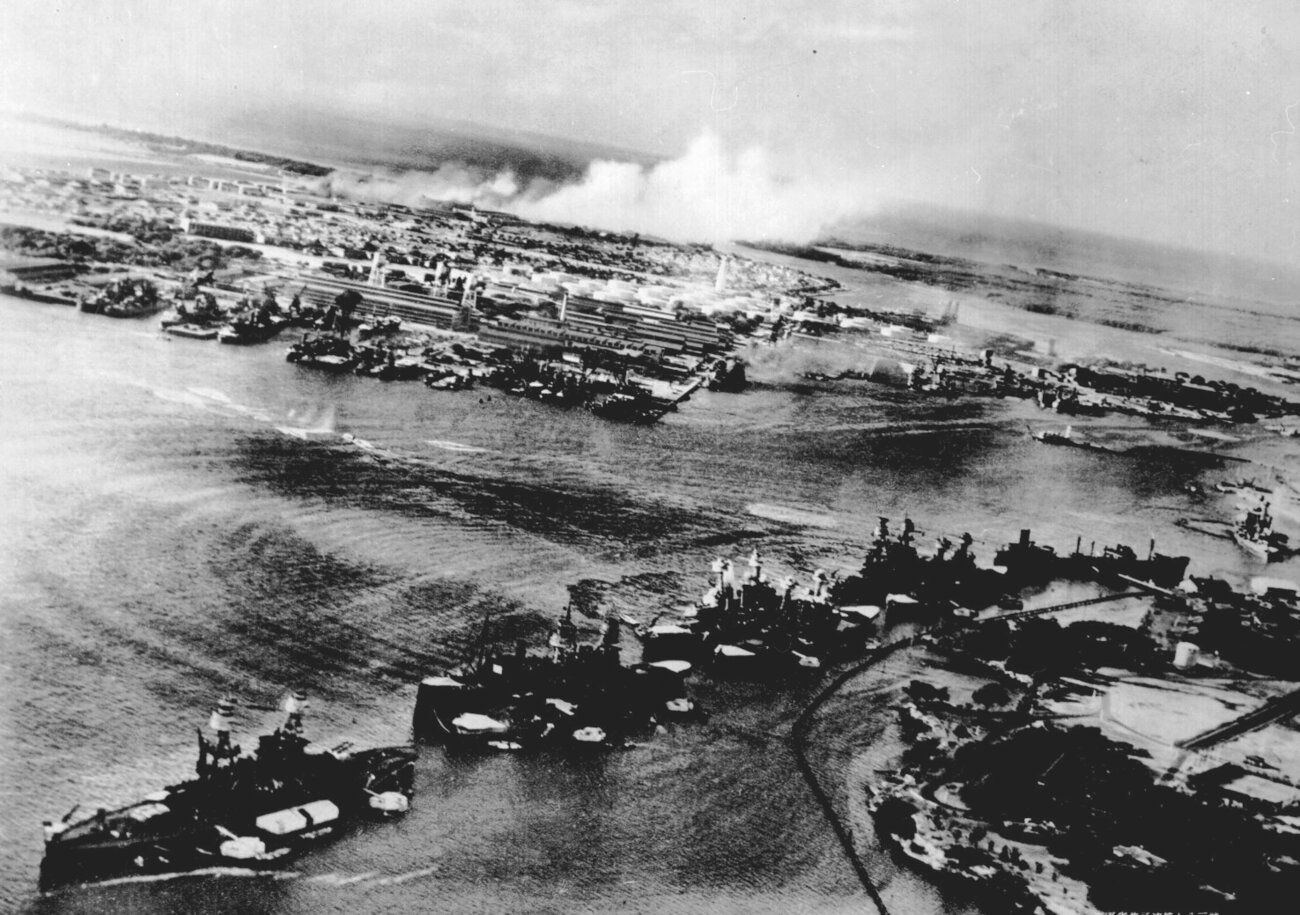
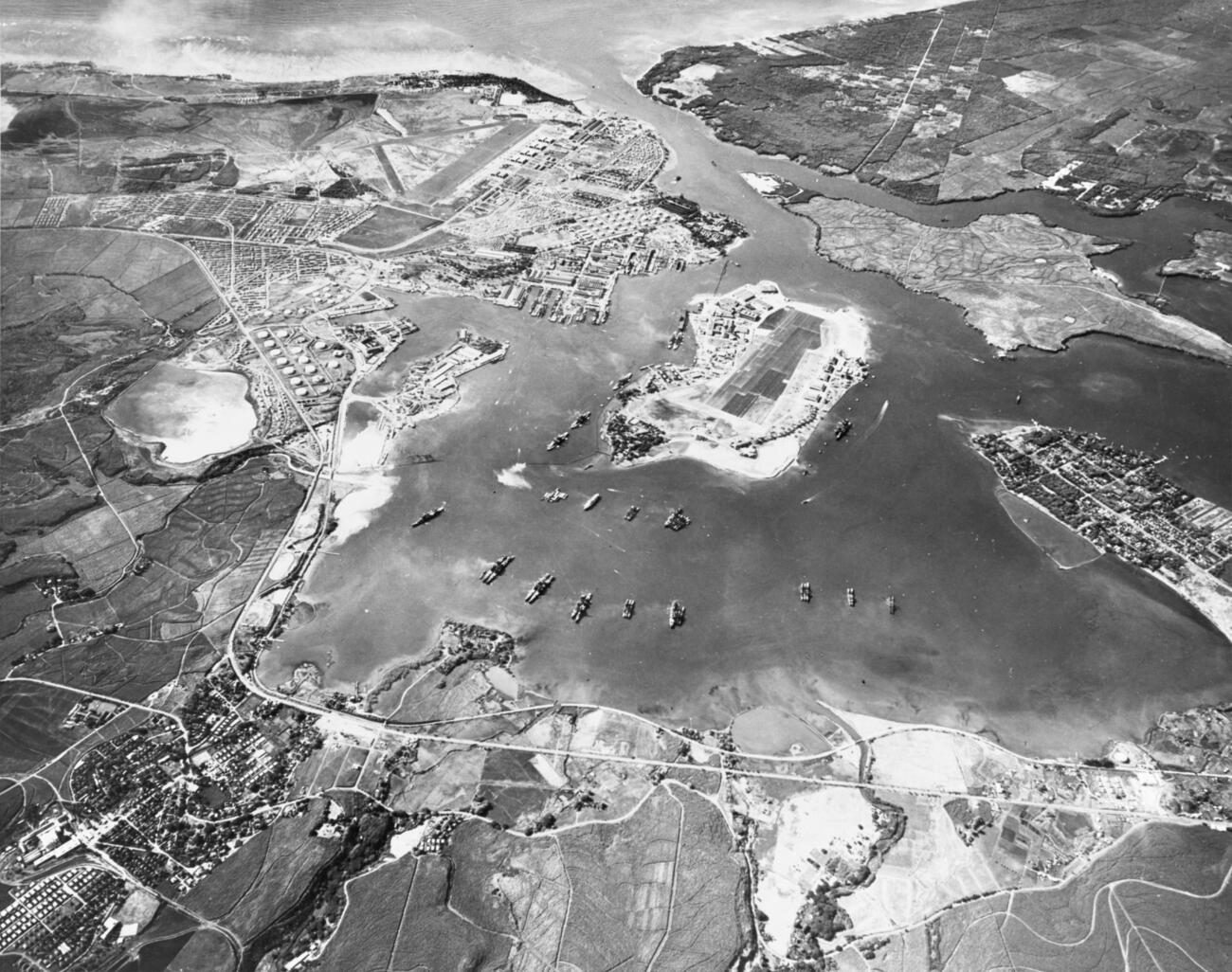
It was also, strategically, a strike that missed the two things that mattered most. No US carriers were in Pearl Harbor that day — they were at sea, delivering aircraft to Midway and Wake — and the shore fuel tank farm holding roughly 4.5 million barrels of fuel oil went almost untouched, along with the repair yards that would have a damaged Pacific Fleet fighting again within months. Historians still argue, seriously, over why Vice Admiral Chūichi Nagumo, commanding the strike force, chose not to launch a third wave against those targets rather than withdraw — a real tactical debate, separate from the intelligence-failure question below.
This gauge shows where historians' debate actually sits — not a simulated probability. It never invents a number; it points at a real argument. Worth being explicit about what this debate is not: it is not a dispute over whether Roosevelt or Washington knowingly let the attack happen. That "advance knowledge" claim is a fringe position, rejected by the mainstream historical record, and it isn't part of what follows.
The real, documented debate is over where the American warning system actually broke down. The Roberts Commission, convened within days of the attack under Supreme Court Justice Owen Roberts, placed blame heavily on the Hawaii commanders, Admiral Husband Kimmel and General Walter Short, for "dereliction of duty" — a verdict later widely seen as scapegoating that let Washington-level failures off comparatively lightly. Gordon W. Prange's At Dawn We Slept (1981), the most exhaustive account of the intelligence breakdown, found warnings at multiple levels that were never integrated or acted on in time: a delayed final-warning telegram that reached Honolulu after the attack had already begun, the Opana radar station's detection of the incoming strike misattributed to expected American B-17s, and a working assumption that Japan lacked the capacity to mount more than one major operation at once and would strike the Philippines first. Later reviews across the following decades kept arguing over where that failure concentrated — Washington's failure to get decrypted intelligence to Hawaii in usable time, Hawaii's failure to interpret and act on what it did receive, or a broader failure of imagination about a carrier strike on the fleet's own home base. It's a real argument about organization and communication, not concealment.
John Garcia's account, recorded decades later, does not read like a battle story. It reads like a long shift of unglamorous, physical work: oil-slicked water, men trapped inside capsized hulls who could be heard tapping from below, days afterward spent helping recover bodies from the harbor. He was not enlisted, not trained for any of it, and stayed anyway, because there was nobody else standing there to do it.
"Yesterday, December 7, 1941 — a date which will live in infamy — the United States of America was suddenly and deliberately attacked by naval and air forces of the Empire of Japan."
The fastest conquest in modern military history
Pearl Harbor was never meant to stand alone. Within hours to days, Japan struck Malaya, Hong Kong, the Philippines, Guam, Wake Island, and Thailand — the actual objective, the oil and rubber of Southeast Asia, moving on its own separate, much larger timetable. What followed over the next six months is, by scale and speed, one of the fastest territorial conquests any modern army has managed.
From a surprise strike on Hawaii to an empire stretching from Burma to the Solomons.
Malaya, Hong Kong, the Philippines
Hours after Pearl Harbor (still December 7 across the International Date Line, December 8 in Asia), Japanese forces land in Malaya and attack Hong Kong. Japanese aircraft strike US airfields in the Philippines the same morning, destroying much of General Douglas MacArthur's air force on the ground.
Hong Kong surrenders
The British colony falls after eighteen days. Japanese landings on Luzon in the Philippines continue; Manila is declared an open city the following day, and MacArthur withdraws his forces to the Bataan Peninsula and the fortress island of Corregidor.
Singapore falls
Britain's supposedly impregnable Asian fortress surrenders to a Japanese attacking force roughly a third the size of its own garrison. Some 80,000 British, Indian, and Australian troops go into captivity — Churchill later called it "the worst disaster and largest capitulation in British history."
Bataan and Corregidor
Bataan's roughly 76,000 US and Filipino defenders surrender April 9, beginning a forced march to prison camps marked by beatings, starvation, and mass death — the Bataan Death March. Corregidor holds out until May 6. MacArthur had already left by PT boat for Australia in March, on Roosevelt's direct order, with a promise: "I shall return."
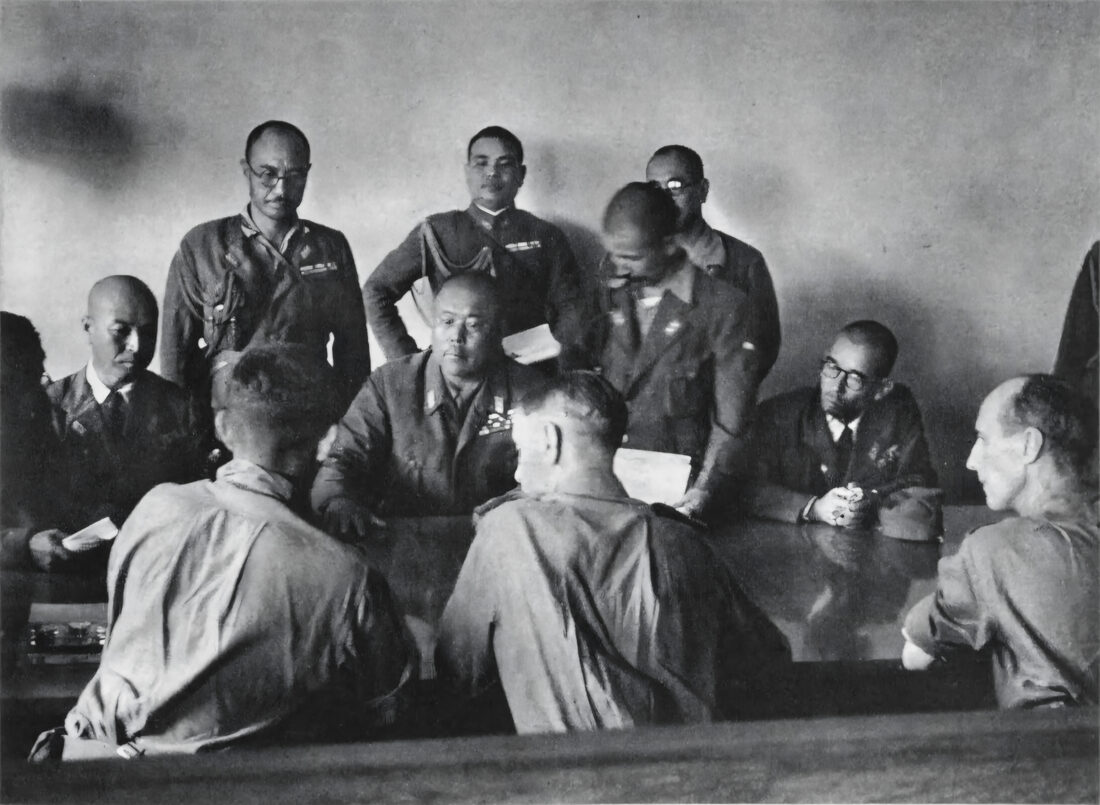
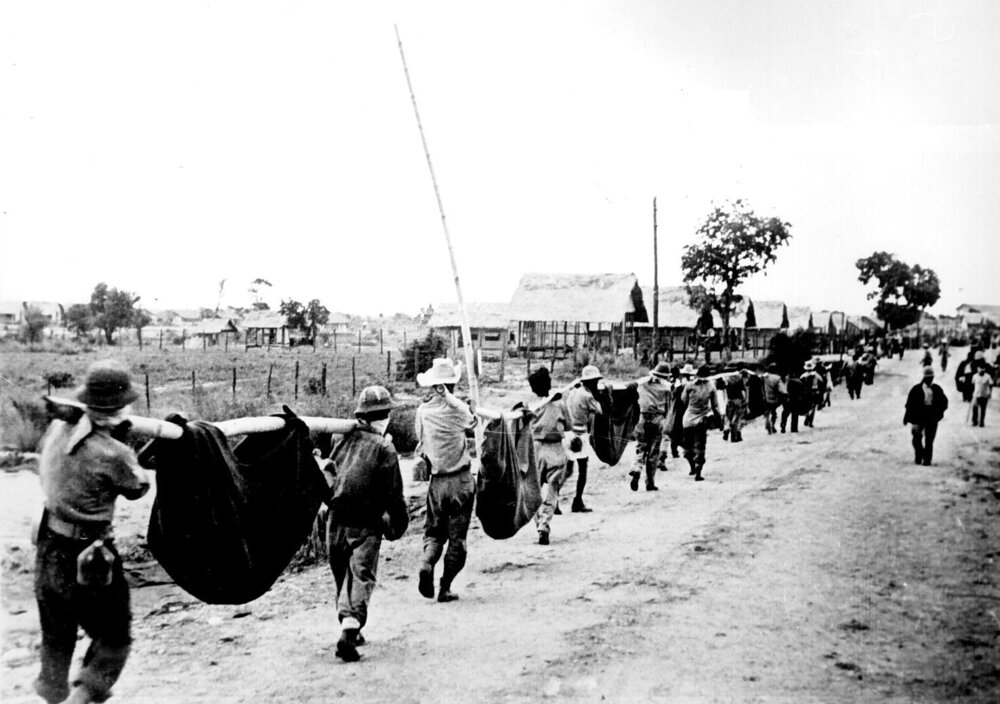
Carlos P. Romulo, a Filipino journalist serving as an aide-de-camp to MacArthur, stayed through the retreat and was among the last officers flown out of Mindanao in April 1942. He published his account within the year, while the war was still being fought, not decades later as memory.
Romulo's real-time reportage describes a collapse experienced from the losing side as it happened, not reconstructed afterward: the exhausting improvisation of a fighting retreat with no reinforcements coming, and the particular disorientation of watching an ally's promise to defend a colony run up against the reality of what that ally could actually deliver in the moment it mattered.
In six months, Japan had conquered an arc of territory from Burma to the Solomon Islands — probably the fastest and largest territorial conquest by any single military force in modern history. It also, in doing so, had used up most of the fuel and shipping the empire could easily replace, against an opponent whose industrial base hadn’t even begun to turn toward war production yet.
Two carrier battles, and the water that gave away Midway
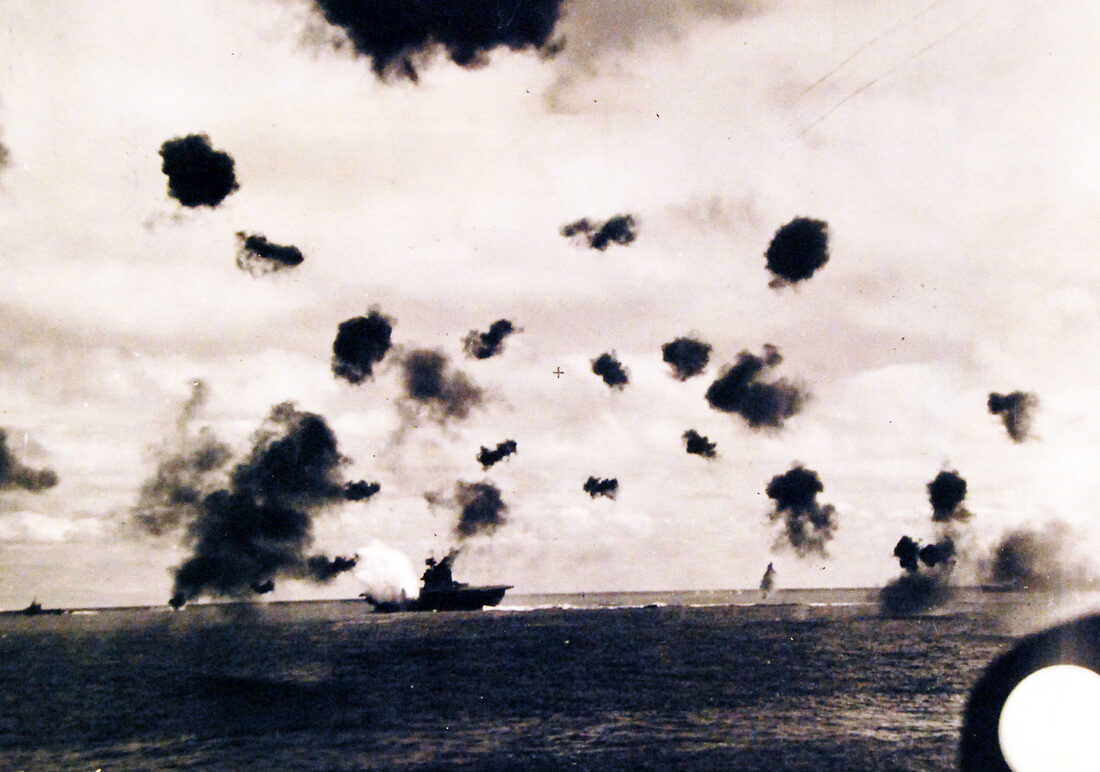
The first check on that expansion came at the Battle of the Coral Sea, May 4–8, 1942 — the first naval battle in history fought entirely by carrier aircraft, with the opposing fleets never once sighting each other directly. The US lost the carrier Lexington; Japan lost the light carrier Shōhō, and damaged the fleet carrier Shōkaku badly enough, and depleted Zuikaku’s air group enough, that neither could join the fight that followed a month later. Tactically it was close to a draw. Strategically, it was the first time a Japanese invasion — of Port Moresby, New Guinea — had to be called off.
That fight a month later, the Battle of Midway, June 4–7, 1942, is conventionally treated as the Pacific war’s turning point, and the reason it worked at all traces back to a small, obsessive codebreaking unit that has become one of the best-documented intelligence stories of the entire war.
Joseph Rochefort
The ambush worked. US carrier aircraft sank all four Japanese fleet carriers committed to the operation — Akagi, Kaga, Sōryū, Hiryū — four of the same six carriers that had launched the strike on Pearl Harbor six months before. (Shōkaku and Zuikaku, the other two, were sitting this battle out — still recovering from Coral Sea.) Fuchida himself, the pilot who had radioed “Tora! Tora! Tora!” that December morning, was aboard Akagi at Midway and was badly wounded, breaking both ankles, in the explosion that doomed her. The US lost USS Yorktown, already damaged at Coral Sea, and the destroyer Hammann. Japan lost roughly 3,057 dead and 248 aircraft against US losses of 307 dead and about 150 aircraft. Six months into a war Japan had started specifically to buy a fast, negotiated peace, its carrier striking power was gutted.
An island called Guadalcanal, and a strategy for the rest of the war
The offensive that followed Midway didn’t come from a grand plan so much as an airstrip. On August 7, 1942, US Marines landed on Guadalcanal, in the Solomon Islands, to deny Japan a nearly finished airfield — Henderson Field — that threatened the supply line between the United States and Australia. It was the first major Allied land offensive of the Pacific war, and it ran six brutal months, through February 1943, combining vicious jungle fighting on land with repeated naval battles fought in the waters nearby, nicknamed “Ironbottom Sound” for what ended up on its floor.
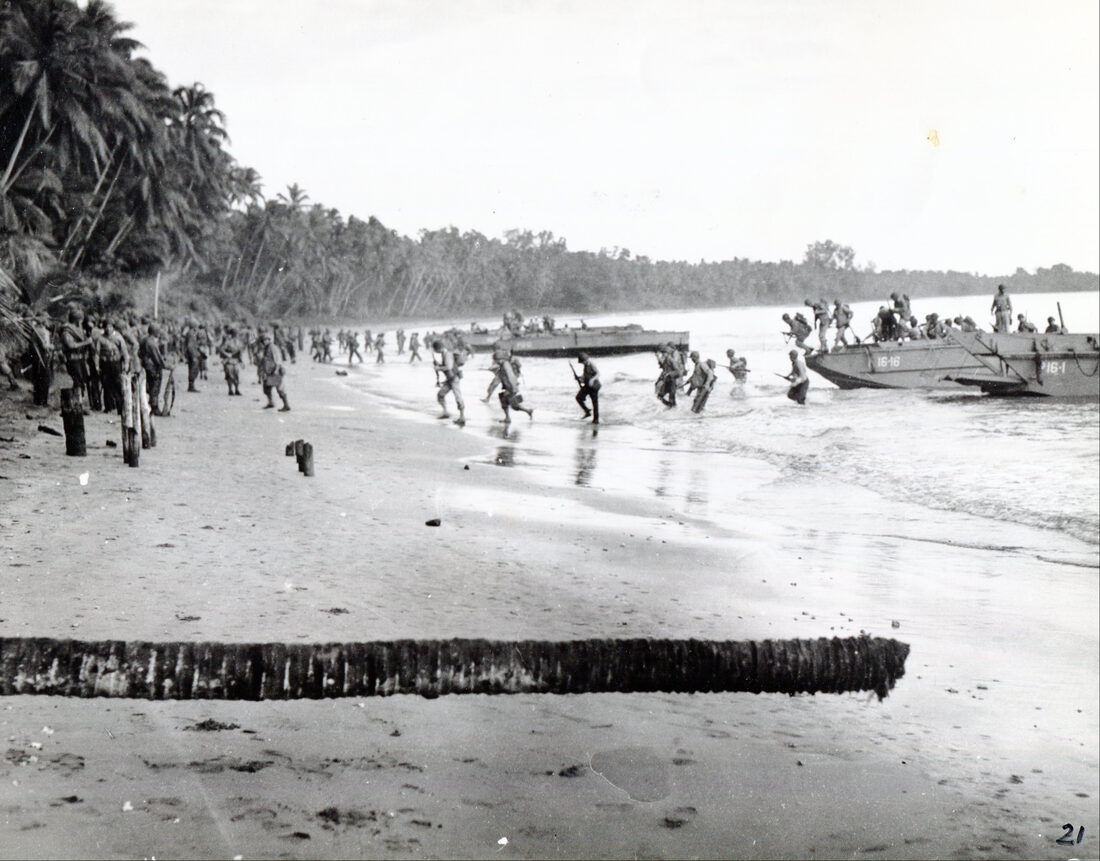
Out of that grinding campaign came the strategy that would carry the rest of the Pacific war: island-hopping. Rather than assault every Japanese-held position in sequence, forces under Admiral Chester Nimitz in the Central Pacific and General MacArthur in the Southwest Pacific began selectively seizing lightly defended islands useful as air and naval bases, while bypassing and isolating the strongest Japanese garrisons instead of attacking them directly. The clearest example is Rabaul, on New Britain — one of Japan’s most heavily fortified bases in the entire theater, and one the Allies never invaded at all. Cut off from resupply and pounded by sustained air attack, it was simply left to wither, its garrison of roughly 100,000 troops sitting out the rest of the war unable to fight anywhere that mattered. The approach traded a slower, cheaper string of victories against weak points for the avoidance of costly frontal assaults — though it would still produce brutally costly direct battles later, at places bypass wasn’t possible. That harder, bloodier stretch of the island war — and the war’s ending — is where Parts 18 and 19 pick this thread back up.
In one sentence: was Pearl Harbor a brilliant tactical strike that solved Japan's problem, or a gamble that bought time against a clock it was never going to beat?
A gamble that bought time, not a solution. It hit the fleet's battleships and missed its carriers and its fuel; it achieved total tactical surprise and changed nothing about the arithmetic of oil, steel, and shipyards that had put Japan on the clock in the first place. Yamamoto himself seems to have known this — his own promise was never victory, just a year or so of running wild before the numbers caught up. They caught up at Midway, six months later, and the rest of this arc is what island-hopping looked like once they did.
Sources
- Gordon W. Prange (with Donald M. Goldstein and Katherine V. Dillon), At Dawn We Slept: The Untold Story of Pearl Harbor (McGraw-Hill, 1981)
- Gordon W. Prange (with Goldstein and Dillon), Miracle at Midway (McGraw-Hill, 1982)
- Mitsuo Fuchida and Masatake Okumiya, Midway: The Battle that Doomed Japan (1955; US Naval Institute Press editions)
- Carlos P. Romulo, I Saw the Fall of the Philippines (Doubleday, Doran & Co., 1942)
- Roberts Commission Report (US Government, January 1942)
- Ian W. Toll, Pacific Crucible: War at Sea in the Pacific, 1941-1942 (W.W. Norton, 2011)
- John Costello, The Pacific War, 1941-1945 (Rawson, Wade, 1981)
- Studs Terkel, The Good War: An Oral History of World War Two (Pantheon, 1984)
- Pearl Harbor National Memorial / National Park Service, “People” and “Stories” survivor accounts (nps.gov/perl)
- Library of Congress Veterans History Project (loc.gov/vets)
- National WWII Museum (New Orleans) Digital Collections and oral history archive