Last time: Operation Barbarossa reached the outskirts of Moscow by early December 1941, after five straight months of shattering every Soviet army in front of it — so what actually stopped it short of the one city that might have ended the war? Not one dramatic reversal but an accumulating one: supply lines that had already outrun a single-track Russian rail gauge and roads that dissolved into mud each autumn, arriving in front of Moscow in October with worn-out tanks, no winter clothing, and a rested Soviet reserve army German intelligence hadn't accounted for. On December 5, 1941, Georgy Zhukov's counteroffensive pushed the German line back 100 to 250 kilometers from the city. Barbarossa's planners had promised a knockout in weeks; six months in, Germany was fighting a war it hadn't built the economy, the clothing, or the fuel reserves to sustain.
In September 1942, a forty-six-year-old war correspondent named Vasily Grossman crossed the Volga River into a city that was already mostly rubble. He wrote for Krasnaya Zvezda — Red Star, the Red Army’s own newspaper — and kept notebooks alongside his published dispatches, notebooks his editors would not fully publish for another sixty years. He wasn’t writing from a headquarters miles behind the line. He went into the wrecked factory districts with the infantry, stayed for weeks at a stretch, and wrote down what he saw close to when he saw it — not reconstructed afterward, not softened for the reader back home. What his notebooks describe is a city that had stopped looking like a city: a front line that sometimes ran through the floors of a single building, one side holding the stairwell and the other the room at the top of it. Grossman would stay through the worst of what came next. This part is about how that worst happened, and how it ended.
Stalingrad didn’t start as Hitler’s main objective for 1942. It became one by accident of ambition. After Barbarossa failed to take Moscow, Hitler’s summer offensive that year — Case Blue, launched June 28, 1942 — aimed at something narrower: the oil fields of the Caucasus, at Maikop, Grozny, and Baku, and the Volga River itself, the Soviet Union’s main north-south supply artery. Taking the Volga would cut the country roughly in half and choke off the Lend-Lease shipments coming up through Iran. On July 23, Hitler split the advancing force into two army groups — Army Group A for the Caucasus, Army Group B for the Volga — a division of an already stretched army across two diverging axes. That same order upgraded a city meant only to anchor Army Group B’s flank into a target to be taken outright, largely because it carried Stalin’s name. By late August, the German 6th Army, under General Friedrich Paulus, had reached Stalingrad’s outskirts.
What followed on August 23 was not the ground battle — it was the Luftwaffe. A single day’s firebombing killed an estimated 40,000 to 70,000 civilians and turned much of the city to rubble before the infantry fighting had even really begun. That’s worth sitting with rather than moving past quickly: most of Stalingrad’s dead in this battle were never soldiers on either side.
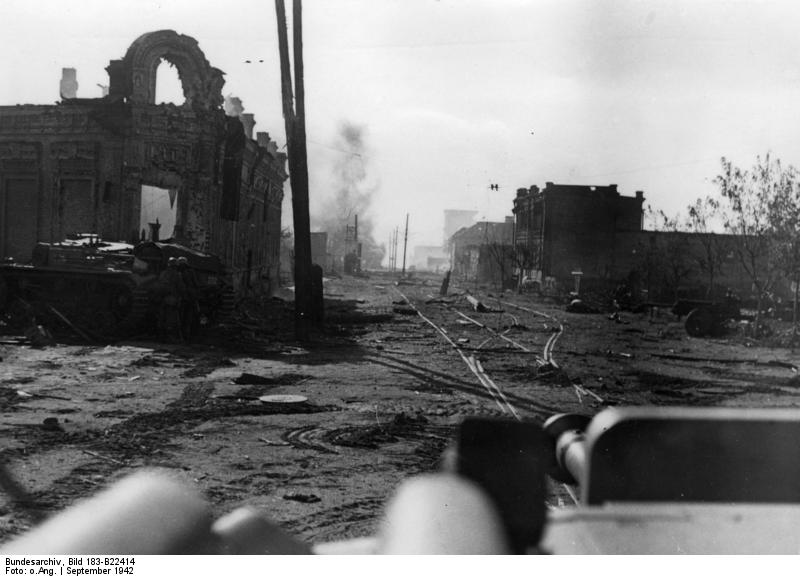
That rubble is what General Vasily Chuikov’s 62nd Army then turned into a weapon of its own. Chuikov took command inside the city on September 12, with orders that amounted to: hold the west bank of the Volga, because there is nowhere left to retreat to.
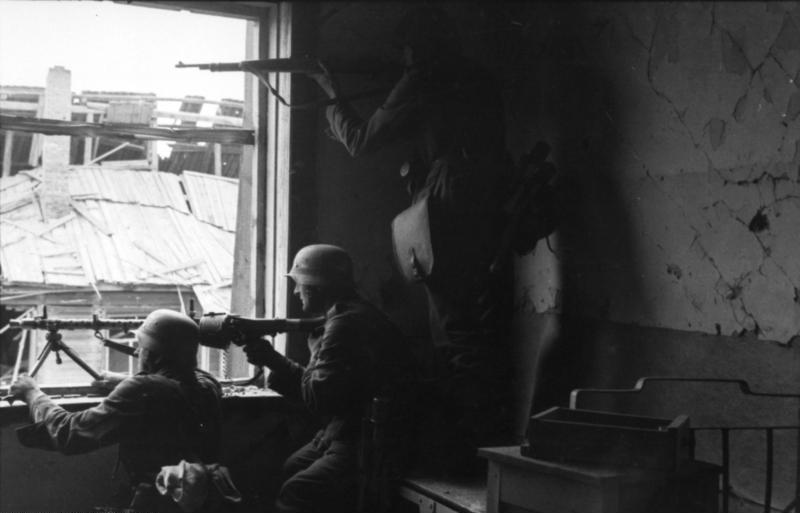
Two pieces of ground from this phase are still named today. Mamayev Kurgan, a hill overlooking the city, changed hands so many times that it’s counted among the most fought-over single positions of the entire war. And a four-story apartment block near the central square was held for roughly 58 days by a small garrison under Sergeant Yakov Pavlov — “Pavlov’s House,” a name that stuck because Pavlov himself did, decorated after the war as a Hero of the Soviet Union. A claim sometimes attached to that siege — that it cost the Germans more casualties than some sectors of their 1940 advance on Paris — is the kind of comparison that’s easy to repeat and hard to actually verify; treat it as battlefield folklore riding alongside a real, well-documented action, not as a sourced fact in its own right.
Grossman's wartime notebooks from inside the city don't read like retrospective memory — they're dated, contemporaneous field notes, written in the fighting rather than reconstructed after it. Editors Antony Beevor and Luba Vinogradova, working from the notebooks decades later, describe entries recording the physical detail of the battle as it happened around him: what a shelled street actually looked like, what soldiers said between attacks, the mechanics of survival in a city with no safe rear area left. That closeness — written down at the time, not shaped into a story afterward — is what makes his notebooks a different kind of source than his own later, censored 1952 novel about the same battle.
The ground fighting alone was never going to end Stalingrad. What ended it was a plan aimed at the weaker armies on either side of the German 6th Army, not at the 6th Army itself. Romanian and Italian troops held the flanks north and south of the city — under-equipped allies given a front too long for their numbers. On November 19–23, 1942, Soviet forces coordinated by Georgy Zhukov and Aleksandr Vasilevsky struck those flanks in Operation Uranus. The pincers met at the town of Kalach on the Don on November 23, sealing somewhere between 250,000 and 330,000 Axis personnel inside a pocket around Stalingrad. The 6th Army that had spent three months grinding through Chuikov’s rubble was now, itself, surrounded.
You are Friedrich Paulus, commanding the German 6th Army. Word has just reached your headquarters: the Soviet pincers have closed at Kalach. Your army is encircled. The ring around you is still thin — freshly dug in, not yet reinforced in depth. Some of your own subordinate generals are arguing for an immediate breakout, before the Soviets can consolidate. Berlin has not yet issued a formal order either way. What do you do?
Paulus was a career staff officer, not a commander with a record of acting outside his orders, and he waited for Berlin. On November 24, Hitler designated Stalingrad a "fortress" to be held at all costs, overriding generals — including Manstein's own staff — who wanted a breakout attempt. Hermann Göring personally promised Hitler the Luftwaffe could keep the 6th Army supplied by air. It couldn't: estimates of the army's daily requirement vary by source, from a bare-survival minimum of a few hundred tons up to the 500-750 tons quartermasters said was needed to keep it fighting, and against any of those figures the Luftwaffe's actual average — closer to 100 tons a day — fell drastically short, flown through a Soviet-controlled sky and a Russian winter. Paulus's decision not to act on his own judgment wasn't cowardice — it was the exact discipline his whole career had trained into him. In this case, that discipline doomed the men under his command.
A relief attempt did come. Erich von Manstein’s Operation Wintergewitter (“Winter Storm”) pushed to within about 48 kilometers of the pocket in mid-December before German forces elsewhere on the front collapsed and it had to be called off. Hitler never authorized the breakout that might have let the 6th Army fight its way out to meet it. The Soviet Operation Koltso (“Ring”) destroyed the pocket in stages starting January 10, 1943. On January 30 — the tenth anniversary of Hitler’s own appointment as Chancellor — Hitler promoted Paulus to Generalfeldmarschall, a rank from which no German field marshal had ever surrendered. The implication was plain: die fighting, or by his own hand, rather than capitulate. Paulus surrendered anyway, on February 2, 1943, with roughly 91,000 remaining troops. Around 235,000 Axis personnel were taken prisoner across the battle’s final phase. Fewer than 6,000 of the 6th Army’s prisoners are generally recorded as having survived Soviet captivity to see Germany again, most not released until 1955.
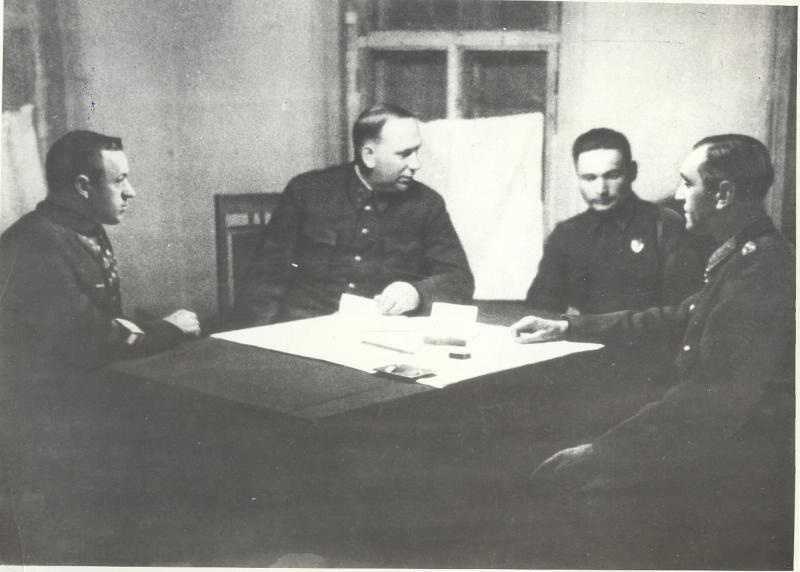
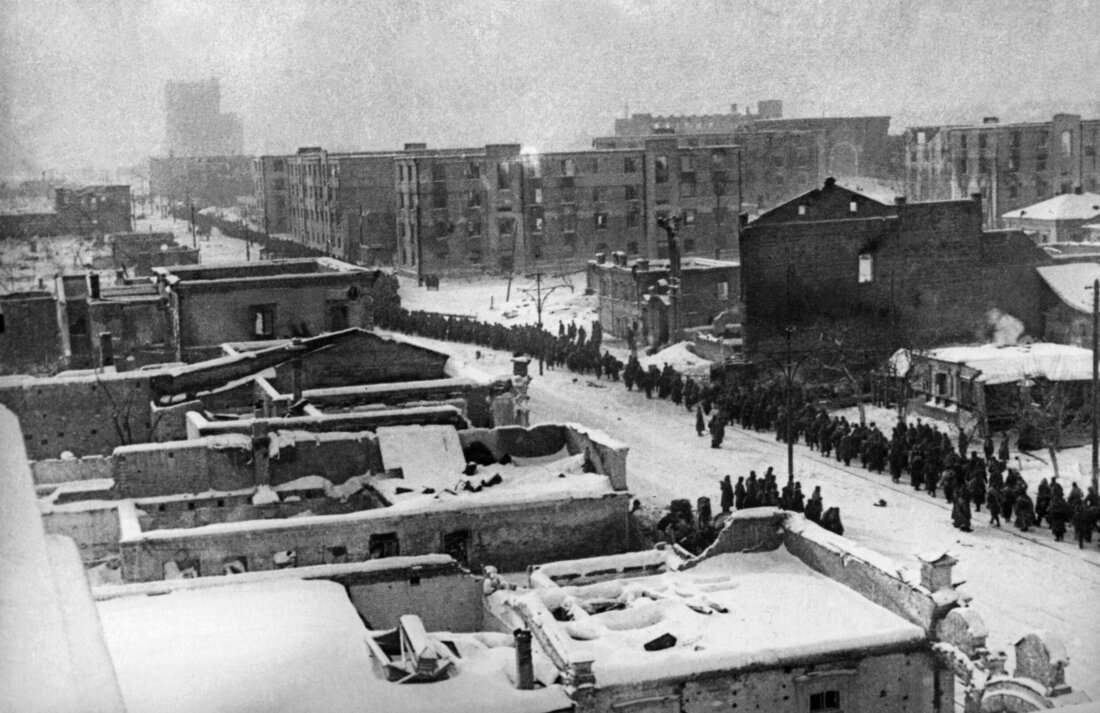
None of that would have worked without a deception that German intelligence never saw coming — and a second operation Moscow itself kept hidden for decades.
Stalingrad broke the myth of German invincibility. It did not, by itself, take away Germany’s ability to attack. That took one more battle, seven months later.
After a Soviet overreach in the immediate aftermath of Stalingrad, Manstein’s counterstroke recaptured Kharkov in March 1943, stabilizing the front and leaving a Soviet-held bulge — the Kursk salient — jutting roughly 150 kilometers into German lines. Both sides spent the following four months building for what everyone knew was coming: a German pincer attack, Operation Citadel, meant to cut the salient off. Originally planned for early May, Citadel was delayed repeatedly so Germany could field more of its new Panther and Tiger tanks — a wait that gave the Red Army months to turn the salient into the most heavily fortified position built in the war so far, roughly eight belts of defenses and 300 kilometers of cumulative depth. General Heinz Guderian questioned the operation directly to Hitler that May. Hitler’s own recorded reply, in Guderian’s postwar memoir: “Whenever I think of this attack, my stomach turns over.”
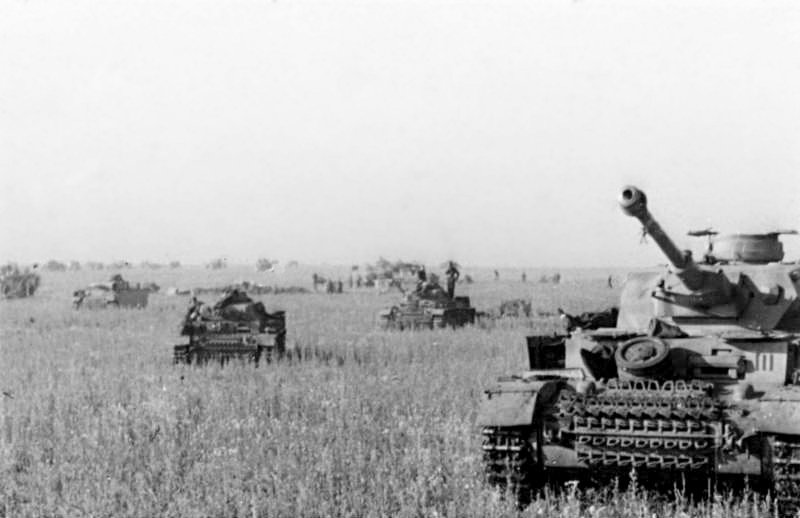
Citadel opened July 5, 1943: Walter Model’s 9th Army attacking the salient’s northern face, Hermann Hoth’s 4th Panzer Army and Army Detachment Kempf attacking the south under Manstein. Soviet defense in depth blunted both pincers within days — the northern attack stalled almost immediately. On July 12, the southern battle produced a tank engagement near the village of Prokhorovka, long mythologized in Soviet-era accounts as the largest tank battle in history — a claim modern archival research has substantially revised downward, though it remains one of the largest armored engagements ever fought. That same day the Soviets opened Operation Kutuzov against the German-held Orel salient; on August 3, Operation Rumyantsev against Belgorod-Kharkov — both launched while Citadel was still technically underway, turning a German attack into a Soviet one within weeks. Hitler formally called off Citadel on July 13, two days after the Allied landing in Sicily began pulling German attention toward Italy — though most historians treat Sicily as a contributing factor, not the main one, since the attack had already stalled on its own merits. Kharkov changed hands a fourth and final time on August 23, 1943. From that point, the German army in the East never again launched a major strategic offensive. Everything that followed, for the rest of the war, was Soviet-initiated, or German defense and retreat.
"In the battle of Prokhorovka our corps, in the beginning, was in the second echelon supporting the engagement of other corps and only then did we move forward. The distance between tanks was no more than one hundred meters, the only thing they could do was fidgeting, no maneuvering. It was not war, but tank slaughter. They crawled and fired. Everything was on fire. An inexpressible stench was in the air of the battlefield. Everything was so covered with smoke, dust and fire that it seemed that twilight had fallen."
This gauge shows where historians' debate actually sits — not a simulated probability. It never invents a number; it points at a real argument.
This is a genuine, long-running, three-cornered argument over which single point actually "decided" the war in the East — not a dispute about whether any of these battles mattered. Antony Beevor's Stalingrad (1998) and Geoffrey Roberts's Victory at Stalingrad (2002) make the most widely read case for the city on the Volga: the point an entire German field army was destroyed and the myth of Wehrmacht invincibility broke, in German public opinion and in occupied Europe's reading of the war. Rodric Braithwaite's Moscow 1941 (2006) argues the real hinge predates both by a full year — the Wehrmacht's failure outside Moscow in December 1941 is where the premise of a fast knockout war died, and everything after is confirmation, not decision. David Glantz, across The Battle of Kursk (1999) and his Stalingrad trilogy, makes the operational case for Kursk specifically: Stalingrad alone didn't prove Germany had lost the strategic initiative, since Citadel itself, seven months later, is proof the Wehrmacht could still choose to attack. It's Citadel's failure, not the earlier loss of one army, that's followed by an unbroken run of Soviet-initiated operations for the rest of the war — this part's own framing leans toward that reading. A fourth, dissenting voice complicates all three: German historian Karl-Heinz Frieser, in the German Federal Armed Forces' own official history, argues the strategic outcome was arguably already settled by the winter of 1942–43, and that Citadel was a battle Germany didn't need to fight and had little real hope of winning even before Prokhorovka — making its "decisiveness" as a single clean moment less certain than the Glantz reading suggests.
Grossman stayed in Stalingrad through the worst of it and kept writing. Paulus, who spent his career doing exactly what he was told, did the one thing his own training hadn’t prepared him for and surrendered anyway. A Soviet deception plan German intelligence never caught kept a second suppressed for fifty years by the same government that ran it. None of that is a story about inevitability. It’s a story about an army that had the initiative in the East, threw it at a city, lost it there, clawed enough of it back seven months later to attack one more time — and then didn’t get to choose what happened next, for the rest of the war.
In one sentence: if three real historians can each make a serious case for a different single "turning point" in the same war, what does that tell you about what a turning point actually is?
That a turning point usually isn't one moment, no matter how cleanly a subtitle wants to describe it — it's a process spread across a year and a half, where each stage (Moscow's failure, Stalingrad's destruction, Kursk's loss) closes off options the ones before it hadn't fully closed. Historians disagree about which stage did the most closing, not about whether the direction of the war changed. By late August 1943, whichever moment you'd pick as "the" turning point, the outcome downstream of all three was the same: Germany never attacked in the East again.
Sources
- Antony Beevor, Stalingrad (Viking, 1998)
- Antony Beevor and Luba Vinogradova (eds./trans.), A Writer at War: Vasily Grossman with the Red Army, 1941-1945 (Pantheon, 2005)
- Geoffrey Roberts, Victory at Stalingrad: The Battle That Changed History (Longman, 2002)
- Rodric Braithwaite, Moscow 1941: A City and Its People at War (Profile Books, 2006)
- David M. Glantz and Jonathan House, The Battle of Kursk (University Press of Kansas, 1999)
- David M. Glantz and Jonathan House, To the Gates of Stalingrad (2009); Armageddon in Stalingrad (2009); Endgame at Stalingrad (2 vols., 2014) — the Stalingrad Trilogy
- David M. Glantz, Zhukov’s Greatest Defeat: The Red Army’s Epic Disaster in Operation Mars, 1942 (University Press of Kansas, 1999)
- Karl-Heinz Frieser et al., Germany and the Second World War, Volume VIII: The Eastern Front 1943-1944 (Militärgeschichtliches Forschungsamt; Oxford University Press English translation)
- Vasily Chuikov, The Battle for Stalingrad (Holt, Rinehart and Winston, 1964)
- Heinz Guderian, Panzer Leader (Michael Joseph, 1952)
- iremember.ru (“I Remember”), Artem Drabkin’s Soviet veteran oral history archive — testimony of Vasily Bryukhov
- Wikimedia Commons, Category:Battle of Stalingrad and Category:Battle of Kursk (Bundesarchiv-sourced material, CC BY-SA 3.0 DE); Russian State Archive of Film and Photo Documents (RGAKFD), via Commons