Last time: by May 1943, Britain had held the Atlantic supply line against the U-boat wolf packs — but what actually flipped a battle that had been going badly for years into a battle the Allies clearly won? A combination that arrived all at once in spring 1943: more escort ships and long-range aircraft finally closing the ocean's mid-Atlantic "air gap," better radar, and — kept secret for another thirty years — codebreaking that let convoys dodge the wolf packs waiting for them. In May 1943 alone the Allies lost fewer than 40 ships while 43 U-boats went down. Admiral Karl Dönitz pulled his boats out of the North Atlantic on May 24 and privately admitted, "We had lost the Battle of the Atlantic."
On the afternoon of June 21, 1942, Winston Churchill was sitting in Franklin Roosevelt’s study at the White House when an aide handed the President a telephone message slip. Roosevelt read it and passed it across without a word: Tobruk, the fortress port in Libya British and Commonwealth troops had held for months, had surrendered — roughly 32,000 men taken prisoner in a single day. Churchill later wrote that he didn’t try to hide what he felt: “I did not attempt to hide from the President the shock I had received. It was a bitter moment. Defeat is one thing; disgrace is another.” Roosevelt’s answer was immediate and practical: within days, 300 American Sherman tanks were on ships bound for Egypt, pulled straight from US Army units still training with them.
A strange place to find the desert war — thousands of miles from Washington, over sand most Americans couldn’t have pointed to on a map. But it shows how far this theater’s consequences traveled. To see how a fortress in Libya reached the White House, rewind two years and reset how you’re picturing the calendar.
Mussolini declared war on Britain and France on June 10, 1940 — the same week France was collapsing, a move widely read at the time, including by Churchill, as pure opportunism: joining a war at the last possible moment to grab territory from a fight Italy hadn’t actually helped win. The next day, Commonwealth forces in Egypt raided across the border into Italian Libya: the desert war opens during the exact weeks Part 9 covers the Battle of Britain, then runs straight through the Atlantic convoy war Part 10 covered — Malta’s own supply runs are convoy warfare, the same mechanism, fought in a smaller sea. Its opening act — Greece, Crete, Rommel’s first offensives — lands in the ten weeks immediately before Germany invades the Soviet Union on June 22, 1941. Hitler’s original target date was May 15; it slipped five weeks, and historians still argue how much the Balkan campaign caused that against a simply late, wet spring further east — a real, unsettled question.
Mussolini’s war, and Britain’s answer to it
Mussolini’s ambitions in Africa were his own — undertaken without clearing them with Hitler. On September 13, 1940, Marshal Rodolfo Graziani’s Italian Tenth Army, roughly a quarter-million men on paper, advanced from Libya into Egypt, got about sixty miles, and stopped at Sidi Barrani to dig in. Six weeks later, on October 28, Mussolini tried again in Greece, invading from Italian-held Albania without telling Germany. Greek Prime Minister Ioannis Metaxas’s actual reply to the Italian ambassador was a curt sentence in French, “Alors, c’est la guerre” (“Then it is war”) — but Greek memory compressed it into a single defiant word, “Ohi,” Greek for “no,” and that version is still marked every October 28 as a national holiday. It held up, too: Greek troops stopped the invasion in the mountains, then pushed it back into Albania by January.
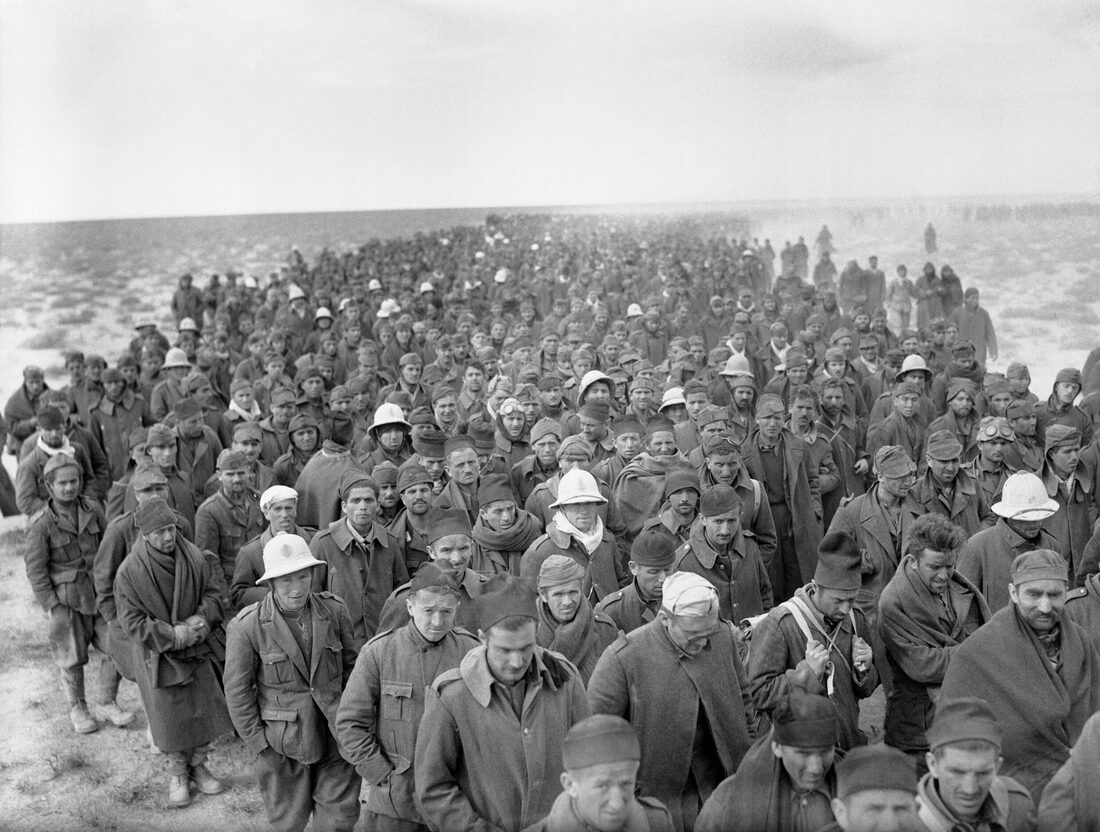
Britain’s answer to the stalled invasion of Egypt was devastating. Operation Compass, launched December 9, 1940 under Lieutenant-General Richard O’Connor, sent about 36,000 British and Commonwealth troops against an Italian army several times its size — and destroyed it. At the campaign’s climax, the Battle of Beda Fomm in early February 1941, British forces cut off the retreating Italian column on the coast road and finished it there. Compass took roughly 133,000 Italian prisoners for around 500 British dead — one of the most lopsided victories of the war, and the reason Hitler decided he could no longer leave North Africa to his ally alone.
Rommel arrives, and the seesaw begins
The man Hitler sent was Erwin Rommel, a general with no desert experience, given a newly formed Afrika Korps that began landing at Tripoli on February 12, 1941. In letters home to his wife Lucie — later published as The Rommel Papers — Rommel described taking command of a force still unloading, and deciding at once not to wait for it to be ready. Against his own orders from Berlin, which called for a defensive posture while the corps built up, Rommel attacked immediately. It worked: by April the overextended British had been pushed back to the Egyptian frontier, and the port fortress of Tobruk, bypassed rather than taken, was left under siege behind German lines.
That siege held from April 10 to November 27, 1941, defended chiefly by the 9th Australian Division under Lieutenant-General Leslie Morshead. German propaganda mocked the trapped garrison as “rats in a trap”; the defenders adopted the insult as their own name, the Rats of Tobruk, and wore it as a badge of pride. Operation Crusader, launched November 18, 1941, relieved them and pushed the Axis back to El Agheila by January.
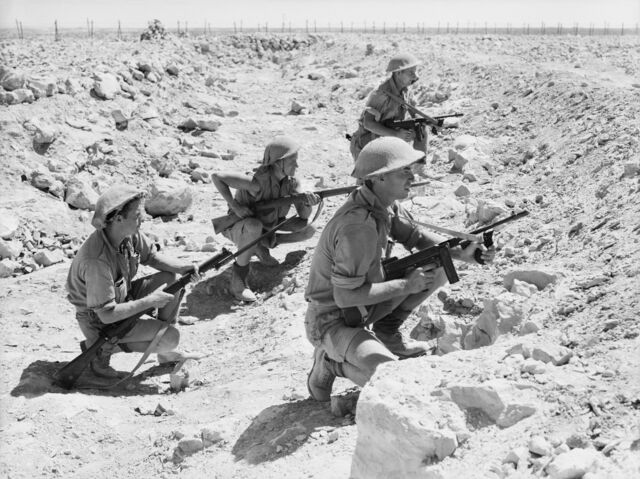
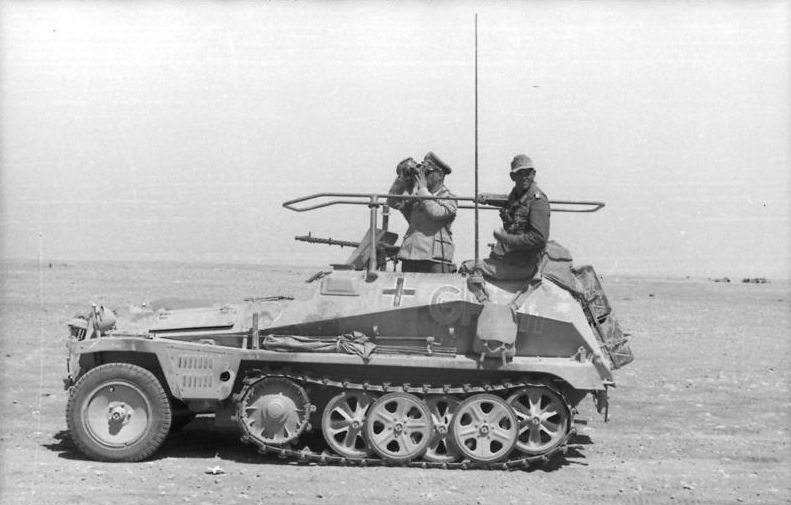
That’s the pattern the desert war ran on for two years: an attacking army outruns its own fuel line, stalls, and gets pushed back by whichever side has just been resupplied, over the same few hundred miles of coast road. It’s less about generals being brilliant or careless than about how far a tank can drive before it needs more fuel than one desert road can deliver.
Greece, Crete, and a decision made under real pressure
While Rommel was landing in Libya, Germany was pulled into the Balkans to rescue Mussolini’s failed invasion of Greece. Operation Marita, launched April 6, 1941, overran Greece in under three weeks; Greek forces surrendered April 20-23, and roughly 57,000 British and Commonwealth troops evacuated, many redirected to Crete rather than home. What followed there, May 20 to June 1, 1941, was the first invasion in history to depend on airborne troops — more than 20,000 German paratroopers under General Kurt Student, dropped onto an island defended by Major-General Bernard Freyberg.
You are Bernard Freyberg, commanding the defense of Crete. British codebreakers have handed you a real warning: German intelligence traffic shows an airborne attack could begin any time after May 17. You know roughly what's coming. You do not know exactly where the Germans will concentrate their drop. Your forces are limited, and you have to decide where to put your strongest defenses before the attack lands.
Freyberg weighted his defense toward the coast, expecting a seaborne landing alongside the airborne one. A small seaborne convoy was in fact intercepted and destroyed by the Royal Navy before it landed. The airfields, especially Maleme, were the real German objective, and were held only with difficulty before falling — once the Germans controlled one, they could fly in reinforcements by the thousand, and the battle turned. Crete fell after twelve days. Freyberg had genuine advance warning most commanders never get, and it still wasn't enough: knowing an attack is coming isn't the same as knowing where to stand.
German losses at Crete — roughly 6,000 total casualties, of which around 2,000 were killed, plus 284 aircraft destroyed or written off — were severe enough that Hitler judged the cost of airborne assault had outrun its value. He never authorized an operation on that scale again.
The pendulum swings, and swings back
Rommel struck again in spring 1942. At the Battle of Gazala in May and June, he outmaneuvered Eighth Army badly enough that Tobruk — held for eight months the year before — fell in a single day, June 21, 1942: the 32,000 prisoners that reached Churchill’s hand in Washington. The Axis advance stopped about ninety miles from Alexandria, the closest it would ever get to the Nile. General Claude Auchinleck took personal command of Eighth Army and halted it at the last defensible line before the delta, in the First Battle of El Alamein that July.
That August, one of the war’s more desperate supply runs played out at sea. Operation Pedestal was a convoy sent to keep besieged Malta from starving and running out of the aviation fuel its own aircraft and submarines needed to keep attacking Rommel’s supply ships. The tanker SS Ohio, crippled by torpedo and bomb damage, had to be lashed between two destroyers just to stay afloat; it limped into Grand Harbour on August 15 to crowds cheering from the bastions above.
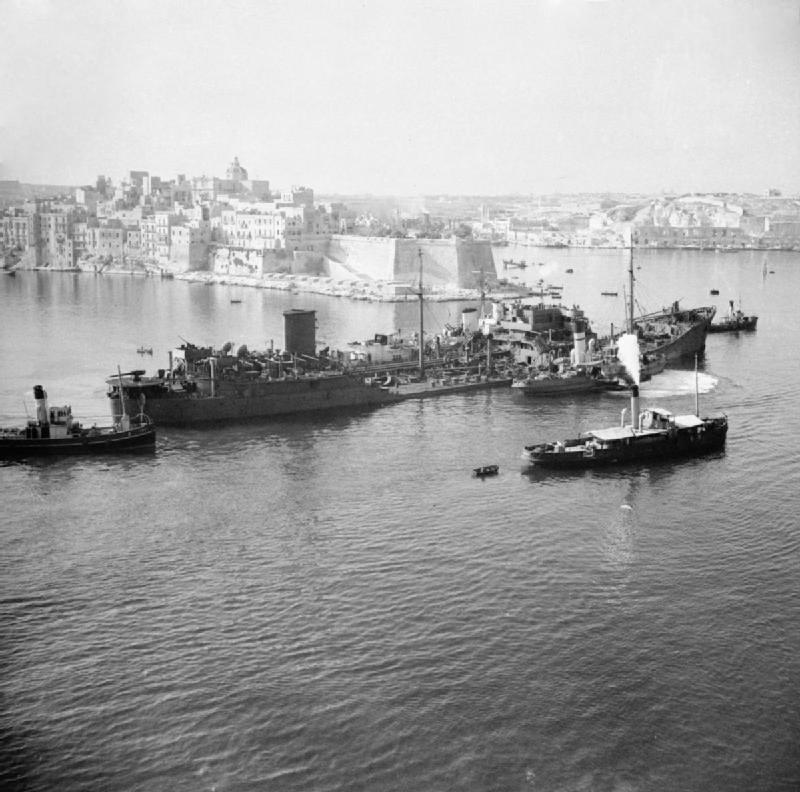
What almost nobody in that scene understood was why Malta’s aircraft and submarines kept finding Rommel’s convoys in the first place.
That same intelligence gave Freyberg his warning before Crete — worth remembering here for what it proved: knowing what’s coming and knowing how to use it are two different skills. Every wartime explanation for “why Rommel kept running out of fuel,” from journalists to the German high command itself, was written by people who didn’t know the real answer.
By late October 1942, command of Eighth Army had passed to Bernard Montgomery, and the desert war reached its hinge point. The Second Battle of El Alamein, fought October 23 to November 11, 1942, was a set-piece victory decisive enough that Churchill later summed it up in a sentence that has outlived almost everything else written about the campaign: “It may almost be said, Before Alamein we never had a victory. After Alamein we never had a defeat.”
Keith Douglas, a tank commander with the Sherwood Rangers Yeomanry, wrote his Alamein memoir with a wry, unsentimental eye he brought to everything, illustrated with his own drawings — describing his fellow officers less as hardened soldiers than as ordinary civilians thrown into uniform, dryly critical of the whole enterprise even as they fought it.
Paolo Caccia Dominioni commanded an Italian sapper battalion through Alam Halfa and Second Alamein, then spent decades afterward personally recovering and identifying Italian, German, and British dead from the battlefield, and building the Italian memorial that still stands there. Worth being honest here: recorded oral testimony from Italian desert veterans is thinner in accessible archives than the British and Commonwealth record — Caccia Dominioni's written memoir is the strongest widely available first-person Italian source.
Hans von Luck commanded the 3rd Panzer Reconnaissance Battalion of the 21st Panzer Division under Rommel and screened the German withdrawal from Second Alamein. Same honesty applies on the German side: centralized, English-accessible recorded testimony from Afrika Korps veterans specifically is less consolidated than the British archives; von Luck's memoir is a genuine written source, not a substitute for that gap.
Two more fronts, and an ending
Two weeks after Alamein, the campaign widened again. Operation Torch, launched November 8-16, 1942, put Anglo-American forces ashore at Casablanca, Oran, and Algiers under General Dwight Eisenhower — a second front against Vichy French North Africa, squeezing the Axis from the west while Eighth Army pushed from the east. The untested US Army got its first hard lesson that February, when green troops of II Corps were badly mauled by Rommel at Sidi Bou Zid and Kasserine Pass — a real cost paid before the American army faced the German one again at a far higher stake.
It ended May 13, 1943: every Axis soldier still in Tunisia, over 275,000 of them, surrendered — a number roughly matching Stalingrad, which had fallen three months earlier on the other side of the continent. The war in Africa was over. The Mediterranean was open for the invasion of Sicily.
This gauge shows where historians' debate actually sits — not a simulated probability. It never invents a number; it points at a real argument.
A genuine, long-running historians' argument, and not really a "did it matter" question — both camps agree the desert war happened and had real consequences. It's a debate about relative weight. The case for a secondary theater rests on scale: David Glantz and Jonathan House, in When Titans Clashed (1995), point to well over a hundred German divisions on the Eastern Front against a peak of roughly four in North Africa. Stalin pressed this same point on Churchill and Roosevelt for years, insisting Mediterranean operations were no substitute for a real second front in France. The case for real significance comes from Rick Atkinson's Pulitzer-winning An Army at Dawn (2002), arguing Tunisia was where the untested American army learned to fight the German one before Normandy raised the stakes; Niall Barr's Pendulum of War (2004) and Correlli Barnett's The Desert Generals (1960) treat Alamein as consequential in its own right — and there's a concrete case beyond reputation, too: the shorter Mediterranean shipping route, Italy's lost African empire, and a strain on the same Ju-52 transport fleet the Luftwaffe needed for the Stalingrad airlift that same winter. Both camps are right about their own numbers — they're answering slightly different questions.
In one sentence: was the desert war a sideshow that happened to produce some good stories, or a real front that just ran on a different clock than the ones this series has told so far?
A real front, running on its own clock. Scale alone makes almost any theater look small next to the Eastern Front — true, and slightly beside the point, since North Africa wasn't competing with that front for the same divisions or the same outcome. It cost Italy its African empire, taught the American army to fight the German one before Normandy raised the stakes, and ran an intelligence war that quietly decided how much fuel Rommel's tanks actually had. None of that shows up if you only count divisions.
Sources
- Rick Atkinson, An Army at Dawn: The War in North Africa, 1942-1943 (Henry Holt, 2002)
- Niall Barr, Pendulum of War: The Three Battles of El Alamein (Jonathan Cape, 2004)
- Correlli Barnett, The Desert Generals (William Kimber, 1960)
- David Glantz and Jonathan House, When Titans Clashed: How the Red Army Stopped Hitler (University Press of Kansas, 1995)
- Erwin Rommel, The Rommel Papers, ed. B. H. Liddell Hart (Collins, 1953)
- Keith Douglas, Alamein to Zem Zem (Editions Poetry London, 1946)
- Paolo Caccia Dominioni, Alamein 1933-1962: An Italian Story (Allen & Unwin, 1966; Italian orig. Longanesi, 1962)
- Hans von Luck, Panzer Commander: The Memoirs of Colonel Hans von Luck (Praeger, 1989)
- Winston Churchill, The Hinge of Fate (The Second World War, vol. 4) (Houghton Mifflin, 1950)
- F. W. Winterbotham, The Ultra Secret (Weidenfeld & Nicolson, 1974)
- F. H. Hinsley et al., British Intelligence in the Second World War (HMSO, multi-volume, 1979-90)
- Ian Kershaw, Hitler: 1936-1945 Nemesis (Allen Lane, 2000)