Last time: Poland fell in five weeks. Was that speed proof of a new kind of war Germany had built on purpose — or something else entirely? Poland alone can't answer that, because the material mismatch there was too lopsided to prove anything about method. This part tests the question properly, on a campaign fought against far longer odds — the invasion of Denmark and Norway that opened five months later.
At 04:21 on April 9, 1940, a 64-year-old Norwegian colonel named Birger Eriksen stood in the dark at Oscarsborg Fortress, a small island fort in the Oslofjord, watching a line of unlit warships slide past toward the capital. He had no orders authorizing him to fire. He had no way to confirm, in the dark, whose ships they were. What he had was a fortress built in the 1890s, two 28cm Krupp guns nicknamed Moses and Aron, and a strong guess about what an unidentified column of blacked-out ships heading for Oslo at four in the morning was likely to mean.
He gave the order anyway.
"Either I will be decorated, or I will be court-martialled. Fire!"
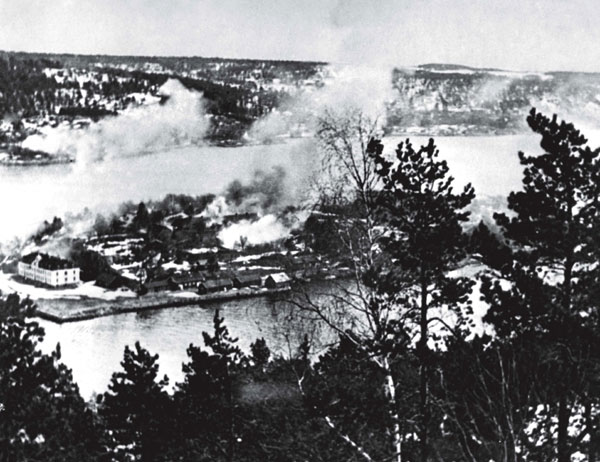
The lead ship was the German heavy cruiser Blücher, carrying roughly 2,000 men — soldiers, sailors, and the Gestapo and administrative staff meant to secure Oslo and arrest the Norwegian king and government before dawn. Oscarsborg’s guns hit her at nearly point-blank range. Forty-year-old land-based torpedoes, older than the men who fired them, finished the job. Blücher capsized and sank at 06:22, taking somewhere between 650 and 800 of the people aboard with her.
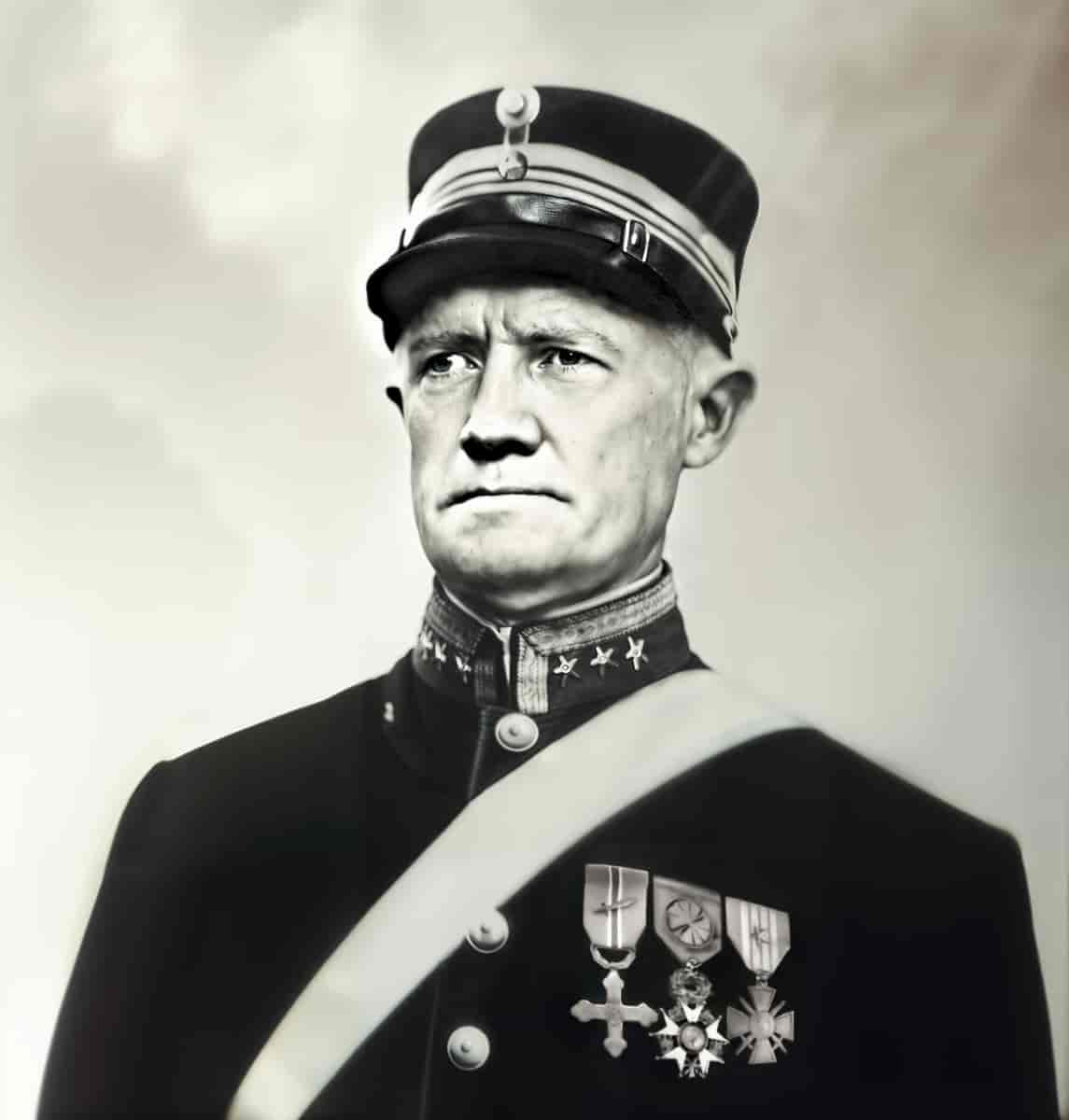
That single decision is the reason King Haakon VII, his government, and Norway’s gold reserves were on a train out of Oslo before the sun was fully up. It is also one of the cleanest arguments in this entire war against the idea that Germany’s early victories ran on a finished master plan. Nothing in Berlin’s planning accounted for one old colonel choosing to fire on a warning he wasn’t sure of. This part is about how much of what people now call “blitzkrieg” was actually built that way — real capability meeting real improvisation, in real time, with no script.
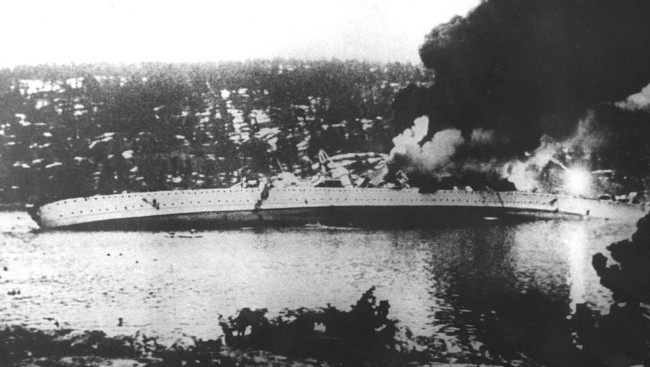
Eriksen’s fort was the one place the plan visibly broke. Everywhere else that same morning, it mostly worked. At 04:15, German forces had crossed the Danish border and begun landing simultaneously at Norwegian ports from Oslo to Narvik, 1,200 kilometers north — Operation Weserübung, the first operation in history to combine land, sea, and airborne assault at once, and the site of history’s first opposed paratrooper attack, at Sola airfield near Stavanger. Denmark’s government ordered a ceasefire at 06:00 and formally capitulated by 08:34 — one of the shortest campaigns of the war, bought with roughly 26 Danish dead in exchange for keeping its own government running under occupation. Germany committed around 120,000 troops against a Norwegian force that could in theory field 52,000 and a Danish one of 14,500 — figures far less lopsided on paper than the speed of the collapse suggested, mostly because so much of Norway’s army was never mobilized before its ports were already gone.
That evening, at 19:32, a Norwegian named Vidkun Quisling used German-arranged radio access to proclaim himself prime minister — a coup with no real backing, staged so fast that the German commander running the invasion was reportedly as surprised as the Norwegians were. Berlin, embarrassed, had him replaced within a week. His name entered English within months as the word for someone who hands his own country to its invader.
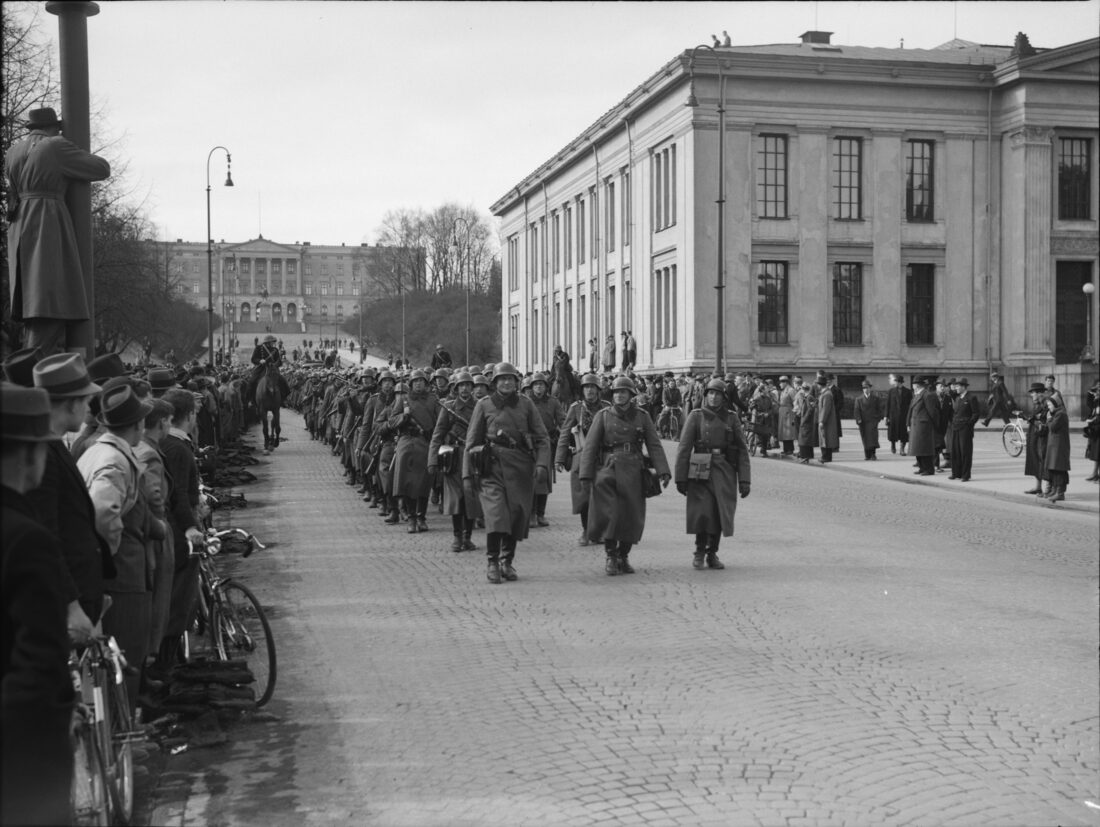
King Haakon refused Berlin’s ultimatum on April 10 to legitimize Quisling’s government, telling his cabinet he would abdicate rather than sign it. The royal party was bombed out of the small town of Nybergsund the next day — by the documentary record, a deliberate attempt to kill them — and bombed again out of Molde at the end of the month, where two-thirds of the town burned, including its wooden church. Norway’s gold reserve, hidden in a Molde clothing factory, had to keep moving ahead of German intelligence that the record shows already knew roughly where it was. The King, his government, and the gold finally reached Britain aboard HMS Devonshire on June 7, carrying 461 passengers — the same week Allied forces evacuated Narvik, the one Norwegian town they had actually recaptured from German control, and gave it back after holding it barely ten days. Norway formally surrendered on June 10, 1940. Denmark had lasted six hours. Norway held out for two months.
A plan built from a tourist guidebook
Here is the part of the story that complicates the word “blitzkrieg” more than anything Germany actually did on the ground. Hitler didn’t settle on invading Norway until the winter of 1939–40, and even then only in stages — a minimal planning study in mid-December, expanded by the navy in January, formally codenamed on January 27. On February 20, 1940, Hitler told General Nikolaus von Falkenhorst he would command the invasion and gave him until five o’clock that same afternoon to produce a workable plan. According to the documented account in François Kersaudy’s Norway 1940, Falkenhorst had no time to get hold of proper military maps — so on his way to his hotel room, he bought a Baedeker tourist guidebook to Norway at a stationery shop and built his invasion plan from the maps printed inside it. Hitler’s final directive ordering the invasion of both Norway and Denmark went out on March 1 — thirty-nine days before it happened.
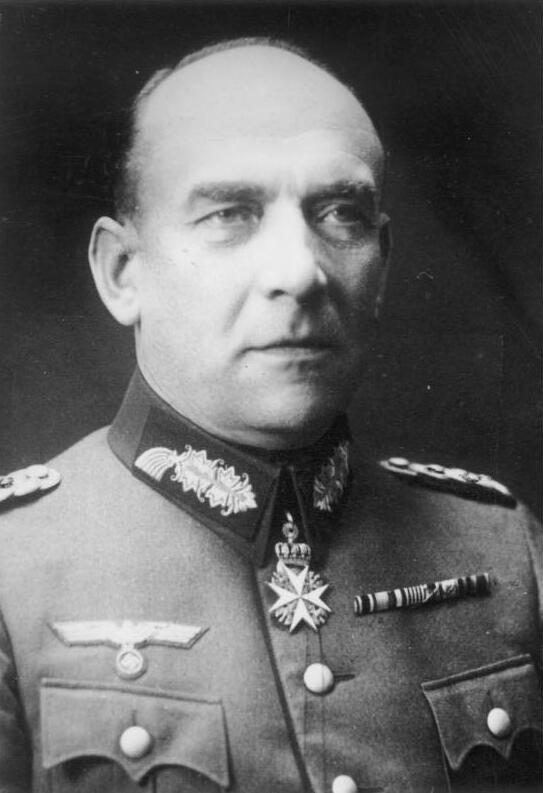
That doesn’t settle the argument by itself, but it’s a real, well-sourced illustration of how compressed and improvisational even this early “model” campaign’s planning actually was — worth holding onto against any version where Weserübung was a long-matured master plan waiting to be switched on.
That habit of trusting officers to improvise is real, and it predates 1940 by two decades. What’s much less clear is whether it ever hardened into a single, named, pre-planned doctrine called “blitzkrieg” — because the word has a strange history. It shows up in German military press as early as 1935, meaning simply “a fast war,” but no Wehrmacht field manual ever defines it as a method. A Time magazine piece in September 1939, covering the invasion of Poland, popularized it in the English-speaking world; the German press itself only picked the word up nine months later, after the fall of France. Hitler reportedly dismissed it as “a completely idiotic word.”
Whether the thing the word describes — fast, combined-arms, deep-penetration warfare — was a coherent doctrine Germany planned in advance, or a label stitched onto improvised successes after the fact, is a real, live, named argument among military historians. It isn’t a question this series invented to sound clever.
This gauge shows where historians' debate actually sits — not a simulated probability. It never invents a number; it points at a real argument.
Historian Matthew Cooper argued in 1978 that there was no formal "blitzkrieg" doctrine in German field manuals — what looked new was the older German idea of decisive, annihilating battle, carried out with new technology. J. P. Harris, in the 1990s "myth of blitzkrieg" literature, found no evidence a developed blitzkrieg doctrine appeared anywhere in German army or Luftwaffe manuals, and traced the term's popularity to what he called journalistic sensationalism. Robert Citino reaches a similar place differently: Germany was applying new tools — tanks, aircraft, radios — to a much older Prussian tradition of rapid maneuver warfare, not inventing a new one. Shimon Naveh goes furthest, describing a "complete absence of a coherent theory" behind German operations at all. Karl-Heinz Frieser's Blitzkrieg-Legende (1995), the study this part's subtitle is named after, shows the 1940 France campaign turning on real-time improvisation — commanders like Guderian and Rommel repeatedly outrunning their own high command's orders — while still arguing something genuinely new in method emerged from that improvisation, even unplanned. James Corum pulls the needle back the other way: Seeckt's 1920s reforms were real, deliberate doctrinal innovation, with genuine antecedents, even if they never crystallized into one named plan. The honest picture is a band, not a point: real groundwork fed real improvisation under pressure, which got a journalistic label after the fact — then, as the next section shows, got oversold as a master plan by someone with his own reasons for telling it that way.
What Britain didn’t see coming either
Germany wasn’t the only side improvising that spring. On December 30, 1939, British Prime Minister Neville Chamberlain wrote privately to his sister that he still believed “Hitler missed the bus in September 1938” — and he said much the same thing publicly, more elaborately, in a speech at Central Hall, Westminster, on April 4, 1940. Five days later, Germany invaded Denmark and Norway.
British intelligence had real warning and still misread it. RAF patrols spotted German warships moving south of Norway on April 7. The next morning, the German cruiser Admiral Hipper sank the British destroyer Glowworm, confirming a real force was at sea. The Admiralty had to decide what it meant.
You are the British Admiralty, under Admiral Sir Charles Forbes. RAF reconnaissance has spotted German warships moving south of Norway. A British destroyer has just been sunk confirming a real force is at sea. Britain has its own operation underway that same week — mining Norwegian waters to cut German iron-ore shipping. What do you conclude the German fleet is doing?
Both explanations fit the same handful of facts.
The Admiralty read it as a breakout attempt and deployed the Home Fleet to intercept a raider in open water, not defend Norwegian ports. The misreading wasn't corrected until the evening of April 8 — by which point German landing forces were already approaching the coast. Britain's own preemptive plan to occupy Norwegian ports if Germany moved first, code-named Plan R4, existed on paper but was never triggered in time. Neither side knew the other's timetable that week; both were reacting to the same prize, on an almost identical clock, by coincidence rather than mutual knowledge.
It’s a small, exact mirror of this part’s thesis: the side usually cast as the amateur — Britain, caught flat-footed — had real reconnaissance and a real plan, and still got the interpretation wrong under time pressure. Nobody in April 1940, on either side, was executing a finished script.
The generals who agreed to a story
If “blitzkrieg” as a settled pre-war doctrine is mostly a myth, it’s worth asking where the myth actually came from — and that has a real, dated, documented answer, and it isn’t Berlin.
A meaningful share of the popular “Germany followed a master doctrine” story, in other words, isn’t German wartime planning at all — it’s a dated postwar PR campaign by one British writer rebuilding his own reputation, repeated back by generals who had every professional reason to let him.
One more thing nobody knew yet: during the fighting, British forces captured three intact German Enigma cipher machines, put into operational use at Bletchley Park on May 17, 1940 — a real contribution to a codebreaking effort that would matter enormously later, from an invasion nobody involved saw as anything but a fight for Norway’s coastline.
Vidkun Quisling
A Norwegian army officer and minor political figure before 1940, largely unknown outside Norway until his radio broadcast on the evening of the invasion. He governed nothing of substance — Berlin sidelined him within a week, later restoring him as a figurehead under civil administrator Josef Terboven in 1942. What survived was the word his own choice created.
Close the file
Denmark fell in six hours. Norway held for two months, against a plan built in an afternoon with a tourist guidebook, defended in its opening minutes by a fortress commander who wasn’t sure what he was firing at and fired anyway. Britain, with real warning, still misread the fleet. The word history uses for all of this — blitzkrieg — wasn’t coined by the army that supposedly invented it, wasn’t defined in any of its manuals, and owes a real share of its later mythology to a British writer rebuilding his own reputation after the fact. None of that makes the German operational method fake. It makes it narrower and more interesting than a master plan: real interwar groundwork, run by officers trained to improvise past whatever broke, that worked often enough to look, from a distance, like something it never quite was up close.
In one sentence: was "blitzkrieg" a doctrine Germany followed, or a story told about what Germany did?
Closer to a story, but not a false one — real doctrinal habits (trusting officers to improvise toward a fixed goal) produced real operational successes, and only afterward got compressed into a single word and, in Liddell Hart's case, actively rewritten into something tidier and more deliberate than what actually happened in a colonel's decision at Oscarsborg or a general's afternoon with a guidebook.
Sources
- Karl-Heinz Frieser, The Blitzkrieg Legend: The 1940 Campaign in the West (Naval Institute Press, 2005; German orig. Blitzkrieg-Legende: Der Westfeldzug 1940, 1995)
- Matthew Cooper, The German Army 1933-1945: Its Political and Military Failure (Stein and Day, 1978)
- Robert M. Citino, The German Way of War: From the Thirty Years’ War to the Third Reich (University Press of Kansas, 2005)
- J. P. Harris, Men, Ideas and Tanks: British Military Thought and Armoured Forces, 1903-1939 (Manchester University Press, 1995)
- Shimon Naveh, In Pursuit of Military Excellence: The Evolution of Operational Theory (Frank Cass, 1997)
- James S. Corum, The Roots of Blitzkrieg: Hans von Seeckt and German Military Reform (University Press of Kansas, 1992)
- John J. Mearsheimer, Liddell Hart and the Weight of History (Cornell University Press, 1988)
- B. H. Liddell Hart, The Other Side of the Hill (Cassell, 1948) and The German Generals Talk (William Morrow, 1948)
- Heinz Guderian, Panzer Leader, trans. Constantine Fitzgibbon (Michael Joseph, 1952)
- François Kersaudy, Norway 1940 (Collins, 1990) — source for the Falkenhorst planning timeline and the Baedeker guidebook account, pp. 45-47
- David T. Zabecki (ed.), World War II in Europe: An Encyclopedia — Denmark campaign chronology and casualty figures
- Leland Stowe, No Other Road to Freedom (Alfred A. Knopf, 1941)