Last time: after three years of Chamberlain giving ground to avoid war, why did the occupation of Prague finally push Britain to draw a hard line over Poland? Because Munich's entire premise had been that Hitler's demands were limited to uniting German-speaking people under one flag. When German troops moved into Prague in March 1939 and took a country that had no ethnic German majority at all, that premise broke in public. Chamberlain read it as proof that no future concession would be the last one, and within two weeks Britain had guaranteed Poland's independence outright.
On the morning of August 28, 1939, a journalist named Clare Hollingworth borrowed a car from the British Consul-General in Katowice, in southern Poland, and drove north toward the German frontier. She was five days into her first-ever job as a foreign correspondent, for the Daily Telegraph. The border crossing was open to diplomatic traffic that week, so she drove straight through, made a loop on the German side, and turned back — and somewhere along a valley road, a gust of wind lifted a canvas screen the German army had rigged to hide what was parked behind it. Engines were already running. She counted what she later described as scores, if not hundreds, of tanks, aimed at Poland.
She had no way of knowing it yet, but she had just seen, with her own eyes, the physical proof of an agreement that almost nobody outside two rooms — one in Berlin, one in Moscow — knew existed.
Five days earlier, on the night of August 23–24, 1939, Soviet foreign minister Vyacheslav Molotov and German foreign minister Joachim von Ribbentrop had signed a treaty in the Kremlin, with Stalin standing behind them. In public, it was a ten-year non-aggression pact between Germany and the Soviet Union — a reversal so sharp that most of Europe struggled to believe it. Nazi Germany had built its entire self-image around opposing communism; the Soviet Union, through the Communist International’s official “Popular Front” line from 1935 to 1939, had positioned itself as fascism’s leading opponent. Now the two governments that had spent years calling each other’s ideology the enemy of civilization had just promised, on paper, not to fight one another.
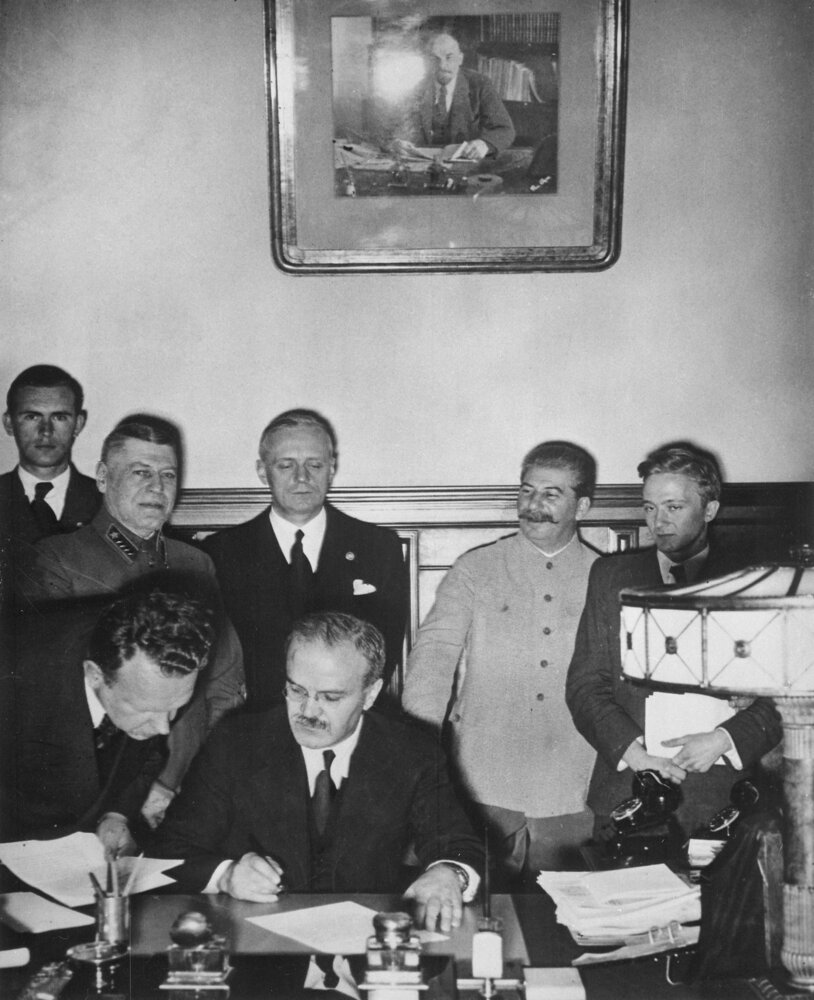
That was the whole document, as far as the public record showed. What nobody outside the negotiating room knew was that a second document had been signed alongside it, and that second document is most of why this part of the story matters.
The secret protocol split Eastern Europe between the two dictatorships. Finland, Estonia, and Latvia went into the Soviet sphere. Poland was divided along the Narew, Vistula, and San rivers — the western share to Germany, the eastern share to the USSR. Lithuania was assigned to Germany’s sphere at first, then moved into the Soviet one in a supplementary protocol signed September 28. A note recorded Soviet interest in Bessarabia, Romanian territory at the time. None of it was shown to the public, or to most of either government’s own diplomats.
Why would Stalin agree to any of this, after twenty years of open hostility to the regime he was now signing with? Part of the answer sits in a place most retellings skip past: a battlefield on the other side of the world, on the border between Soviet-backed Mongolia and Japanese-occupied Manchuria, where Soviet and Japanese forces were fighting a real, undeclared war that summer at Khalkhin Gol. A Soviet Union already committed against Japan in the east could not also afford an unresolved confrontation with Germany in the west. Talks in Moscow toward a mutual-defense alliance with Britain and France, meanwhile, had gone nowhere for months — stalled partly because Poland itself refused to let Soviet troops cross its territory even to fight the Germans on Poland’s behalf. Germany was offering something concrete instead: non-aggression, and territory.
You are Joseph Stalin. Soviet negotiators have spent months in Moscow trying to build a mutual-defense alliance with Britain and France against Germany, and the military talks have stalled. Soviet troops are fighting a real, undeclared border war against Japan at Khalkhin Gol. Germany has now offered a non-aggression pact — with an agreed division of Eastern Europe attached. What do you do?
A two-front confrontation — Germany in the west, Japan in the east — is the exact situation Soviet planning has spent years trying to avoid.
Stalin took Germany's offer. Molotov and Ribbentrop signed in Moscow on the night of August 23–24, 1939, secret protocol attached. From the Soviet side, the calculation was strategic rather than ideological: the Anglo-French talks had produced no real commitment, the war with Japan made a second front in Europe the one thing the USSR could least afford, and Germany was offering land and time. Historians still argue how much of this was cold calculation versus simply taking the strongest offer on the table — but what isn't in dispute is that within twenty-two months, the government on the other side of this agreement invaded the Soviet Union anyway.
This gauge shows where historians' debate actually sits — not a simulated probability. It never invents a number; it points at a real argument.
This gauge is about how surprising the Pact really was, given the two regimes' history — a narrower question from how the fighting in Poland went, which Part 7 takes up. Historian Geoffrey Roberts has called the Pact "the most stunning volte-face in diplomatic history," a genuine reversal of nearly two decades of open Nazi anti-Bolshevism and Soviet anti-fascism. A more realist reading pushes the other way: German and Soviet militaries had cooperated quietly for years after the 1922 Treaty of Rapallo, the Anglo-French talks had genuinely stalled, and Stalin was fighting a live border war with Japan at the same moment. Sean McMeekin's Stalin's War (2021) reads the Pact as the calculated, foreseeable move of a strategic actor, not a bolt from nowhere. Both sides agree what happened in the room in Moscow; they disagree how predictable that outcome should have looked from outside it.
Eight days after the signing, the plan on paper became a plan on the ground. On the night of August 31, SS operatives staged a fake Polish attack on a German radio station at Gleiwitz, near the border — using a murdered concentration-camp prisoner, dressed in a Polish uniform, left behind as manufactured evidence. It was one incident inside a wider operation, code-named after SS chief Heinrich Himmler, built to give Germany a public pretext for what was already scheduled.
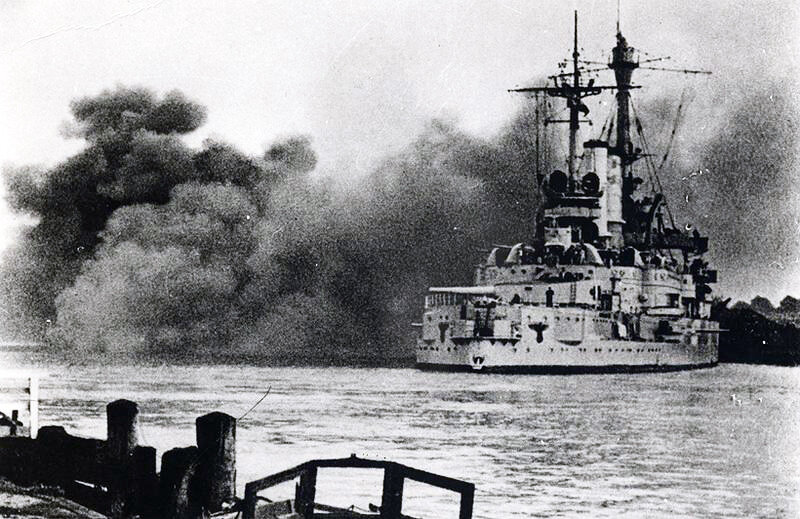
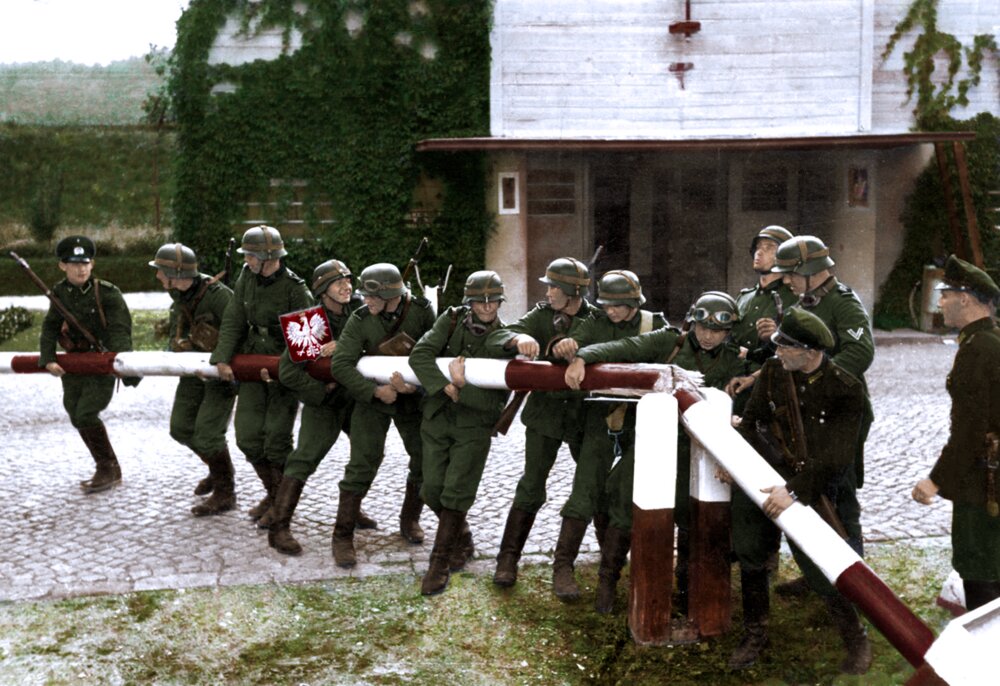
At 04:45 on September 1, 1939, the German battleship Schleswig-Holstein, docked in Danzig harbor on what had been billed as a courtesy visit, opened fire on the Polish military depot at Westerplatte. German forces crossed the frontier at the same hour, all along its length. Roughly 1.5 million German troops moved against roughly 1 million Polish troops — a Polish army that had been kept deliberately short of full mobilization in its final days, because Britain and France had urged Warsaw not to look “provocative” while diplomacy still had a theoretical chance.
Clare Hollingworth was in Katowice when it began. She heard, and by some accounts saw, the opening bombardment from where she was staying, and telephoned the British Embassy in Warsaw — reportedly holding the receiver out of the window at one point so the duty officer on the other end could hear the guns for himself. Her report is generally credited as the first from any correspondent describing the invasion as it was happening. Four days earlier, she had seen the tanks that made it possible.
"Scores, if not hundreds, of tanks" — the phrase Hollingworth used, again and again over the decades that followed, for what the wind uncovered on that valley road outside Katowice.
Polish soldiers met that force with what they had. Kazimierz Dziadosz, a young volunteer with the 3rd Carpathian Light Artillery Regiment, later gave the Imperial War Museum a detailed account of the opening fighting — an army meeting the invasion at less than full strength.
Two days later, Britain and France kept the promise Britain had made to Poland the previous March. Britain’s ultimatum expired at 11:00 GMT on September 3; Chamberlain’s radio broadcast announcing war followed within the hour. France’s own ultimatum expired at 17:00 the same day. Neither government mounted a real offensive to relieve Poland — the French army’s brief “Saar Offensive” was a limited, quickly halted gesture. In Barrow-in-Furness, a Mass Observation diarist named Nella Last, a housewife in her late forties who had been keeping a diary for the project since 1937, recorded the day the way millions of ordinary Britons experienced it: not as strategy, but as a Sunday morning that had just stopped being ordinary.
Poland fought on alone. On September 17, the Soviet Union invaded from the east — somewhere between roughly 460,000 and 800,000 troops, depending on how the count is made — citing the collapse of the Polish state as its pretext, even as the Polish government was still fleeing toward the Romanian border rather than having already fallen. Warsaw held under siege until it capitulated on September 28.
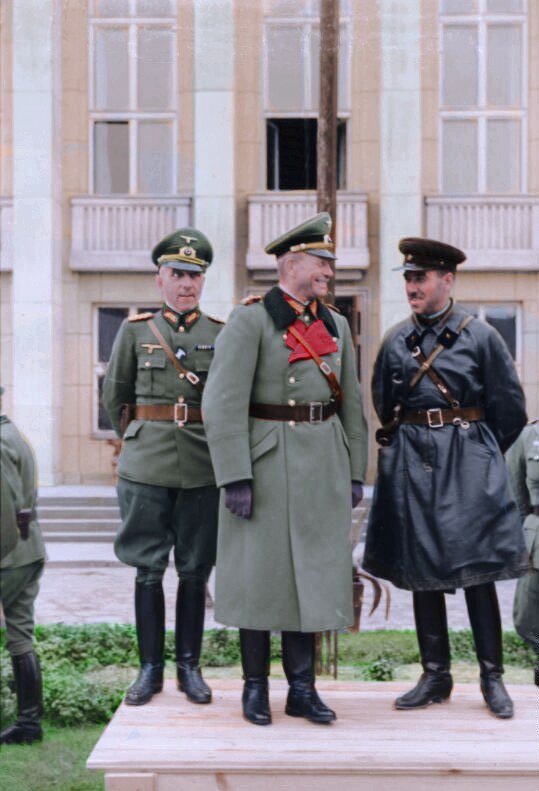
Five days before that capitulation, on September 22, German and Soviet forces staged a joint military parade at Brest-Litovsk, formally handing the city from German to Soviet control. German general Heinz Guderian and Soviet brigade commander Semyon Krivoshein reviewed the troops together, photographed side by side — the single clearest image of what the secret protocol actually meant in practice, two armies standing where an agreed line said they should.
One more scene from inside the siege is worth keeping, because it is small, specific, and entirely real. On September 23, 1939, a Polish-Jewish concert pianist named Władysław Szpilman was performing live on Polish Radio in besieged Warsaw when German shelling hit the station and knocked it off the air, mid-broadcast, with Chopin still playing. Szpilman survived the war. In 1945, when Polish Radio came back on the air, he reopened it by playing the same piece.
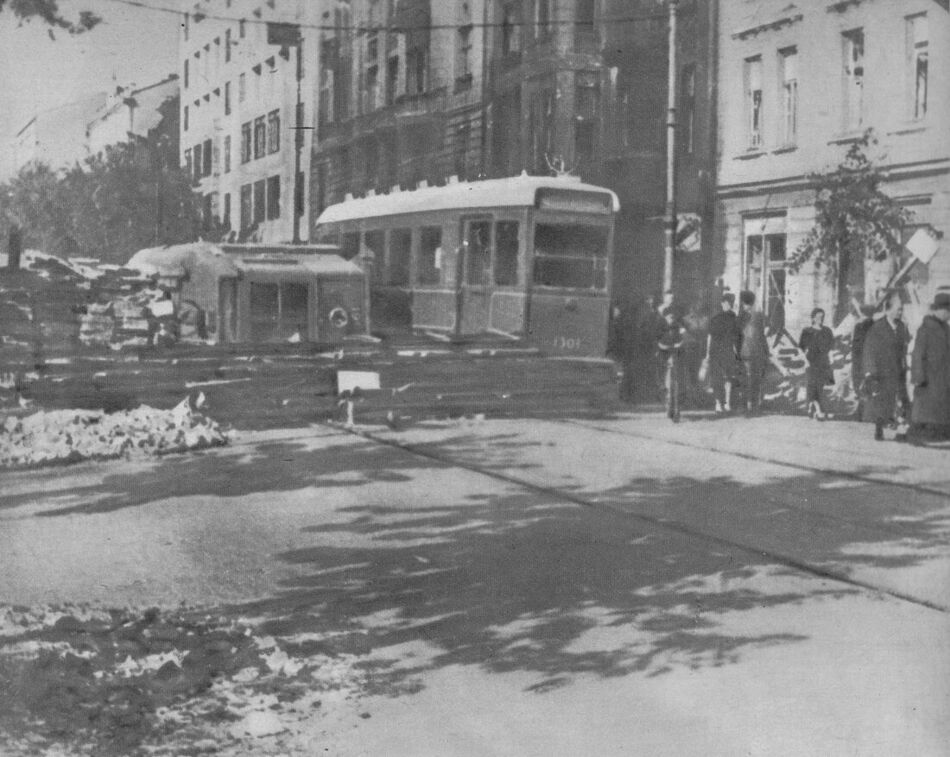
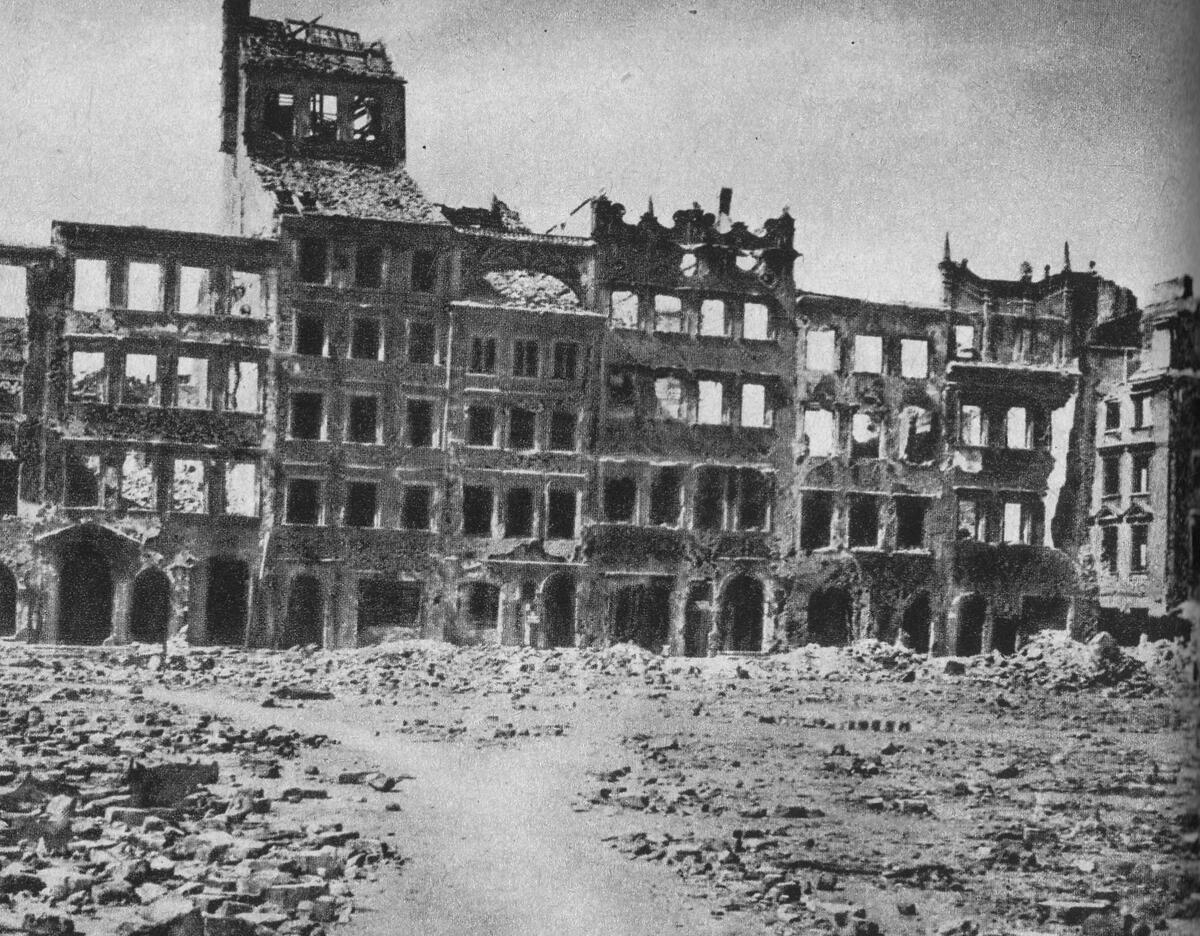
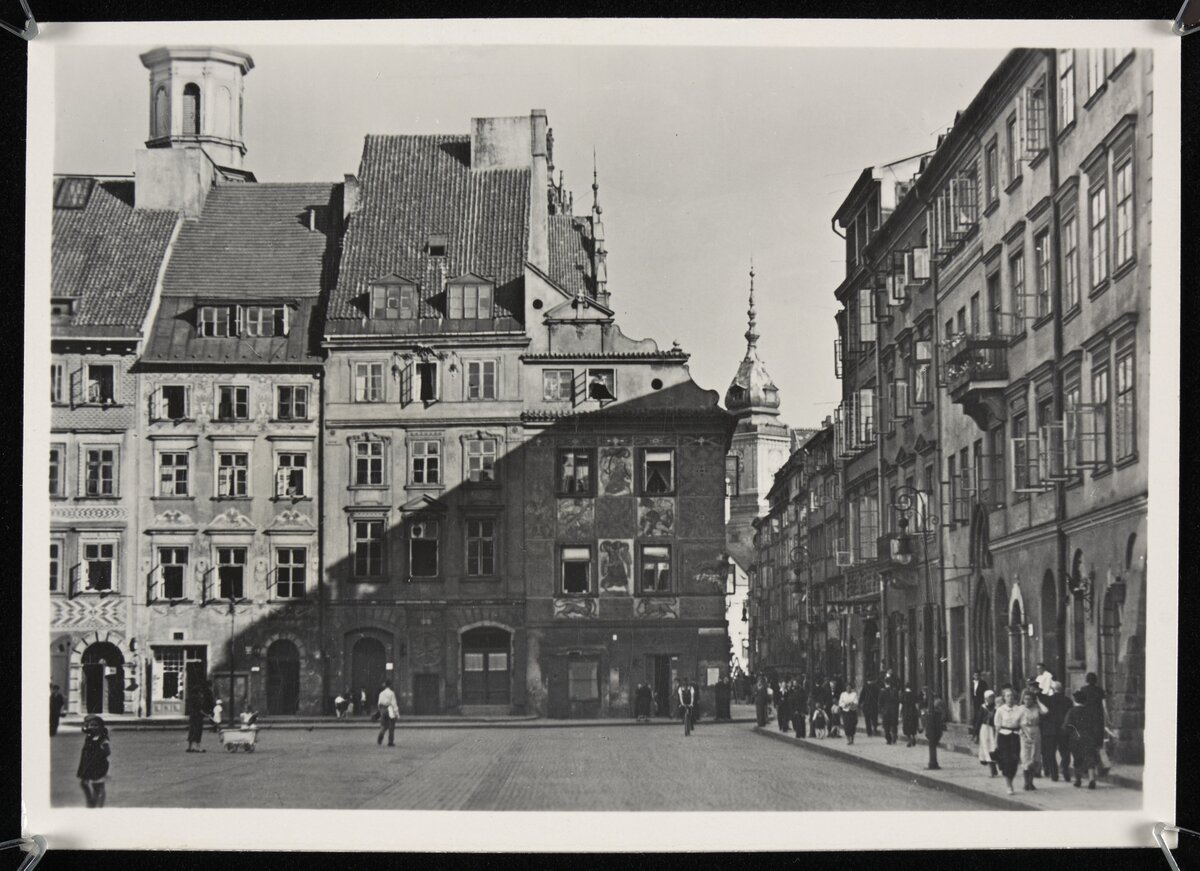
By early October, the fighting in Poland was over. What had been agreed on paper in Moscow on August 23 had, five weeks later, been carried out on the ground almost exactly as written — by soldiers on both sides who mostly had no idea the line existed as a document at all.
The disclosure of that document is its own real story, and it took two separate tracks that didn’t fully close until the Soviet Union itself was gone.
The Secret Protocol, Fifty Years to Daylight
Eight real dates, 1943–1992, in the order the truth actually surfaced. Tap each to read what happened.
Friedrich Gaus, the legal adviser who drafted the protocol and stood in the room when it was signed, made photostat copies for the Foreign Ministry's files — the paper trail that would outlast the regime that made it.
As Germany collapsed, Foreign Ministry official Karl von Loesch microfilmed the protocol and handed the film to American and British authorities rather than let it burn — the copy that became the entire Western documentary basis for what follows.
Gaus gave a sworn affidavit describing the protocol from firsthand knowledge. The Soviet Union — a co-prosecuting power at Nuremberg — blocked it from the Tribunal's official findings, but the affidavit still entered the Western record.
Nazi-Soviet Relations, 1939–1941 reproduced the captured microfilm texts of the pact and both secret protocols — the first full public release anywhere, built from documents the USSR had never acknowledged.
The Soviet government's official position, unchanged for half a century, was that the German-published documents were fabrications. Foreign minister Andrei Gromyko was still denying the protocol existed in 1989.
A Soviet commission under Politburo member Alexander Yakovlev, working under glasnost, found no original in any Soviet archive. Working from photographic analysis of the German-held copies, and from how closely they matched what actually happened on the ground, it concluded the document was authentic anyway.
The Congress of People's Deputies formally acknowledged the protocol, declaring it "legally unjustified and invalid from the moment of signing" — an act of personal power by Stalin and Molotov that had violated Soviet treaty obligations to third countries.
After the USSR's collapse, Russian archivists released the actual Soviet-held originals from the Communist Party's restricted Presidential Archive — confirming the German-sourced texts for good.
In one sentence: was the secret protocol kept hidden because it was shameful, or because it was still useful?
Both, at different times. In 1939 it was useful — a working plan neither government wanted its own population, let alone the other's, to see in writing while it was still being carried out. By 1989 the plan itself was fifty years finished; what the Soviet government was protecting by then was the story it told about itself — that the USSR had entered Poland to rescue fellow Slavs from a collapsing state, not to collect the eastern half of a map two dictatorships had already divided between them before either army crossed a border.
Sources
- Geoffrey Roberts, Stalin’s Wars: From World War to Cold War, 1939–1953 (Yale University Press, 2006)
- Geoffrey Roberts, The Unholy Alliance: Stalin’s Pact with Hitler (I.B. Tauris, 1989)
- Sean McMeekin, Stalin’s War: A New History of World War II (Basic Books, 2021)
- U.S. Department of State, Nazi-Soviet Relations, 1939–1941: Documents from the Archives of the German Foreign Office (1948) — full texts hosted at the Avalon Project, Yale Law School
- Resolution of the Congress of People’s Deputies of the USSR, “On the political and legal assessment of the 1939 Soviet-German Pact,” December 24, 1989
- Nella Last, Nella Last’s War: The Second World War Diaries of ‘Housewife, 49’, ed. Richard Broad and Suzie Fleming (Falling Wall Press, 1981; Profile Books, 2006)
- Clare Hollingworth interview, Imperial War Museums Sound Archive, object/80020181 (recorded 2001)
- Kazimierz Tadeusz Dziadosz interview, Imperial War Museums Sound Archive, catalogue 17478 (recorded June 16, 1997)
- Norman Davies, God’s Playground: A History of Poland, vol. 2 (Oxford University Press)