Last time: one Nazi Party member running a civilian refuge inside occupied Nanjing helped shelter a quarter million people through the worst of the massacre there. What happened to him when he went home and tried to tell Germany what he had seen? Almost nothing, and that was the point. John Rabe was quietly warned off ever showing his own film and photographs in public, Germany was building an alliance with Japan and had no use for the story, and he spent the years after 1938 as an increasingly obscure man whose testimony the country he'd risked his career for didn't want circulated.
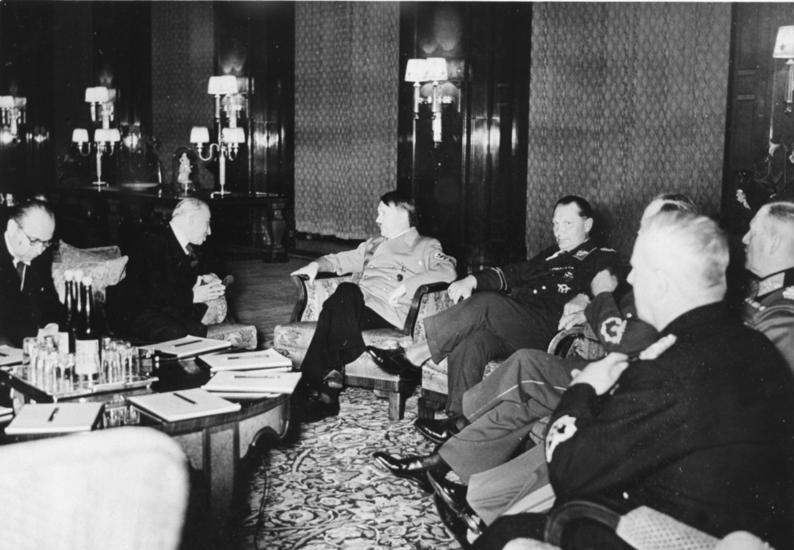
A little after eleven at night on March 14, 1939, a 66-year-old former judge named Emil Hácha was shown into a room in Hitler’s Reich Chancellery in Berlin. He had been president of Czechoslovakia for less than four months, and he’d come from Prague hoping to negotiate. Instead he was told the terms: German troops would cross the border at six the next morning whether he agreed or not, and if the Czech army fired a single shot, the Luftwaffe would level Prague. Hácha argued and stalled past 1 a.m., trying to reach his government by phone, while Hitler’s aides — by multiple accounts from people in the building that night — pushed a document across the table for him to sign. At some point he collapsed. Hitler’s own physician, Theodor Morell, gave him an injection to revive him. Hácha signed a little after 4 a.m., formally asking Germany to take his country under its “protection.” German troops crossed the border a few hours later, in falling snow.
That scene is the end of this part’s story. To understand how a head of state ended up alone in a room being talked into surrendering his country in real time, you have to go back three years, to a morning when almost nothing happened at all — and that nothing turned out to matter more than anyone realized.
The test nobody answered
On the morning of March 7, 1936, a small German military force — roughly 3,000 soldiers, lightly armed — crossed into the Rhineland, the strip of German territory along the French border that the Treaty of Versailles and the 1925 Locarno Treaties had both required Germany to keep demilitarized. It was a flagrant, deliberate treaty violation, dressed up in Hitler’s own speeches as Germany simply reoccupying its own back garden — a phrase a Times leader writer actually used, more or less endorsing the move.
Here is the detail almost nobody in France or Britain knew that morning: the German army had standing orders to retreat immediately if France mobilized against it. Hitler admitted as much privately, later. The force sent into the Rhineland was not built to fight a war; it was built to see what would happen if nobody stopped it. France, mid-election season and unwilling to move without British backing, did not mobilize. Britain’s government treated it as a nuisance, not a crisis. Nothing happened. Germany kept the Rhineland.
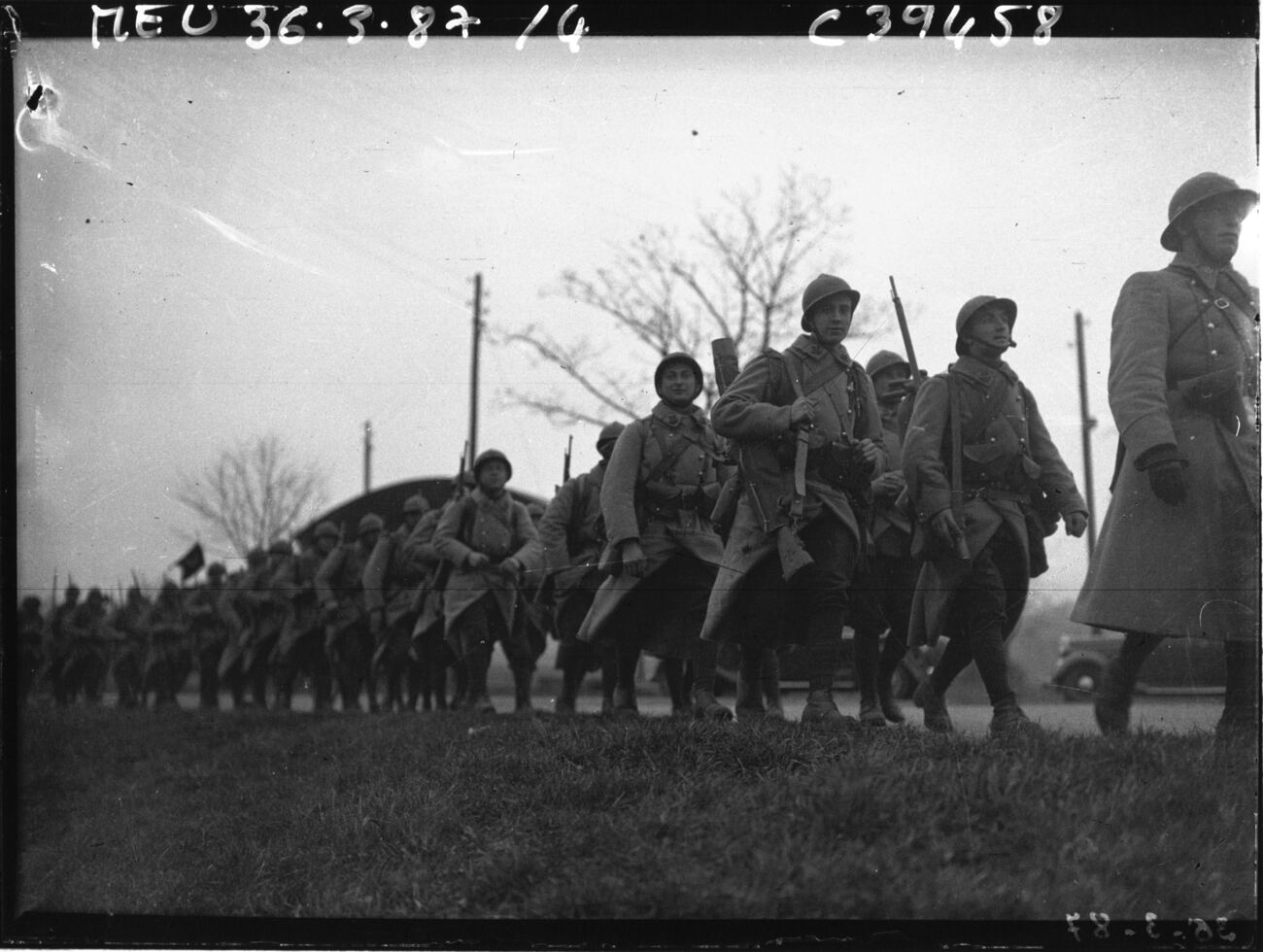
Historians who’ve gone back and checked the German side agree this was the cheapest possible moment to have stopped Hitler — the force was small, overstretched, and under orders to fold. Nobody tested that on the day. The Rhineland crisis didn’t look like the beginning of anything at the time. It just looked like Germany tidying up an old grievance. What it actually did was answer a question Hitler hadn’t been sure of yet, and hand him a data point every crisis after this one would build on.
Two years, then a new country’s turn
Two years passed before the next test. On March 12, 1938, after a campaign of German-sponsored pressure and street unrest inside Austria, German troops crossed the border to “restore order” — the day after Austrian Chancellor Kurt Schuschnigg, having tried and failed to schedule a last-minute independence plebiscite, resigned under direct German threat. Hitler reached Vienna within days. On March 15 he addressed a massive crowd from the Hofburg’s balcony overlooking the Heldenplatz, announcing Austria’s “return” to the Reich. A rigged plebiscite the following month recorded roughly 99 percent approval, under conditions no serious historian since has called free. Austria stopped existing as an independent country until after the war.
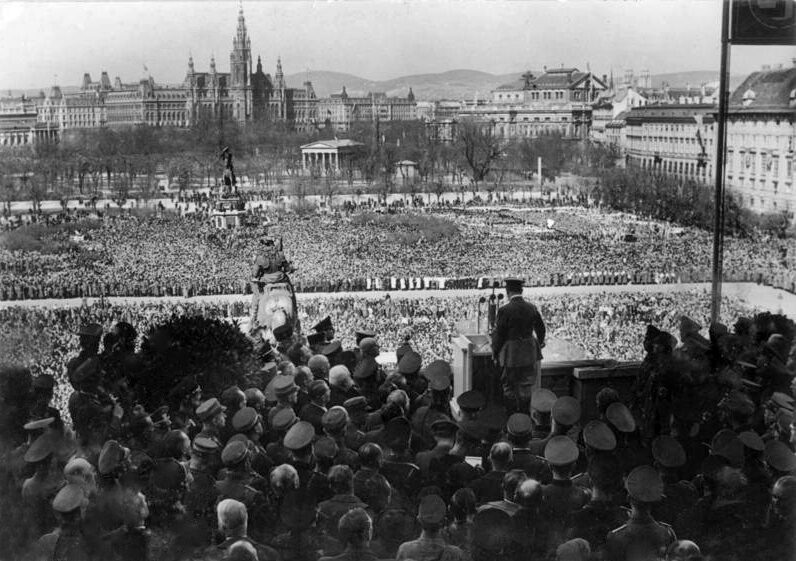
Britain and France protested on paper and did nothing else. By any honest accounting this was a second free pass, on a bigger prize than the first. And Hitler’s next target already had a plan of attack built into its own population — three million ethnic Germans, living inside somebody else’s country, whose loyalty could be organized from Berlin without a single German soldier crossing a border first.
The country that wasn’t at the table
Czechoslovakia, created in 1918 out of the wreckage of the Austro-Hungarian Empire, had a German-majority borderland called the Sudetenland. Through 1938, a local party led by Konrad Henlein — funded and directed from Berlin — agitated for autonomy and then annexation, escalating its demands to whatever Hitler needed the crisis to require next. By September, Europe was watching Hitler meet Chamberlain three times in two weeks: at Berchtesgaden on the 15th, at Bad Godesberg on the 22nd and 23rd — where Hitler raised his demands and the talks nearly broke down entirely — and then, on September 29 and 30, at a hastily arranged four-power conference in Munich.
Chamberlain, Hitler, French premier Édouard Daladier, and Italian dictator Benito Mussolini attended. Czechoslovakia did not — no Czechoslovak representative was in the room while its own borders were redrawn. The agreement ceded the Sudetenland to Germany within ten days, along with Czechoslovakia’s fortified mountain defense line, a large share of its industry, and about a fifth of its population.
You are Neville Chamberlain. Godesberg has collapsed. Britain's fleet has been mobilized, trenches are being dug in London's parks, and you are addressing the House of Commons on the likelihood of war within days when a note is handed up to you: Mussolini has proposed a four-power conference in Munich, tomorrow. What do you do?
Hitler's Godesberg deadline for Czech capitulation is already past. France and Czechoslovakia have treaty obligations to each other that Britain, tied to France, would be pulled into if fighting starts. You have flown to Germany twice already this month — the first flights of your life, at 69.
Chamberlain accepted on the spot, telling the Commons he had "no doubt" about going, to reported cheers in the chamber. He flew to Munich the next morning for his third meeting with Hitler in two weeks. The agreement produced there gave Germany everything Godesberg had demanded, just with a conference's signatures attached to it instead of an ultimatum's. Chamberlain and Hitler also signed a separate bilateral declaration of Anglo-German goodwill — the paper Chamberlain waved on his return to Heston Aerodrome, and the basis for the "peace for our time" line he gave that evening outside 10 Downing Street.
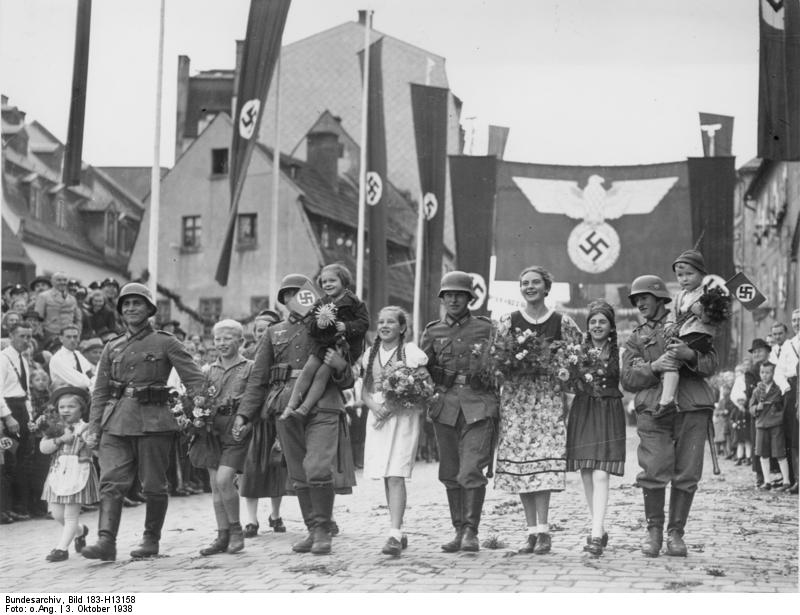
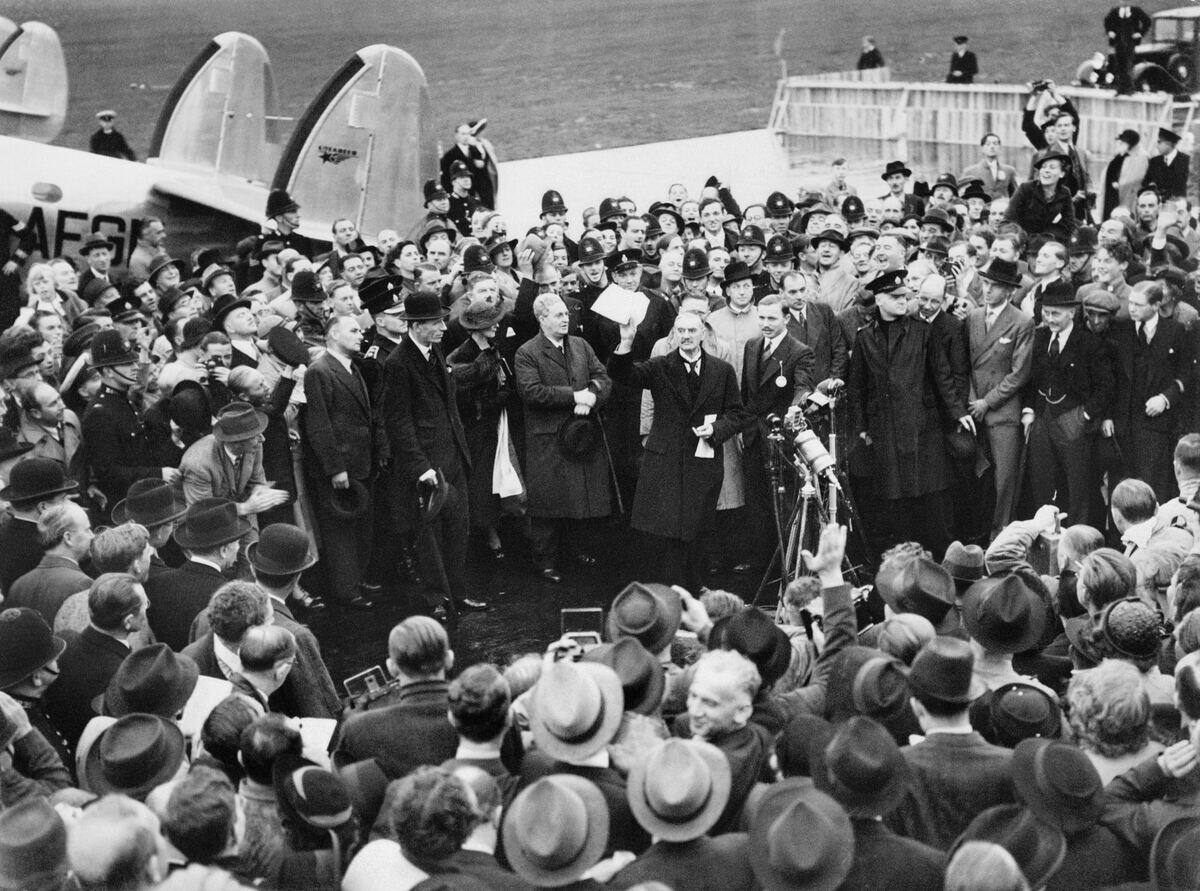
Daladier, who expected jeers when he landed back in Paris, got cheering crowds instead — relief, not judgment, was the mood almost everywhere in Western Europe that week. Not everywhere. Alfred Duff Cooper, First Lord of the Admiralty, resigned from Chamberlain’s cabinet the day the agreement was signed and explained why to the House of Commons on October 3.
"I have retained something which is to me of great value — I can still walk about the world with my head erect." Cooper told the Commons the Godesberg terms Munich had essentially delivered anyway amounted, in his words, to dealing Czechoslovakia "a mortal blow" while pretending to "insure its life" — a guarantee of borders attached to a settlement that had just stripped away the mountains and fortifications that made those borders defensible in the first place.
The gauge historians still argue over
This gauge shows where historians' debate actually sits — not a simulated probability. It never invents a number; it points at a real argument.
The harsh reading is nearly as old as Munich itself. *Guilty Men*, a 1940 pamphlet written under the pseudonym "Cato" by journalists Michael Foot, Frank Owen, and Peter Howard, indicted Chamberlain's circle for cowardice and blindness, and Winston Churchill's own memoir *The Gathering Storm* (1948) framed the 1930s as years Britain could have stopped Hitler cheaply — especially at the Rhineland in 1936. Later historians who substantially uphold that reading include R.A.C. Parker (1993) and Tim Bouverie, whose *Appeasement* (2019) argues Chamberlain was driven by a mistaken personal conviction that Hitler was a rational actor who could be satisfied.
The revisionist case runs differently on two separate tracks. A.J.P. Taylor's *The Origins of the Second World War* (1961) argued Hitler was less a uniquely diabolical schemer than an opportunist working within the normal power politics other European statesmen also practiced — a claim that reopened the whole question of intention versus improvisation. Separately, and more concretely, Williamson Murray's *The Change in the European Balance of Power, 1938-1939* (1984) documents just how much British fighter production and radar-linked air defense improved between September 1938 and September 1939 — the "buying time" case, that Munich was strategically rational for Britain even if morally compromised. Neither side disputes what happened at the Rhineland, Vienna, or Munich. They disagree about how much room those decisions actually left, and what a different choice would plausibly have cost.
What nobody at the table knew
Chamberlain believed Britain was negotiating from weakness in September 1938. By most retrospective military assessments, he had that backwards.
Chamberlain went to his grave in November 1940 without knowing how much stronger his hand had actually been at that table.
The guarantee that lasted six months
Munich’s entire premise — the thing that let people who weren’t Duff Cooper sleep at night — was that Hitler’s demands were about uniting ethnic Germans, and once the Sudeten Germans were home in the Reich, there was nothing left to want. Slovakia, pressured from Berlin, declared nominal independence on March 14, 1939, becoming a German client state overnight. That same evening, Hácha was summoned to Berlin.
You already know what happened in that room. German troops entered Prague the next morning, March 15, in heavy snow. Hitler proclaimed the “Protectorate of Bohemia and Moravia” from Prague Castle. This was the first time Nazi Germany had seized a population that wasn’t German-speaking, and it demolished the Munich settlement’s premise within days — not months, days. The guarantee Chamberlain had extracted alongside the Sudetenland’s surrender had lasted a little under six months.
Chamberlain’s public tone changed almost overnight. His speech in Birmingham on March 17 dropped the language of appeasement entirely, and on March 31, Britain extended a formal guarantee to Poland — the guarantee that would put Britain into the war five months later, over the crisis Part 6 picks up.
Four real tests, three years, one direction. Tap through — the ratchet only advances.
What Germany risked
Roughly 3,000 lightly armed troops, under standing orders to retreat immediately if France mobilized against them — a force built to test the water, not to fight a war.
What Germany risked
A full military crossing this time, not a token force — but one still banking on the same read of the last crisis: that no one with the power to stop it would spend that power.
What Germany risked
A confrontation big enough to trigger France's and Czechoslovakia's mutual treaty obligations — and, on the German side, a serious conspiracy inside the general staff ready to move against Hitler if Britain and France actually resisted.
What Germany risked
Breaking Munich's own stated premise — that Hitler's demands were only ever about uniting ethnic Germans — by seizing a population that wasn't German-speaking at all, six months after promising this was the last demand.
Nicholas Winton
A London stockbroker who visited a refugee camp in Prague in December 1938, in the immediate aftermath of the Sudetenland's cession, and came home and started organizing. Between March and August 1939, Winton arranged eight trains carrying 669 mostly Jewish and Sudeten-refugee children out of Czechoslovakia to Britain — keeping the records, the names, the sponsor families himself. A ninth train, scheduled for September 1, 1939, never left; the invasion of Poland closed the border that same morning.
In one sentence: what actually changed between March 1936, when a small German force could be talked out of the Rhineland by nothing more than the threat of resistance, and March 1939, when Hitler could order Prague bombed and be believed?
Not Germany's actual military strength, which by most postwar assessments was still shakier in 1938 than either side believed — what changed was what each side had learned to expect from the other. Every crossed line that went unpunished taught Hitler his opponents would negotiate rather than fight, and taught his own generals that objecting inside the system wouldn't work either. By the time Hácha sat down in that room in Berlin, three years of evidence already told him what the answer to "what happens if I refuse" was going to be. That's not a story about one weak man facing one strong one. It's a story about what a threat is actually worth once everyone in the room has watched it go untested, again and again.
Sources
- Wesley K. Wark, The Ultimate Enemy: British Intelligence and Nazi Germany, 1933-1939 (Cornell University Press / I.B. Tauris, 1985)
- Williamson Murray, The Change in the European Balance of Power, 1938-1939: The Path to Ruin (Princeton University Press, 1984)
- Terry M. Parssinen, The Oster Conspiracy of 1938 (HarperCollins, 2003)
- R.A.C. Parker, Chamberlain and Appeasement: British Policy and the Coming of the Second World War (Macmillan, 1993)
- Tim Bouverie, Appeasement: Chamberlain, Hitler, Churchill, and the Road to War (Tim Duggan Books, 2019)
- A.J.P. Taylor, The Origins of the Second World War (Hamish Hamilton, 1961)
- ‘Cato’ [Michael Foot, Frank Owen, Peter Howard], Guilty Men (Victor Gollancz, 1940)
- Winston S. Churchill, The Gathering Storm (Houghton Mifflin, 1948)
- Tom Harrisson and Charles Madge (eds.), Britain, by Mass-Observation (Penguin, 1939)
- Telford Taylor, Munich: The Price of Peace (Doubleday, 1979)
- Igor Lukes, Czechoslovakia between Stalin and Hitler: The Diplomacy of Edvard Beneš in the 1930s (Oxford University Press, 1996)
- House of Commons Hansard, vol. 339, October 3, 1938 — Alfred Duff Cooper’s resignation statement
- Imperial War Museums Sound Archive — Nicholas Winton interview