Last time: was the naval war a sideshow to the trenches, or the campaign quietly deciding how long both sides could keep fighting them? The second one, even though it rarely reads that way in the popular memory of the war. The trenches decided where the front line sat. The blockade and the U-boat campaign, running the entire time underneath that stalemate, were quietly deciding something larger: how long either side's civilians could keep supplying the men in those trenches at all — and, in Germany's case, how much longer that supply could hold before the home front itself became the war's real breaking point.
In 1916, two battles ran on the Western Front, overlapping for months, that between them produced something close to two million casualties and moved the front line by single-digit kilometers. Neither followed the ordinary logic of trying to break through and win ground. At least one of them, on its commanding general’s own account, was never meant to.
German Chief of Staff Erich von Falkenhayn is widely credited with a Christmas 1915 memorandum to the Kaiser proposing to attack the fortress town of Verdun not to capture it, but because its symbolic importance to France would force French commanders to defend it at any cost — letting Germany, attacking a narrow salient with a firepower advantage, inflict disproportionate casualties and "bleed France white" in a war of attrition it could win by exhaustion rather than maneuver. Alistair Horne's classic history treats that strategy as real and as Verdun's actual design. More recent archival work, particularly by Robert Foley, has raised serious doubts about the memorandum's authenticity in the form usually quoted — no original document has been found, and the version historians rely on comes from Falkenhayn's own postwar memoir, raising the real possibility it was written, or substantially rewritten, after the fact to reframe a failed breakthrough attempt as a deliberate attrition strategy all along. Which version is closer to true changes how the entire battle should be read — as horrifyingly effective by its own stated goal, or as a conventional attack that failed and got a new justification afterward.
Whichever the original intent, what happened at Verdun between February and December 1916 matched the attrition reading closely enough that the distinction mattered less than it should have. German forces opened the offensive on February 21 with one of the war’s heaviest artillery bombardments to that point, and captured Fort Douaumont, the salient’s most powerful fortification, on February 25 — nearly undefended at the time, having been stripped of most of its garrison and heavy guns before the battle began, a real French lapse rather than a German breakthrough against a fully manned position. General Philippe Pétain, given command of the defense, organized a supply road — the “Voie Sacrée” — that kept men and matériel moving into the salient around the clock for the rest of the battle. Fighting continued for ten months, across a battlefield both sides progressively fed more divisions into on a rotating basis, until French counterattacks under Robert Nivelle and Charles Mangin retook Fort Douaumont that October and pushed the line back close to where it had started in February. Combined casualty estimates for the battle vary by source and by what is counted, but commonly cited totals for both sides together run from roughly 700,000 to just under a million.
Sixty kilometers north, a second battle opened on July 1 that was meant, in part, to pull German reserves away from Verdun — and became, on its own first morning, the deadliest single day in the history of the British Army.
You are General Douglas Haig, commanding British forces at the Somme. Day one has just produced roughly 57,000 British casualties, about 19,000 of them dead — the heaviest single-day loss the British Army has ever recorded, against minimal territorial gain. What do you order for the following weeks?
The preliminary bombardment, meant to cut the German wire and destroy their defenses before the infantry advanced, had failed to do either in large stretches of the line — a fact known before the attack, from patrol reports, though its full extent wasn't credited at every level of command.
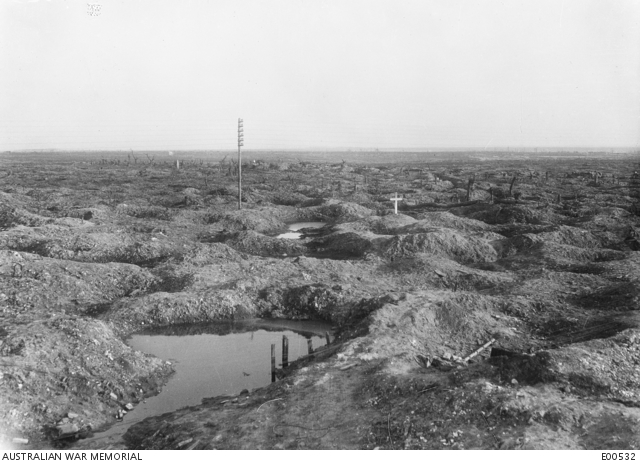
Haig chose to press on, and the Somme offensive continued for four and a half more months, through November 18, 1916. It did draw German reserves that might otherwise have gone to Verdun — a real strategic effect historians generally credit. It also produced combined casualties across both sides commonly estimated at over a million, for a maximum advance of roughly ten kilometers at the deepest point. The battle is also where tanks first appeared in combat, on September 15 at Flers-Courcelette — few in number and mechanically unreliable, not yet decisive, but a real historic first, and this series' next part follows where that technology went from there.
In one sentence: once a campaign like Verdun or the Somme has already cost hundreds of thousands of lives, is continuing it still a real decision, or has it become one only in name?
It stays a real decision — that's what makes the sunk cost trap worth naming rather than treating as an inevitability. Haig, Falkenhayn, and every commander who kept feeding these two battles could have stopped; nothing structural made that impossible the way mobilization's timetables had in 1914. What made stopping so hard was organizational and reputational, not mechanical — which means it was, in the end, a choice, made harder to see as one by everything already spent trying to avoid making it.