Part 12 held a record without interaction or debate — the Armenian Genocide, carried out under cover of a war already consuming the world's attention. There is no essay answer to compare that one against. Some parts of this series are for weighing arguments. That one was for holding still.
Britain entered the war with the largest surface navy on earth, and Germany’s High Seas Fleet, though formidable, was never built to beat it in a single decisive battle — the arms race this series covered in Part 4 had produced a Royal Navy still meaningfully ahead on dreadnought numbers. Neither side’s naval strategy, as a result, was built around seeking that decisive battle. Both built theirs around starving the other side’s country instead, by two almost mirror-image routes.
Britain’s route was the one its fleet size made possible: a distant blockade, patrolling the North Sea’s exits rather than the German coast directly, intercepting merchant shipping bound for Germany and its allies and cutting off food, fertilizer for domestic food production, and raw materials for industry. It was slow, legally contested under the era’s rules on neutral shipping, and — because it worked mostly through denial rather than direct attack — largely invisible to a public expecting battles. Its effects on German civilians accumulated over years rather than days: the winter of 1916–17, remembered in Germany as the “turnip winter” for the vegetable that substituted for scarcer staples, saw serious malnutrition and documented increases in mortality tied to food shortage. How many additional deaths the blockade caused, on top of wartime conditions generally, is disputed; estimates historians have offered for blockade-attributable excess civilian deaths in Germany range widely, commonly cited in the several hundred thousand, and the methodology for separating the blockade’s specific contribution from wartime hardship generally remains a genuinely contested question rather than a settled figure.
Germany’s route was the U-boat. Submarine warfare against merchant shipping could threaten Britain’s own food and material imports directly, but only by sinking ships — including, if the campaign was unrestricted, neutral and passenger vessels — a method the rest of the world was far more likely to notice and condemn than a naval blockade largely invisible to anyone not directly affected by it.
Germany's submarine campaign didn't run at one constant intensity. It escalated, was pulled back under diplomatic pressure, and escalated again — a real oscillation, not a straight line.
The first unrestricted campaign declared
Germany declares the waters around Britain a war zone in which merchant vessels, including neutral-flagged ones, may be sunk without warning.
The Lusitania
A German U-boat sinks the British passenger liner RMS Lusitania off the Irish coast. Of roughly 1,900 people aboard, about 1,198 die, including 128 American citizens. The ship was carrying some war matériel alongside its passengers, a fact German officials cited afterward and that remains a genuinely documented detail — it does not change that the overwhelming majority of the dead were civilian passengers.
Restriction under pressure
Following further sinkings and continued American protest, Germany scales the campaign back, restricting attacks on passenger vessels — a real, if partial and temporary, diplomatic retreat.
The campaign resumes, unrestricted, again
German naval command, calculating that Britain could be forced to negotiate within months before any American intervention could meaningfully arrive, persuades the Kaiser to resume unrestricted submarine warfare — the decision Part 17 picks up directly, and the wager underneath it.
Between those two exhaustion campaigns sat the war’s one great fleet action, and it settled less than either side hoped.
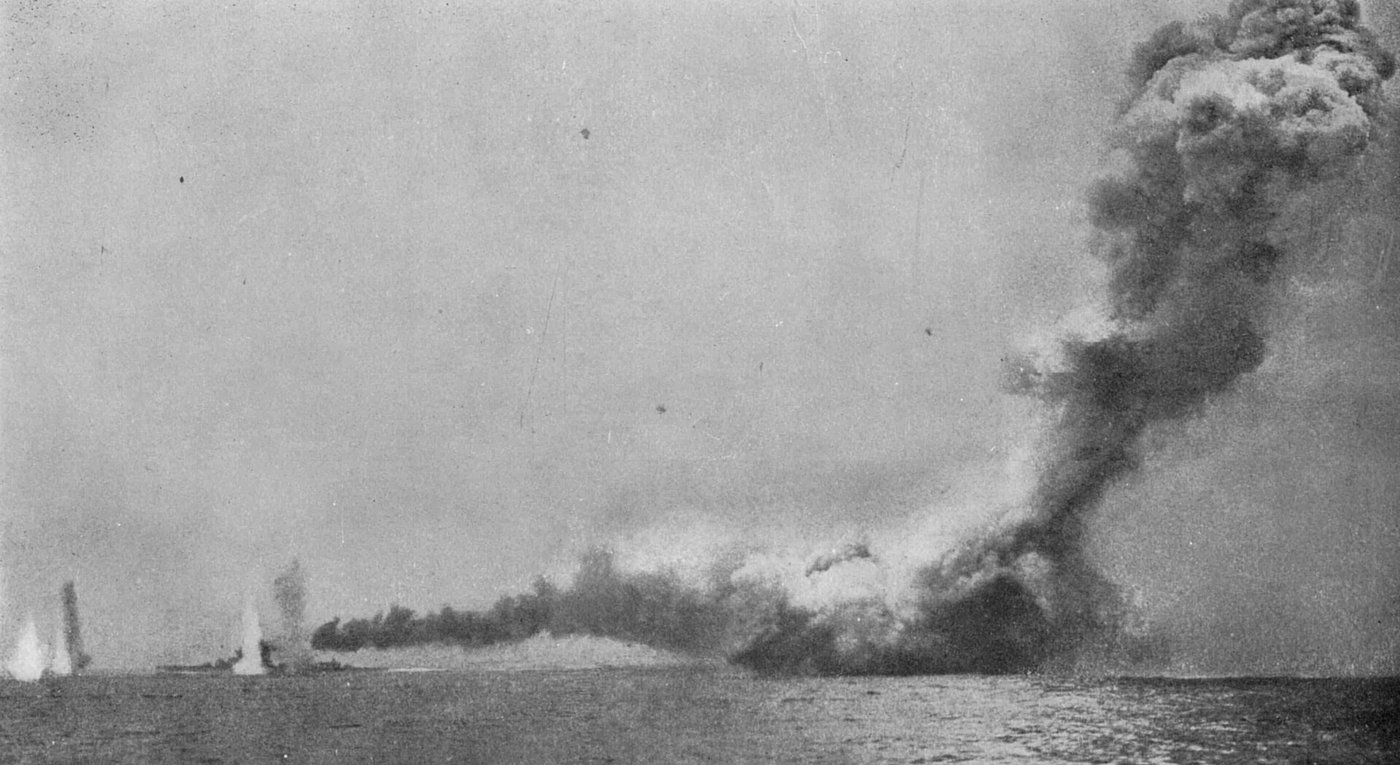
At the Battle of Jutland, May 31–June 1, 1916, Britain's Grand Fleet and Germany's High Seas Fleet met in the war's only major clash between the two main battle fleets. Britain lost more ships and more sailors — roughly 6,000 British dead against roughly 2,500 German — and German gunnery and ship design performed impressively. By most tallies of tonnage sunk and casualties, Germany came out ahead on the day. But the High Seas Fleet withdrew to port that night and, for the rest of the war, largely stayed there; Britain's Grand Fleet remained in control of the North Sea and the blockade continued uninterrupted. Robert Massie's account treats Jutland as a case where the tactical and strategic verdicts genuinely point in opposite directions — a real result, not a rhetorical trick either side's proponents invented after the fact.
Neither exhaustion campaign broke its target outright. The blockade weakened Germany’s home front steadily, without forcing capitulation on its own. The U-boat campaign, in its renewed 1917 form, would come close to strangling Britain’s imports before convoying — grouping merchant ships under naval escort, adopted only reluctantly and late — brought losses back under control. Both strategies did what asymmetric exhaustion campaigns tend to do: they worked, partially, slowly, and at a cost that included consequences neither navy fully controlled once its own campaign was underway.
In one sentence: was the naval war a sideshow to the trenches, or the campaign quietly deciding how long both sides could keep fighting them?
The second one, even though it rarely reads that way in the popular memory of the war. The trenches decided where the front line sat. The blockade and the U-boat campaign, running the entire time underneath that stalemate, were quietly deciding something larger: how long either side's civilians could keep supplying the men in those trenches at all — and, in Germany's case, how much longer that supply could hold before the home front itself became the war's real breaking point.