Last time: was the trench stalemate a problem of technology, or a problem of the people commanding around it? The gap opened as a technology problem — defense had simply outrun offense by 1914 — but how long it stayed open is genuinely a command-culture question, which is exactly why historians still argue about it. The tank, developed and first used within this same period, is the technological fix arriving. Whether it arrived as fast as it reasonably could have is the part of this question that isn't settled by hardware alone.
The front that ran from the Baltic to the Black Sea was, on a map, longer than the Western Front — and defended by far fewer men per kilometer. Fewer railways served it, fewer roads, and neither the Russian nor the Austro-Hungarian army could build and supply the dense, continuous belts of wire and concrete that had frozen Belgium and France. Distance and thin infrastructure did in the east what machine guns and barbed wire did in the west, just in the opposite direction: they kept the front too sparse to hold everywhere at once, so it moved — sometimes by hundreds of kilometers in a single campaign season, in either direction.
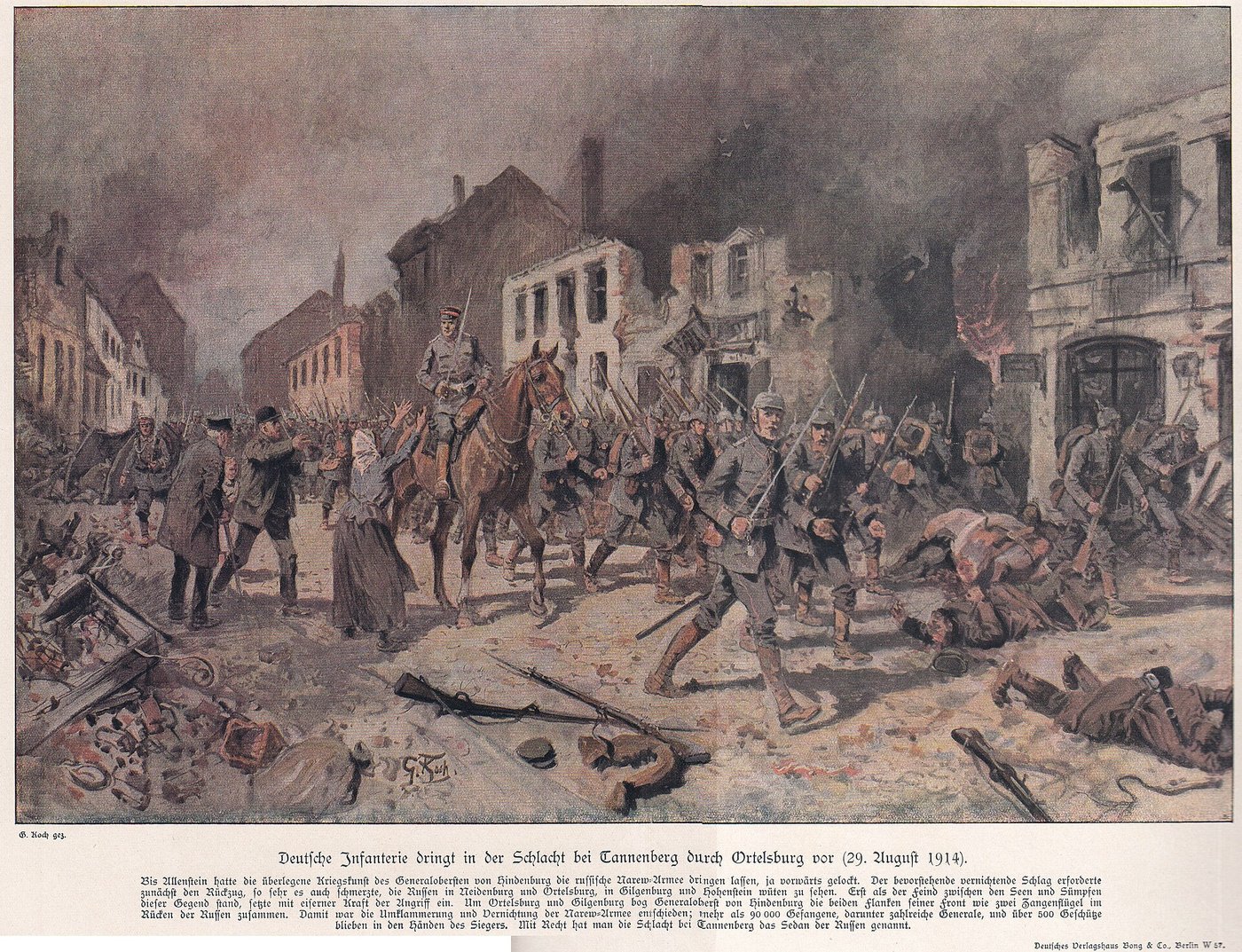
It started moving almost immediately, and badly, for Russia.
Russia mobilized faster than German planners had believed possible, and paid for the speed almost at once.
Two Russian armies push in from two directions
Russia's First Army, under Rennenkampf, advances from the east; its Second Army, under Samsonov, from the south. The two commanders reportedly disliked each other personally — a detail popular history leans on more than the documentary record firmly supports — but the operational problem was real regardless: their advance was poorly coordinated, and a gap opened between the two forces.
German intercepts and a bet on radio silence
German staff, including the officer Max Hoffmann, read Russian radio traffic sent unencrypted — a lapse historians attribute mainly to a shortage of trained cipher clerks rather than simple negligence. Reading Rennenkampf's and Samsonov's own signals, the German command judges Rennenkampf is not moving to support Samsonov, and commits nearly the whole Eighth Army against Samsonov's isolated Second Army.
Envelopment
German forces attack both of Samsonov's flanks. By August 29, several Russian corps are surrounded near the towns of Tannenberg and Allenstein, cut off from resupply and retreat.
Samsonov's death
General Samsonov, separated from his surrounded troops, is reported by multiple contemporary and later accounts to have taken his own life rather than survive the defeat and report it — a detail well established in the historical record, though the precise circumstances are known only through secondhand accounts.
Tannenberg is often credited with forcing Moltke to weaken his western offensive — the two corps he transferred east arrived, in fact, only after the battle was already decided, a real historical irony historians still point out when the popular version of the story skips it. What Russia’s rapid, underprepared advance did accomplish was real, just different: it pulled German attention and reserves eastward at the exact moment the Marne was being decided in the west, honoring the letter of Russia’s promise to France to attack early, even though the specific battle that attack produced was a defeat.
Two years later, Russia’s army fought a campaign that reversed nearly every part of that story — and cost more than Tannenberg had, by an order of magnitude.
You are General Alexei Brusilov, commanding Russia's Southwestern Front. Standard doctrine calls for a single, heavily concentrated point of attack after days of preliminary bombardment — which also reliably tells the enemy exactly where the blow is coming. You have a different idea. What do you order?
Attack simultaneously along a broad front, in narrow, deep thrusts, with only a short bombardment — trading the concentrated mass of a traditional attack for surprise and unpredictability about where the real breakthroughs will land.
Brusilov attacked on a broad front, in narrow, deep thrusts, with only a brief bombardment. The Austro-Hungarian line, stretched thin and undersupplied, broke in multiple places at once; in the offensive's first weeks Russian forces took several hundred thousand prisoners and advanced deep into Galicia and Bukovina — among the largest Allied gains of the entire war. Some historians see Brusilov's broad-front, shallow-penetration method as an early ancestor of the infiltration tactics Germany would later refine; that lineage is suggestive, not a settled, direct line of influence.
The Brusilov Offensive is credited by most historians with real strategic effects: it forced Austria-Hungary to halt its own offensive against Italy and pull divisions back east, and it drew German reserves away from Verdun at a critical moment for France. It also came at an immense cost, with Russian casualty estimates for the campaign ranging widely across sources — figures from roughly half a million to over a million appear in different accounts, depending on what is counted and over what dates — against Austro-Hungarian losses that were catastrophic in their own right and from which that army never fully recovered. Timothy Dowling's study treats it as Russia's most successful operation of the war on its own terms. Norman Stone's earlier account emphasizes the offensive's role in accelerating the exhaustion of Russia's trained officer corps specifically — the same hollowing-out this part's mechanism names — with consequences that reached well past 1916.
By the campaign’s end, Russia had won ground and broken an enemy army, and had also spent, for the second and third time in two years, a disproportionate share of its trained professional officers and NCOs — a fraction of the trained officers who’d started the war in the east, in one memoirist’s account, standing beside far larger numbers of conscripts who had never served alongside them. Anton Denikin, a corps commander who later published his own account, describes watching that professional core thin out year over year, replaced by hastily trained recruits an army raised on paper strength but not on preserved experience. The army that entered 1917 was, in the terms this part has set out, hollow in exactly the way its size on any map did not show.
In one sentence: was the Brusilov Offensive Russia's best campaign of the war, or the one that cost it the most to win?
Both, and the two readings aren't actually in tension — that's what makes the offensive worth holding onto past this part. It achieved everything a campaign is supposed to achieve: it broke an enemy army and changed the strategic picture on two other fronts. It also consumed the one resource an army the size of Russia's could least afford to spend twice: the trained people who made it more than its headcount. A win, honestly counted, is not the same question as a win the institution that achieved it could actually afford.