Last time: what actually put Franz Ferdinand's car in front of Gavrilo Princip — a plot that worked, or a string of accidents? Mostly accidents layered on top of a real plan gone wrong: two conspirators froze, the bomb missed, and the one precaution that might have kept the car away from that corner — a revised route to the hospital — never reached the driver. Princip didn't out-plan anyone that morning. He was standing on the one corner the car wasn't supposed to drive through, and it stalled there anyway.
Franz Ferdinand and Sophie died on June 28. Austria-Hungary did not declare war on Serbia for another month. In between sits the July Crisis: twelve capitals’ worth of decisions, most of them made in secret, most of them made by people who believed — right up until they didn’t — that the war they were risking could still be kept small. This part follows it the way the people living it did: one telegram, one deadline, one capital at a time.
It starts five days after the funeral, with a promise nobody outside a small circle in Berlin and Vienna was supposed to know about.
With that promise sitting in reserve, Austria-Hungary took three and a half weeks to build its case, timing its next move for a moment when the powers most likely to object were least able to coordinate. French President Raymond Poincaré and Prime Minister René Viviani were on a state visit to St. Petersburg, and Vienna waited for them to leave before acting — a deliberate choice, not a coincidence of scheduling.
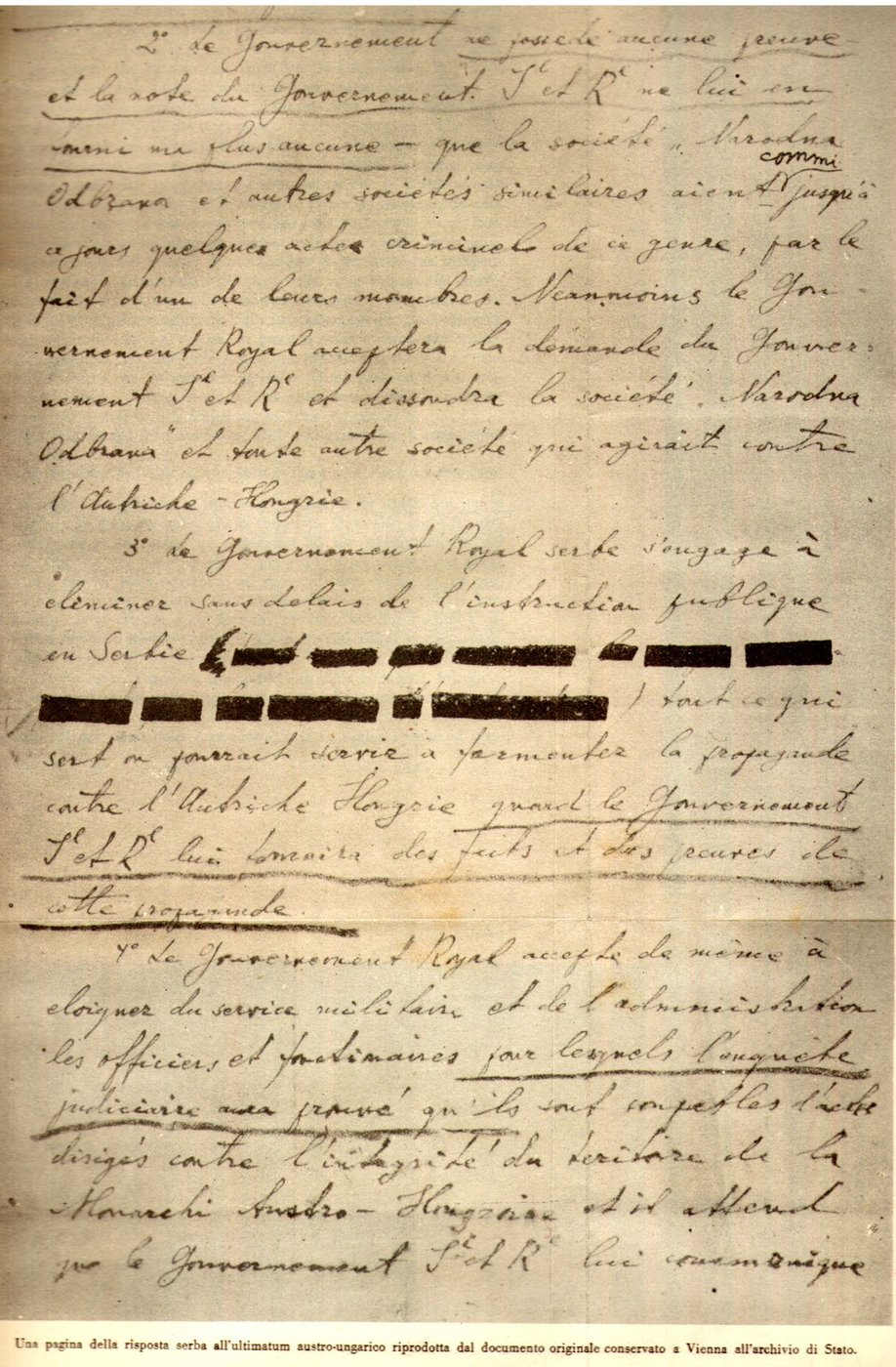
On July 23, Austria-Hungary delivered a ten-point ultimatum to Serbia with a 48-hour deadline. The last part of this series covered that document in full — what it actually demanded, and what Serbia actually did with each point on July 25. The short version, if you’re arriving here without having read it: eight points accepted or accepted with conditions, one answered evasively, and one — allowing Austro-Hungarian officials onto Serbian soil to run their own judicial inquiry — refused outright. Austria-Hungary treated that single refusal as sufficient grounds to break relations immediately.
Then, on the morning of July 28, something almost happened.
You are Chancellor Bethmann-Hollweg. The Kaiser has just read Serbia's reply for the first time and scrawled a note on it: this removes "every reason for war," and Austria-Hungary should occupy Belgrade as a pledge and negotiate from there — a "Halt in Belgrade" — rather than launch a general war. It's your job to get this idea to Vienna. What do you do?
Austria-Hungary has already all but decided on war and is unlikely to welcome a change of plan from Berlin at this stage. The Kaiser's proposal, forwarded as urgently and plainly as possible, might still reach Vienna before its war council finalizes anything.
The historical record is closest to forwarding the idea while softening it: Bethmann-Hollweg did pass the idea along, but folded into a longer, hedged dispatch rather than sent as the Kaiser's urgent, standalone instruction. By the time it reached Vienna, Austria-Hungary had already declared war on Serbia. Historians dispute how much this delay actually mattered — Christopher Clark treats it as a real, if narrow, closing window; others argue Vienna's war party was committed regardless and would have found a reason to brush the idea aside even delivered on time. Either way, "Halt in Belgrade" is the closest thing the July Crisis has to a documented off-ramp, and it was never actually tested.
Austria-Hungary declared war on Serbia on July 28 and shelled Belgrade the next day. Russia, which had spent the crisis promising Serbia diplomatic support it couldn’t yet back militarily, ordered partial mobilization against Austria-Hungary alone on July 29 — and then spent two days in genuine confusion about whether partial mobilization was even a real option. Its own general staff told Tsar Nicholas II the army’s plans weren’t built to execute a partial call-up cleanly; on the evening of July 30, under that pressure and despite a string of personal telegrams from his cousin the Kaiser urging restraint, Nicholas ordered general mobilization instead, effective July 31.
Those personal telegrams are real, and they’re worth reading in their own words. Nicholas and Wilhelm — “Nicky” and “Willy” to each other since childhood — exchanged a run of direct cables between July 29 and August 1, 1914, trying to talk their way out of what their own governments were doing underneath them. The exchange survives because German officials published their war documents in 1919, translated into English in 1924, and it has been quoted by nearly every historian who has written about this week since.
The Telegram Chain
Six real messages and orders, July 29 – August 4, 1914, in the order they went out. Tap each to read what it actually said and did.
As rendered in the published Kautsky collection, the Tsar cabled: an "ignoble war has been declared on a weak country," and he foresaw being "overwhelmed by the pressure brought upon me" and forced toward measures leading to war — closing with a personal appeal, "in the name of our old friendship," to hold Austria-Hungary back.
Wilhelm's reply pressed Nicholas to halt Russia's mobilization, warning — in language close to what the published record shows — that only an immediate, clear reply from his government could still prevent "endless misery." Russia's general mobilization was already underway and did not stop.
Germany demanded Russia demobilize within twelve hours, and demanded France declare neutrality within eighteen — with a further demand that France hand over the fortresses of Toul and Verdun as a guarantee it meant it. Neither demand was met.
Delivered that evening. Germany and France both ordered general mobilization the same day.
Germany demanded free passage for its troops through neutral Belgium, giving Brussels roughly twelve hours to answer. King Albert's government refused the morning of August 3. Germany declared war on France that same day.
German troops crossed into Belgium that morning. Britain's ultimatum demanding Germany respect Belgian neutrality expired at midnight in Berlin — 11:00 pm in London — with no German reply. Britain declared war the same hour. Five of the six great powers this series opened with were now at war within a day of each other.
This gauge is about whether the crisis could still have stayed local after July 28 — an Austro-Serbian war, not a European one. David Fromkin reads the blank cheque and Austria-Hungary's deliberate timing as evidence the war Vienna and Berlin got is close to the war they wanted, making the following week's diplomacy mostly theater. Margaret MacMillan and Christopher Clark read the same week as containing real, live choices at almost every step — Russia's mobilization decision, Britain's hesitation over whether to commit, Germany's ultimatums — made by named people who believed, wrongly, that they could still control what came next. Neither side disputes the blank cheque happened; they disagree about how much room it left afterward.
The account above tells you what each government did. It doesn’t fully explain why, once armies started actually moving, nobody found a way to stop them.
In one sentence: was the war Europe got in early August the war its governments had actually chosen, or the war their own machinery left them with once the telegrams ran out?
Some of both, and the proportion is exactly what historians still argue about. Austria-Hungary and Germany chose to risk a wider war when they issued the blank cheque and the ultimatum — that much is a choice, made in July, by named people. But by August 1, the decision in front of most governments was no longer "should we fight" so much as "can we still afford not to, given what the others are already doing" — and that second question is where the machinery this series turns to next starts to take over.