Last time: Austria-Hungary annexed Bosnia in 1908, and Russia backed down rather than fight over it. What did that humiliation change? Russia's leaders came away vowing never to be humiliated like that again — a resolve that hardened their commitment to defend Serbia no matter what. That resolve would matter enormously once the alliance system below was fully wired together.
On 18 March 1890, Otto von Bismarck resigned as chancellor of Germany. He didn’t want to. He had built the job over nineteen years, unified Germany in 1871 after beating France in the Franco-Prussian War, and spent every year since managing the peace that followed. Kaiser Wilhelm II, twenty years younger and newly on the throne, wanted to rule directly instead of through an aging chancellor who kept overruling him. So he forced Bismarck out.
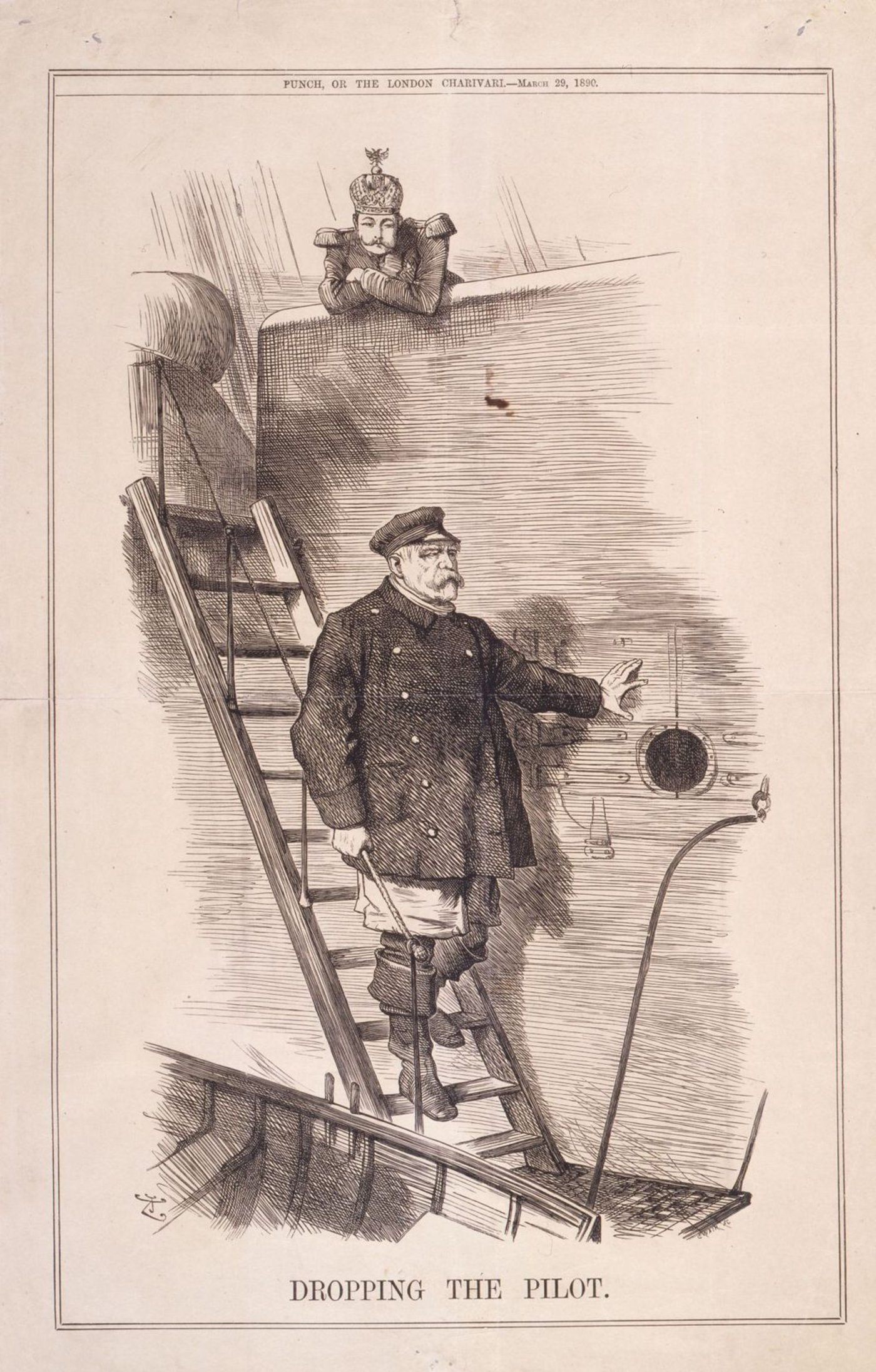
Eleven days later, the British magazine Punch ran a cartoon that has outlived almost everything else from that spring. Drawn by John Tenniel — the same artist who illustrated Alice in Wonderland — it showed a ship with Bismarck climbing down a rope ladder into the sea, while a young Kaiser Wilhelm II leaned over the rail above and watched him go. The caption read “Dropping the Pilot.” Tenniel’s point was simple: Bismarck had been steering this ship for two decades. Now the crew were letting him climb off, and nobody left on deck knew the water half as well.
That water was a system of treaties Bismarck had spent a decade building, precisely because he was afraid of one thing: France, still furious about losing the 1870-71 war and the territory of Alsace-Lorraine, finding a powerful friend and forcing Germany to fight on two fronts at once. Bismarck’s fix wasn’t to make Germany unbeatable. It was to make sure France stayed alone. For as long as he ran German foreign policy, it mostly worked.
What happened after he left is the subject of this part: how four separate treaties, signed over twenty-eight years by six different governments, wired Europe into two opposing blocs — and why one of the most important of those treaties gets misremembered today as something it never was.
The alliance Bismarck actually built
Bismarck’s first move came on 7 October 1879: the Dual Alliance, a secret defense pact between Germany and Austria-Hungary. The terms were narrow and specific. If Russia attacked either country, the other would come in with full force. If some other power attacked one of them — France, say — the other owed only neutrality, unless Russia joined in too. It bound Austria-Hungary to Germany without committing Germany to every fight Austria-Hungary might pick.
Italy joined on 20 May 1882, turning it into the Triple Alliance. Italy’s reason was mostly about anger, not ambition: France had just occupied Tunisia, a piece of North Africa Italy considered its own sphere, and Rome wanted backing against Paris. Under the new terms, Germany and Austria-Hungary would support Italy if France attacked it without provocation, and Italy owed the same in return. All three promised at least neutrality if any one of them was attacked by another power.
Here’s the part that made Bismarck’s system genuinely clever, not just an alliance: he refused to let it become simply anti-Russian. Even while Germany stood behind Austria-Hungary — Russia’s rival in the Balkans — Bismarck kept a separate, secret channel open to Russia itself, the Reinsurance Treaty of 1887. It committed Germany and Russia to neutrality if either was attacked by a third power, with some exceptions. The whole design rested on Bismarck personally managing two relationships that pointed in opposite directions and somehow keeping both alive. It required constant, careful attention. It was not a system built to run itself.
The careful part stops being careful
That’s exactly what stopped happening after Bismarck left. His successor, Chancellor Leo von Caprivi, took foreign-policy advice from an official named Friedrich von Holstein, who judged the Reinsurance Treaty incompatible with the Austrian alliance — Germany, in his view, couldn’t credibly promise things to Russia while also backing Russia’s Balkan rival. So in 1890, Berlin let the Reinsurance Treaty lapse rather than renew it. It was a deliberate choice, not an accident. Russia, suddenly without a partner in Berlin, went looking elsewhere.
It found one in France. A military convention between the two countries was signed in August 1892 by General Raoul de Boisdeffre for France and General Nikolai Obruchev, Russia’s chief of staff (the officer who runs a country’s military planning), and it was locked in through an exchange of formal notes that brought it fully into force by January 1894. Unlike Bismarck’s careful, limited wording, the Franco-Russian Alliance was blunt: if Germany attacked Russia, or if Austria-Hungary attacked Russia with German backing, France would mobilize its full army — meaning call up its reserves and move toward war footing — against Germany. Russia owed France the same in reverse. And there was a second clause that mattered just as much: both countries agreed to mobilize immediately if any Triple Alliance power mobilized first, treaty or no treaty, threat or no threat. That single clause is worth sitting with. It meant a decision made in one capital about troop movements could trigger an automatic, matching decision in another capital, without anyone needing to declare anything yet.
By 1894, the map Bismarck had spent a decade preventing existed anyway: France was no longer alone. It had Russia, and a real, specific, written commitment behind it.
Two agreements that were never military pacts
The next two treaties get misremembered constantly, so it’s worth being exact about what they actually did.
On 8 April 1904, British Foreign Secretary Lord Lansdowne and French Ambassador Paul Cambon signed the Entente Cordiale. Cambon had spent since 1898 as France’s ambassador in London, and had worked the details of this agreement through 1903 and 1904 under instructions from his foreign minister, Théophile Delcassé; his own letters home, later published by his son, describe exactly what the two sides had and hadn’t agreed to. What they’d agreed to was colonial housekeeping: Britain recognized France’s position in Morocco in exchange for France recognizing Britain’s position in Egypt, plus a set of smaller boundary and fishing-rights settlements. It ended roughly a century of British-French colonial friction. What it did not do — and this is the part people get wrong — was commit either country to fight for the other. There was no mutual-defense clause. Britain remained legally free to sit out a Franco-German war right up until it chose otherwise, which it did, but not until August 1914, and not because a 1904 treaty forced it to.
The Anglo-Russian Entente followed on 31 August 1907, signed by Foreign Secretary Sir Edward Grey and Russian Ambassador Count Alexander Benckendorff. It divided Persia into spheres of influence between the two powers and settled rival claims over Afghanistan and Tibet. Same shape as the French agreement: a settlement of colonial friction, not a promise of soldiers.
Put those two together with the Franco-Russian Alliance and you get what historians call the “Triple Entente” — but notice the word doesn’t mean what it sounds like it means. Unlike the Triple Alliance, no single document bound Britain, France, and Russia to fight together. Britain had a real military commitment to nobody. It had two friendly understandings and one increasingly close relationship with France that included, by 1912, secret naval coordination — but on paper, in 1907, Britain could still have stayed neutral in a continental war without breaking a single written promise.
The Coupling Board
Six agreements, twenty-eight years, and only some of them were ever a military tripwire. Tap each one open — the terms are the real terms, not the shorthand history remembers them by.
The Coupling Board
Six real agreements, 1879–1907, in the order they were signed. Tap each to read exactly what it committed its signatories to — not the shorthand history remembers it by.
Germany and Austria-Hungary were bound: if Russia attacked either, the other came in with full force. If some other power attacked one of them, the other owed only neutrality — unless Russia joined in too.
This extended the same binding to Italy. Germany and Austria-Hungary were committed to back Italy if France attacked it without provocation; Italy owed the same in return. All three promised at least neutrality if any one of them was attacked.
Germany and Russia were bound too, secretly: neutrality if either was attacked by a third power, with exceptions. Bismarck ran this alongside the Austrian alliance for years. His successors judged the two incompatible and let it die in 1890 — the one coupling that broke by choice, not by crisis.
France and Russia were bound, more bluntly than anything Bismarck ever signed: if Germany attacked Russia, or Austria-Hungary attacked Russia with German backing, France would mobilize its full army against Germany — and Russia owed the same in reverse. A second clause made it a true tripwire: both agreed to mobilize immediately if any Triple Alliance power mobilized first, treaty invoked or not.
Britain and France signed nothing that bound either to fight. This was colonial housekeeping: Morocco for Egypt, plus smaller boundary settlements. No mutual-defense clause anywhere in it. On paper, Britain stayed entirely free to sit out a Franco-German war.
Britain and Russia signed the same kind of settlement, not a promise: dividing Persia into spheres of influence, settling rival claims over Afghanistan and Tibet. A resolution of friction, not a commitment of soldiers.
The decision Bismarck actually faced
You are Bismarck. France wants revenge for 1871. What do you do?
Germany just took Alsace-Lorraine from France and humiliated it in war. You know France won't forget it. Your real fear isn't France alone — Germany could handle that. It's France finding a powerful ally and forcing Germany to fight a war on two fronts at once.
Bismarck chose the first path, and pursued it with more patience than the options above suggest — he didn't just pick one ally, he tried to hold two rivals at once. The 1879 Dual Alliance bound Austria-Hungary to Germany. The 1882 addition of Italy widened it into the Triple Alliance. And rather than let Austria-Hungary's alliance push Russia away, he ran the secret 1887 Reinsurance Treaty alongside it, keeping a channel to St. Petersburg open even while Berlin backed Vienna against it in the Balkans. It was a system that needed one person managing two contradictions at once. When Wilhelm II removed that person in 1890, his successors judged the contradiction unsustainable and let the Russian half lapse. Within four years, the isolation Bismarck had spent a decade building was gone.
How mechanical was any of this, really?
This meter measures where historians actually stand, not a simulated probability. A. J. P. Taylor, in The Struggle for Mastery in Europe (1954) and later War by Timetable (1969), argued the alliance and mobilization system had become close to mechanical by 1914 — once one part moved, the rest followed almost automatically. Christopher Clark's The Sleepwalkers (2012) pushes back hard: the Entente wasn't even a pact, and leaders at every step made real, avoidable political choices — the treaties narrowed the room to maneuver, but they didn't remove it. Margaret MacMillan's The War That Ended Peace (2013) sits between them: the alliances made a wider war more likely once a crisis started, without making it certain. No consensus exists on exactly how much room was left — which is the entire reason this band spans, rather than points.
Six capitals, two blocs
Bismarck spent his last years in office trying to prevent exactly the map that existed by 1907: France no longer isolated, a rival bloc gathering on Germany’s other side, and no single hand left steady enough to manage contradictions the way he once had. Nobody in 1890 sat down and planned that outcome. Wilhelm II wanted to rule his own way. Holstein made a defensible legal judgment about which treaty conflicted with which. Delcassé and Cambon were settling colonial squabbles, not building a war machine. Each decision, taken alone, was reasonable. Stacked together across twenty-eight years, they produced six major European capitals sorted into two camps — and, crucially, a set of written commitments that meant a mobilization order in one country could force a matching order somewhere else, days before anyone officially declared anything.
None of that made a war inevitable. Historians still argue hard about how much choice was left once the wiring was in place, and that argument matters more than a tidy answer would. What the wiring did guarantee is narrower and colder: if a small, local war ever did start somewhere on the map, the treaties gave it a path to stop being small. The next question is what each side did with the years that followed — not just standing behind their allies, but building up, as fast as possible, the armies and navies those treaties might one day call on.
If you had to explain to a friend why the Entente Cordiale wasn't really an "alliance" in the military sense, what would you say in one sentence?
It settled colonial arguments over Egypt and Morocco between Britain and France — it carried no promise that either country would send soldiers to fight for the other.
Sources: A. J. P. Taylor, The Struggle for Mastery in Europe 1848–1918 (Oxford, 1954); Christopher Clark, The Sleepwalkers: How Europe Went to War in 1914 (2012); Margaret MacMillan, The War That Ended Peace: The Road to 1914 (2013); George F. Kennan, The Fateful Alliance: France, Russia, and the Coming of the First World War (1984); Christopher Andrew, Théophile Delcassé and the Making of the Entente Cordiale (1968); Keith Eubank, Paul Cambon: Master Diplomatist (1960).