Exact expected-value engine
For every hand and dealer card it works out the value of standing, hitting and doubling. The dealer's final-total distribution is computed by memoised recursion, and hitting recurses until standing is better.
Upcard teaches it. A full course, drills that grade every answer, a practice casino with real rules, and a coach who reads your play and tells you what your mistakes cost. Practice only: no real money, ever.
Formerly “Blackjack Mastery.” If the beta link says it's full, email upcard21@gmail.com and I'll add you.
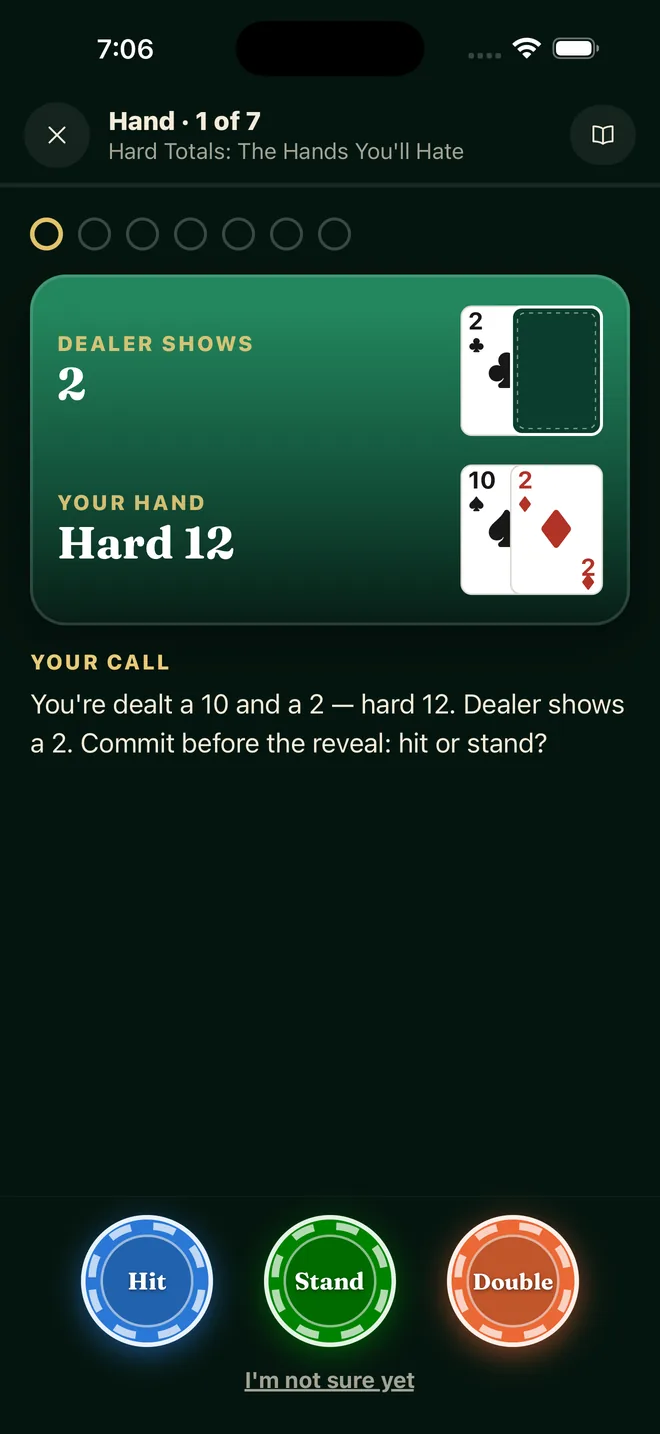
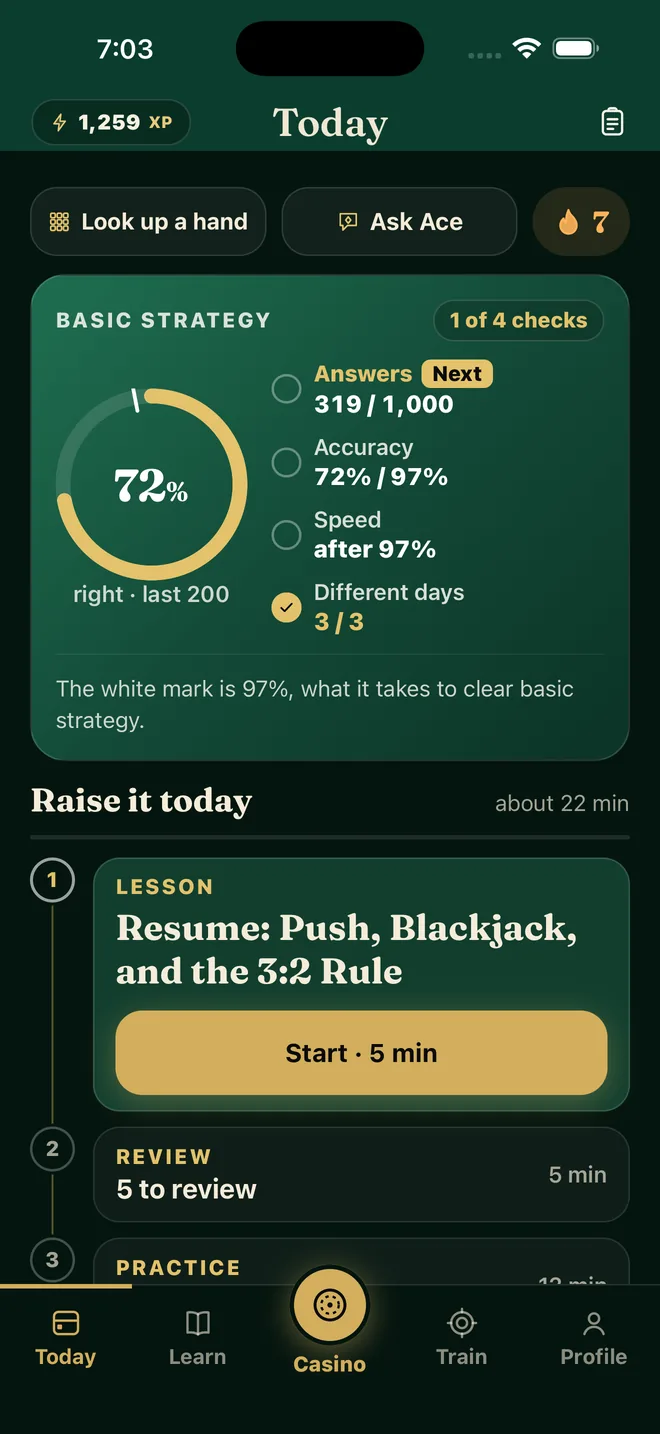
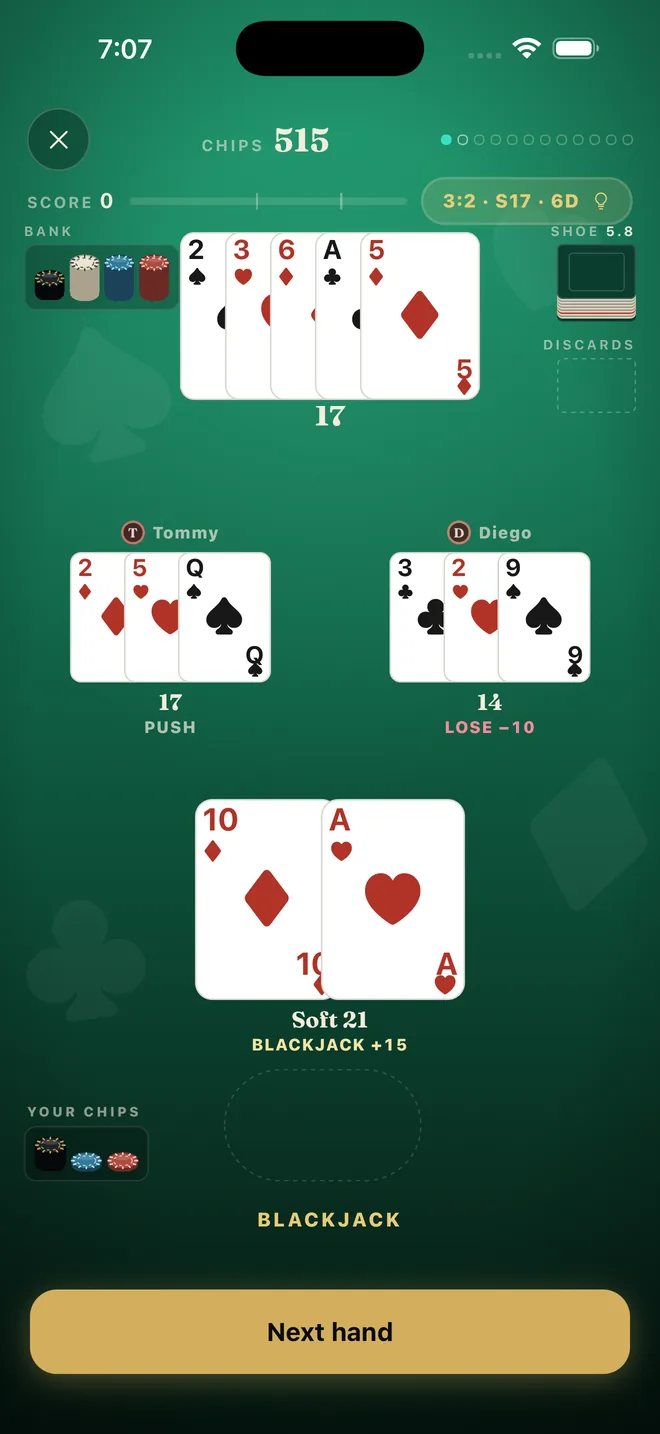
Blackjack is one of the few casino games with a known best play for every hand. That makes it learnable, like a chess opening. Upcard runs one loop until the right play is automatic.
A short lesson deals you real hands. You choose, then see why.
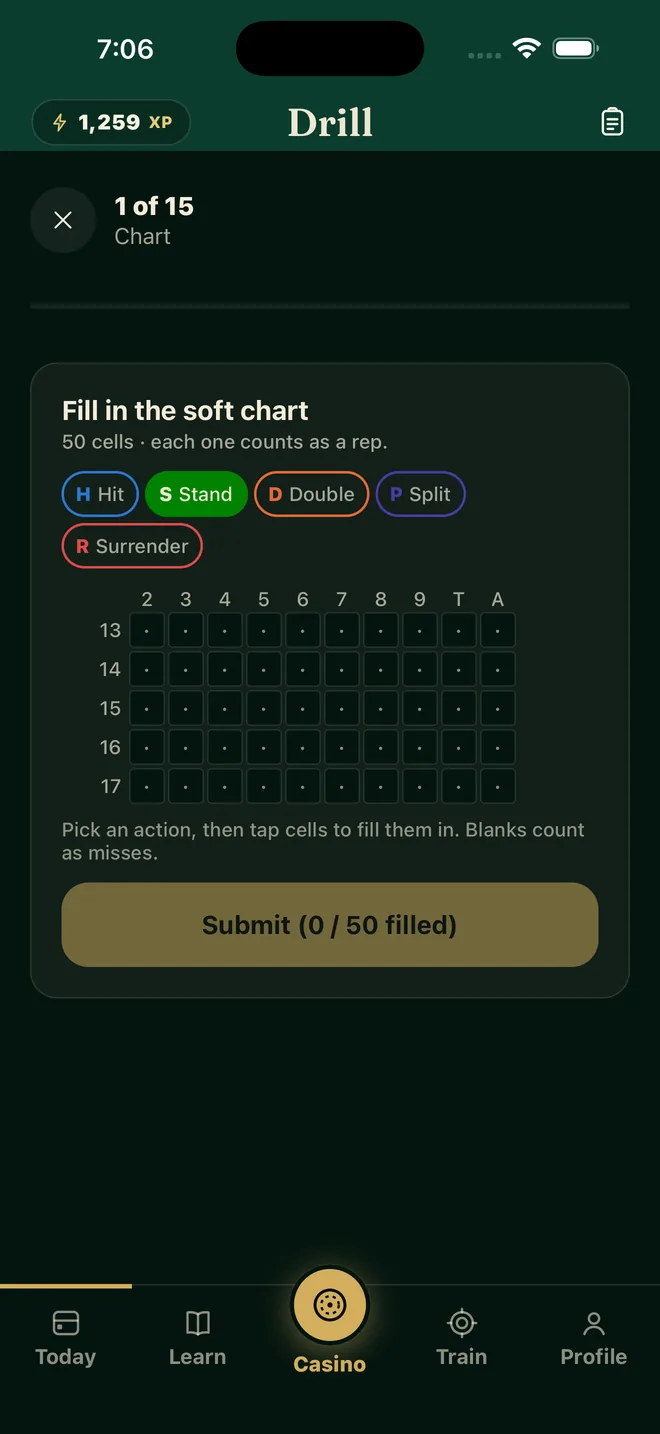
Timed questions on the chart. Every answer is graded against the maths.
Sit at a practice table. Every decision you make is checked.
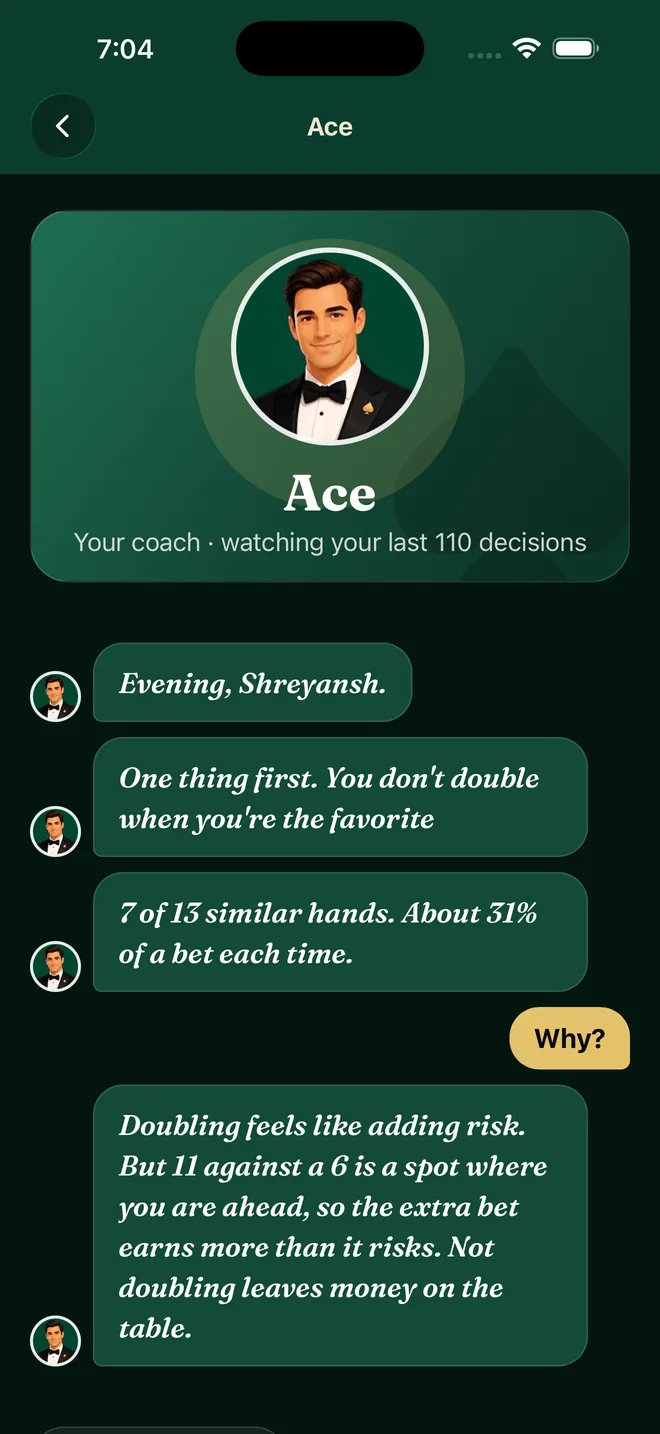
Ace finds the mistake you repeat most and tells you what it costs.
Four measured checks. Clear all four and basic strategy is yours.
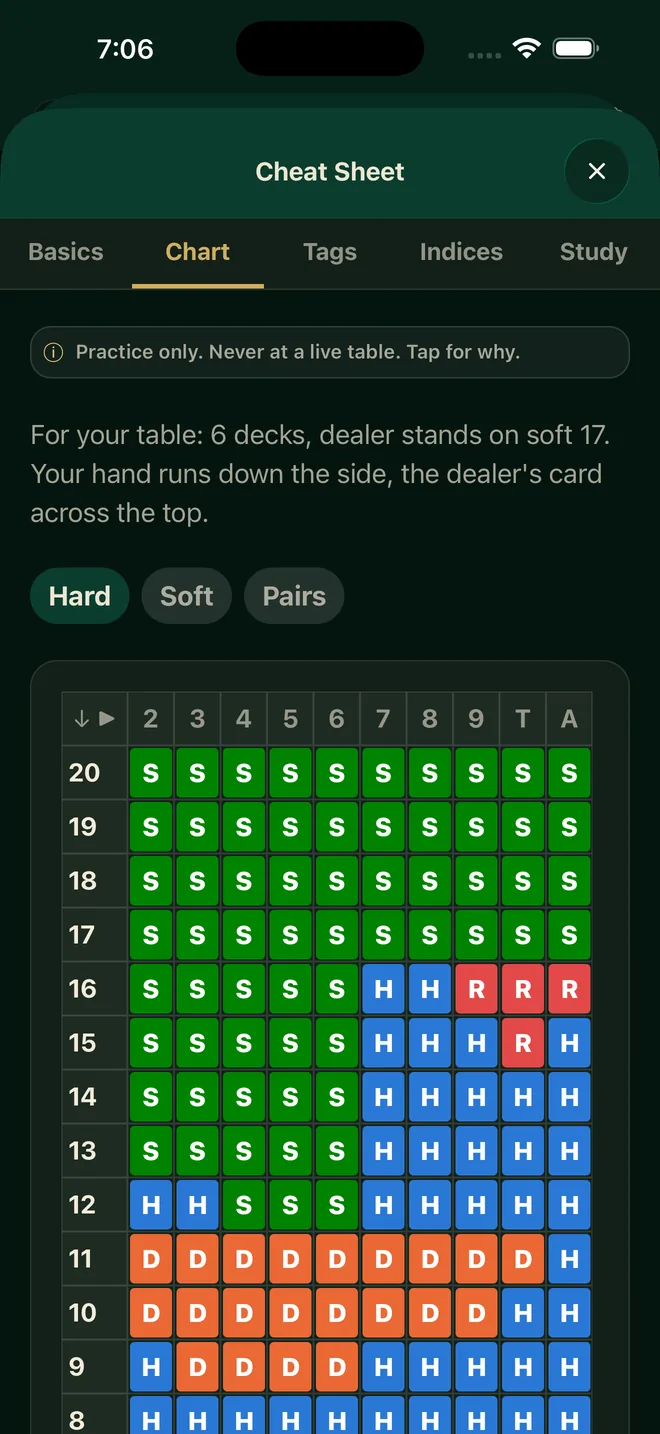
Six decks, dealer stands on soft 17. Each hand has one correct answer. This is the same decide, grade and explain loop the app runs.
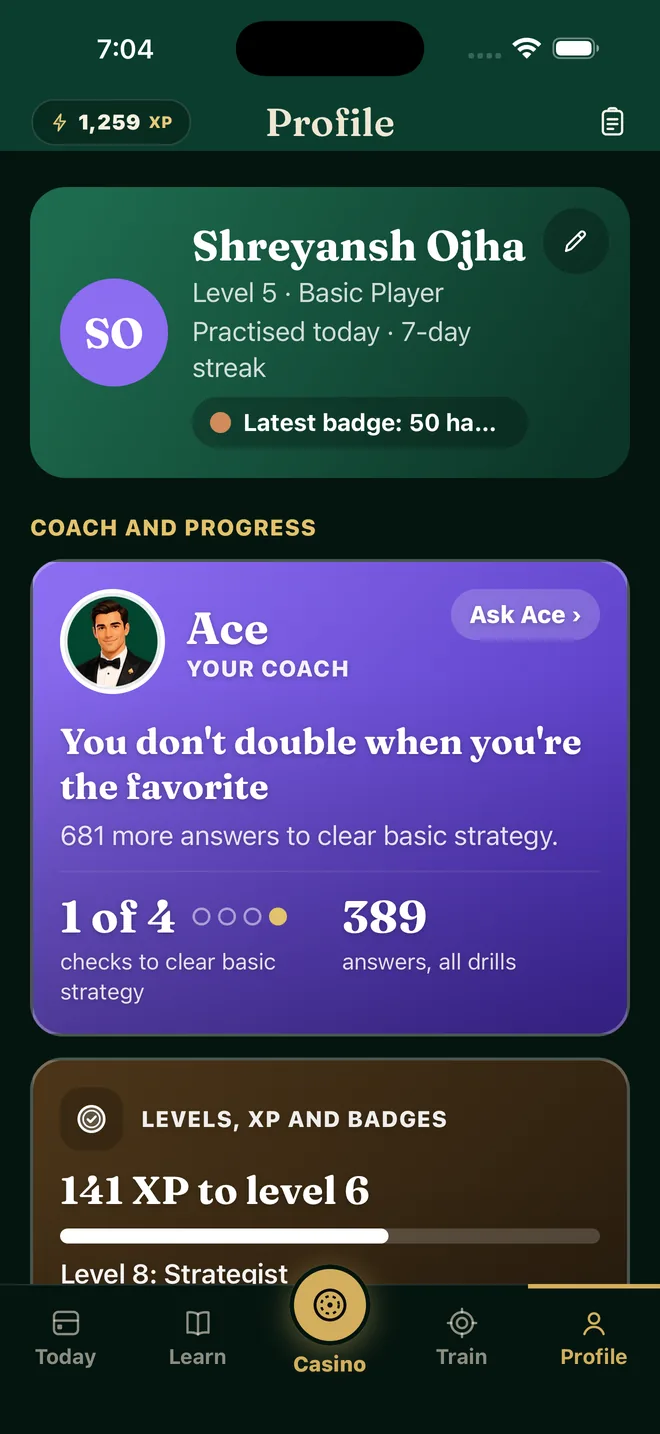
Nine parts, each captured from the current beta build. Nothing below is a mockup.
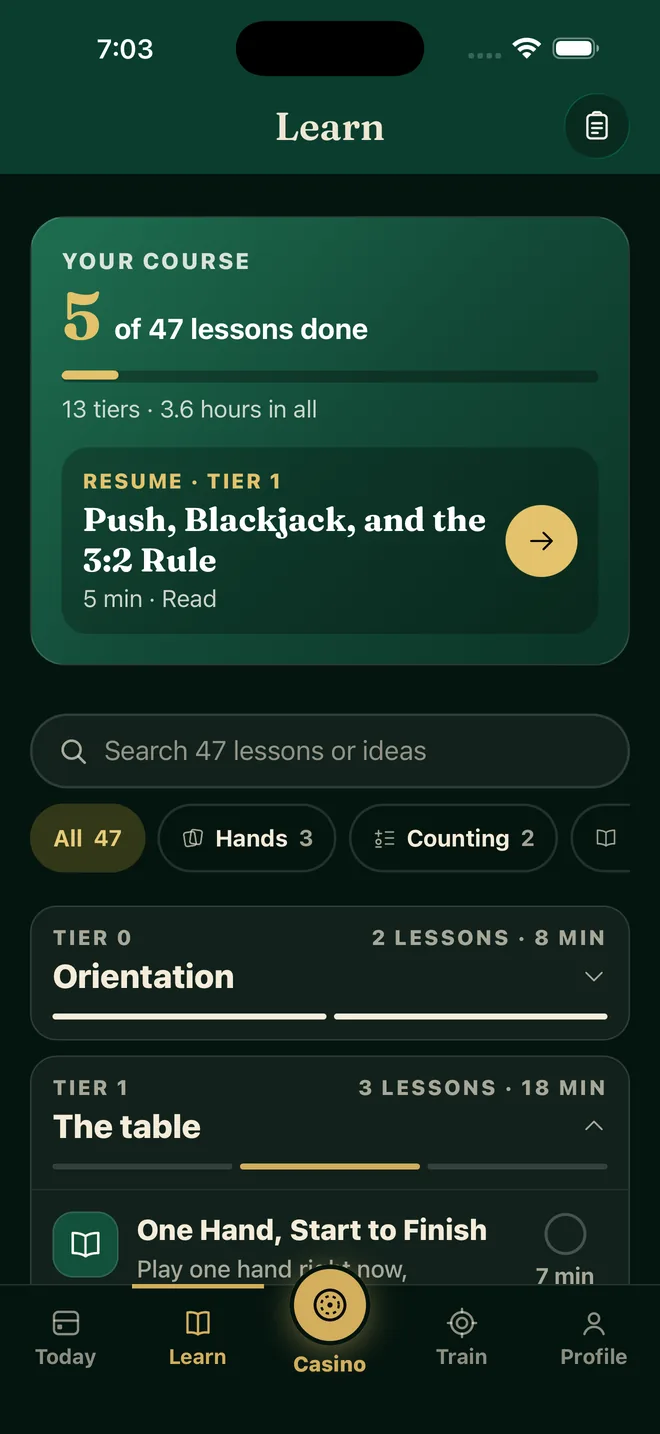
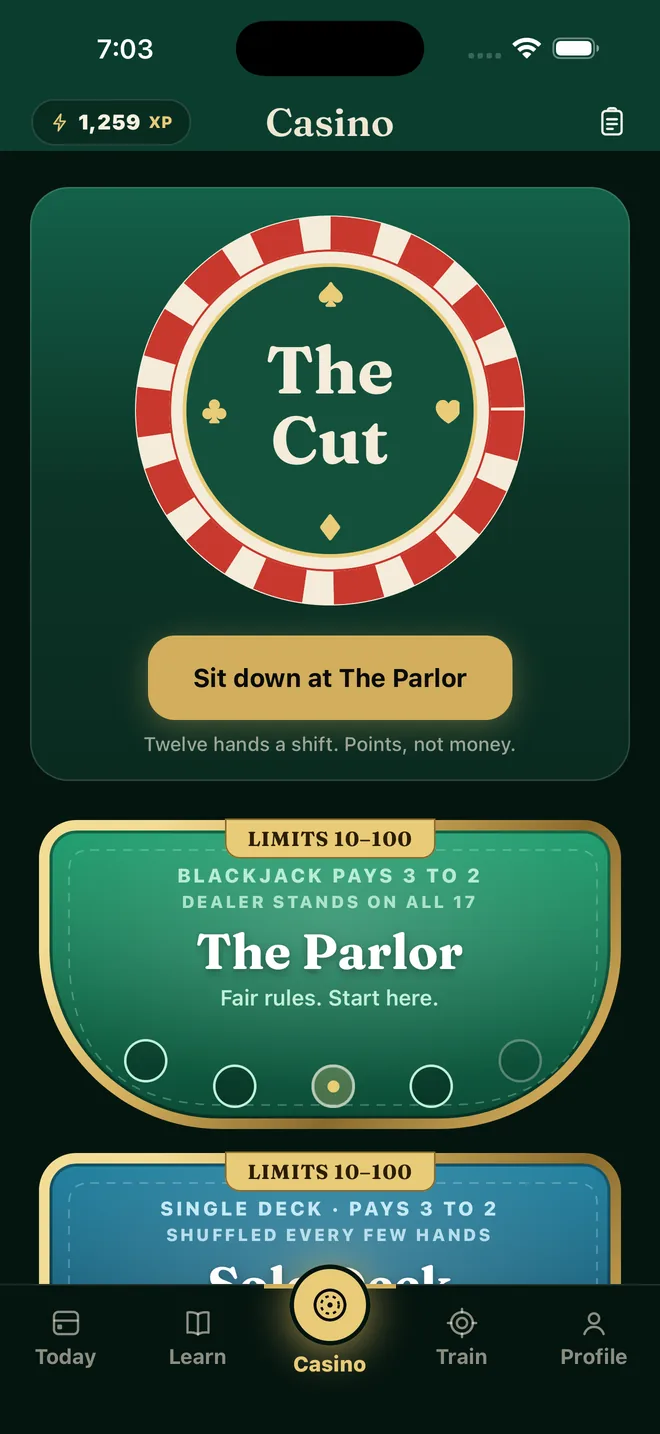
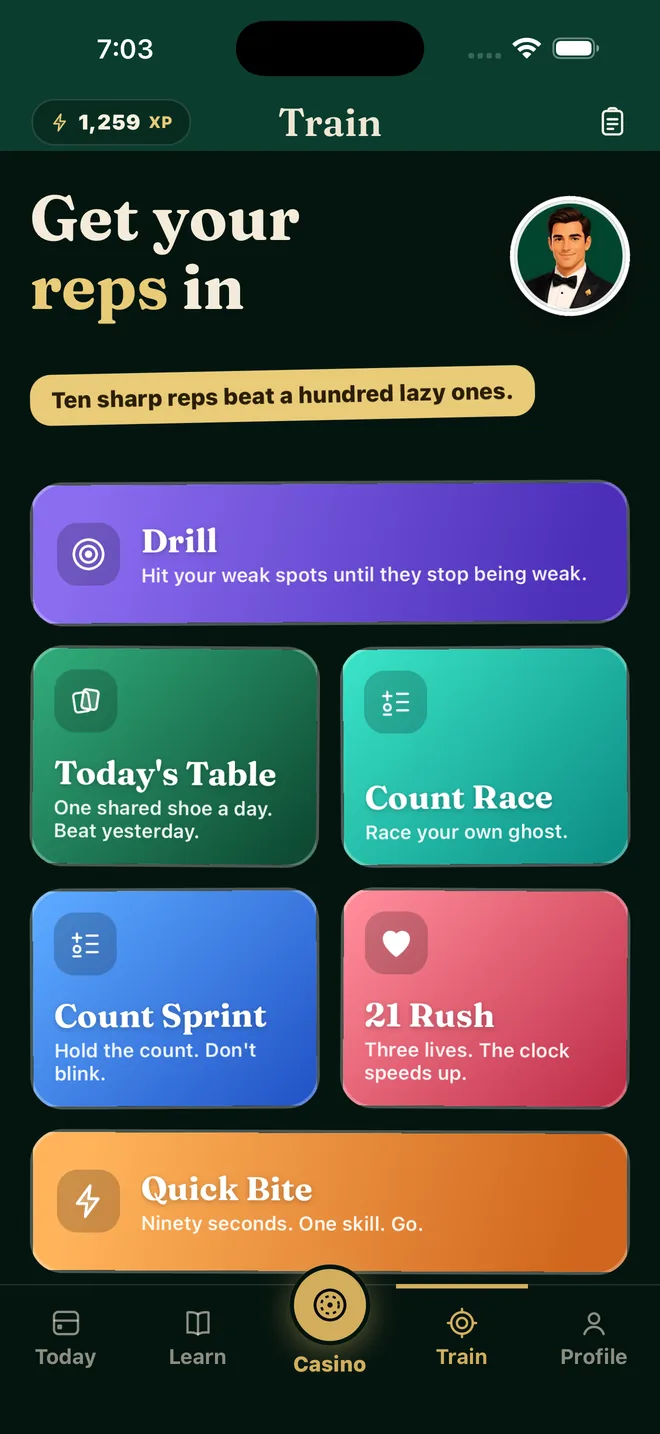
Free on TestFlight. No account needed to start.
You play a few times a year and want to stop guessing on 16 against a 10. Basic strategy, learned properly, in short daily sessions.
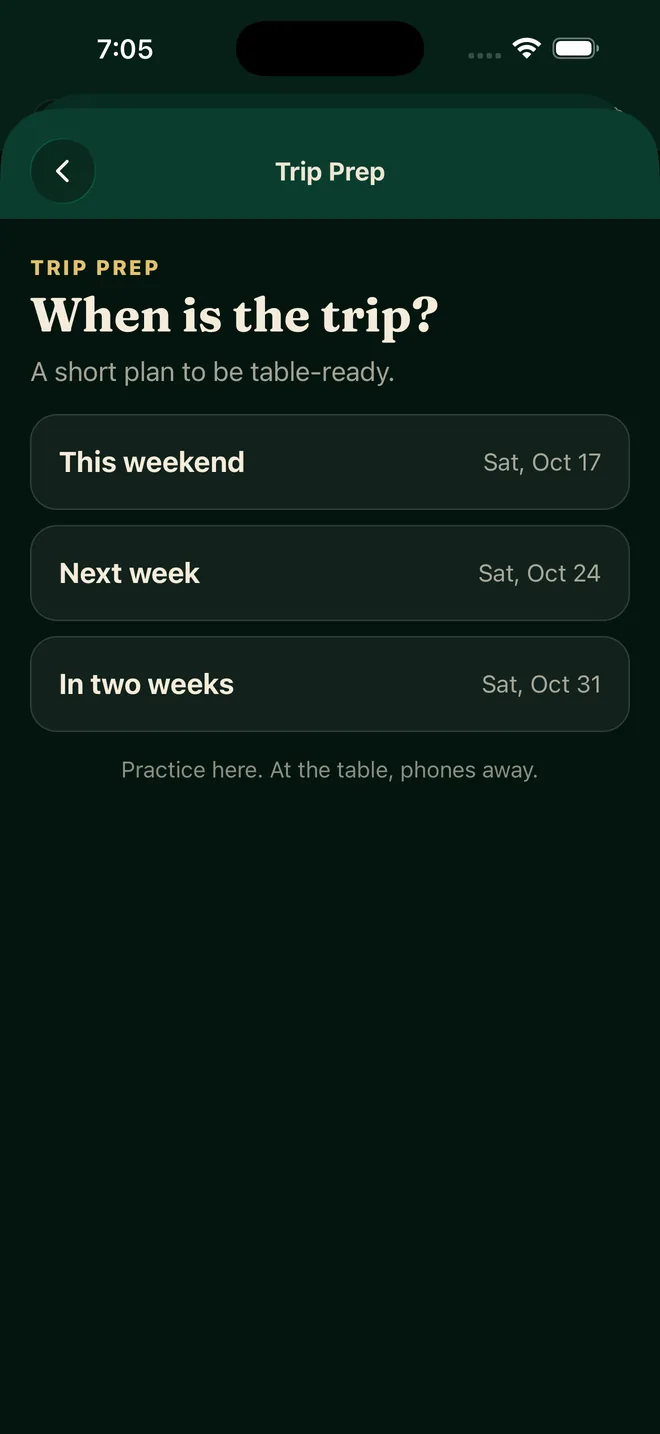
Set the date. Trip Prep shows which hands are still shaky and drills exactly those before you go.
You want the why: expected value, the dealer's odds, counting, risk of ruin. The course goes as deep as you like.
Anyone looking for a way to make money. Upcard will tell you plainly that it isn't one.
Tiers 0 and 1 of the course, your first hand, The Parlor, Quick Bite, 21 Rush, Trip Prep and the trip log.
Everything else: all 13 tiers, Drill, every table and game, the practice table, the planner, Ace, and sync across devices.
From how a hand works to bankroll risk. Basic strategy is the core; counting and deviations come after it, and the honest limits come at the end.
What the game is, and an honest promise about what this app can and cannot do.
One full hand, start to finish: push, blackjack and reading your own hand.
Buy-in signals, rule variants that change the maths, and the ten-second scan for traps.
Hard, soft, pairs and surrender. Twelve rules to understand and a short list to memorise.
Expected value, built by hand: the dealer machine, doubles, splits.
Three tag values, running count to true count, at table speed.
KO, Omega II and Wong Halves, and why most people should stay on Hi-Lo.
Insurance first, the established index plays, and when not to use them.
Kelly betting, risk of ruin, N-zero, and noise versus signal.
What the pit watches, cover play and the back-off.
Shuffle tracking, team play and the line you do not cross.
Blackjack variants, online play, taxes and the myths worth unlearning.
What this actually pays, who it is for, and what you own once you are done.
Perfect basic strategy does not beat the house. It shrinks the house's cut. The app says so, and shows how much the rules on your table matter.
Both figures come from the app's own engine. The worse table costs almost four times as much, with no change in how well you play. Only correct counting can tip the edge to the player, and even then it is thin and shows only over tens of thousands of hands.
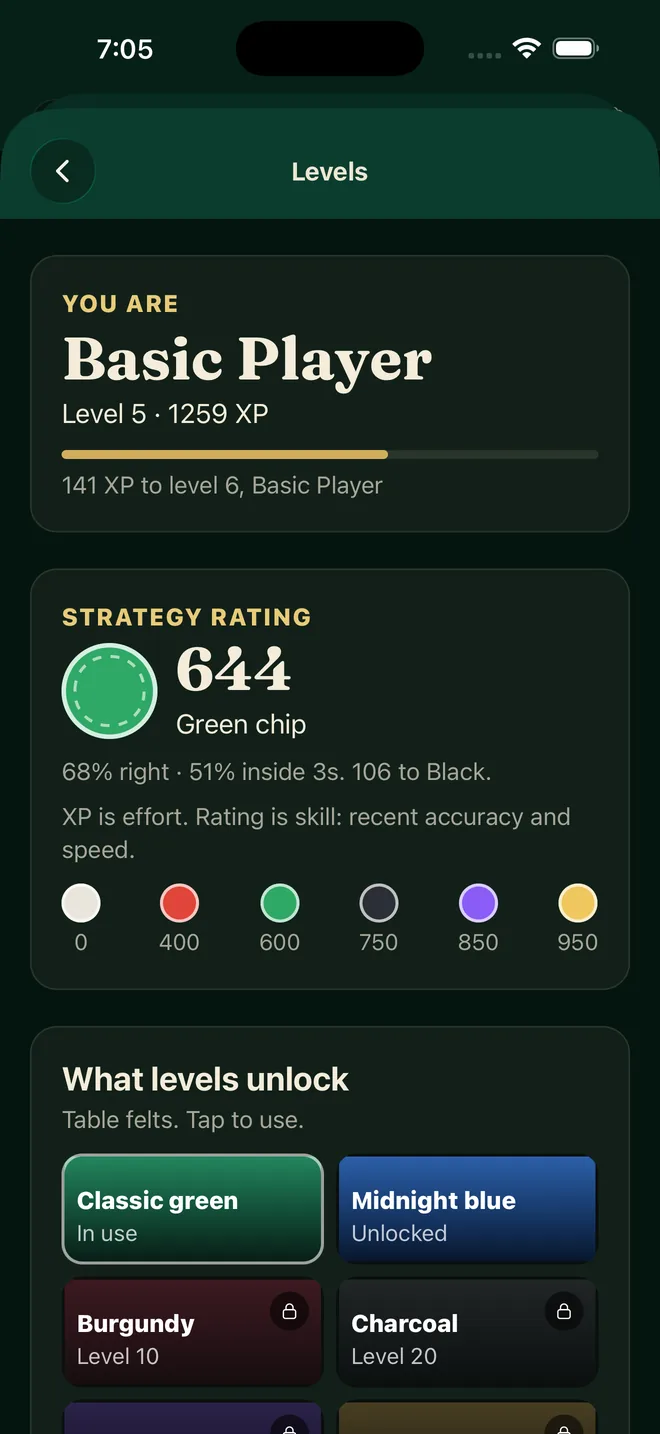
"Mastered" means something specific. 1,000 decisions, 97% right over your last 200, under 5 seconds on average, on at least 3 different days. All four at once, and it slips back if you get worse.
The AI never chooses the right play. A deterministic coach finds the mistake, the chart is handed over as the answer key, and the model's only job is to put it in plain words.
Every graded decision, with the hand, your choice, the book play and your time.
Pure code groups repeated misses and prices each by EV lost per bet.
Gate progress, top mistakes, weak topics, your rules and your full chart. No name, email or money.
Checks the account, takes a slot from the daily cap, calls Claude with a server-side key.
Short, labelled "The chart is the final word", with a Report link.
Pure TypeScript, no server, each one covered by tests. Where a model is an approximation, the code says so.
For every hand and dealer card it works out the value of standing, hitting and doubling. The dealer's final-total distribution is computed by memoised recursion, and hitting recurses until standing is better.
The chart is the best action per cell under your rules (decks, soft 17, payout, double and surrender rules). Change a rule and the chart, lessons and drills change with it.
Models one split: two hands, one new card each, played out normally. Resplits are a documented simplification; every published split decision still comes out right.
Sums the EV of every two-card start against every dealer card, then adds back the dealer-blackjack branch at its true probability. The Parlor: 0.57%. Tourist Trap: 2.14%.
The tables deal from an ordered, depleting shoe: Fisher-Yates shuffle, a cut card at the set penetration, no replacement until the reshuffle. That is what makes counting mean something.
Four systems (Hi-Lo, KO, Omega II, Wong Halves) with their own tags. True count is the running count divided by decks left, estimated from the discard tray.
The Illustrious 18 and the Fab 4 surrenders: the true counts where the right play changes, ranked by value.
A simplified SM-2, the method Anki uses. A miss comes back now and lowers its ease; a hit comes back in 1 day, then 6, then the last gap times the ease.
1,000 decisions, 97% over your last 200, under 5 seconds on average, on 3 different days. Recomputed from history every time, so it can slip if you get worse.
Groups your misses by situation (for example "hit a stiff against a weak card"), counts them, and prices each by the EV it lost, in cents per dollar bet. Worst first.
80% recent accuracy, 20% answers inside the 5-second budget, scaled by how much evidence there is, so ten lucky answers cannot make a high rating.
Bet sizing as edge divided by variance (about 1.3 units² per hand), with fractional Kelly because full Kelly is too swingy for real people.
The Wald diffusion approximation, exp(−2 · edge · bankroll / variance), shown next to the simulator's own count of how often a bankroll went broke.
Simulates many trips hand by hand from the house edge and per-hand variance to give a realistic range of results, not one number.
Today's Table hashes the date with FNV-1a and shuffles with mulberry32. Everyone gets the same cards on the same day, with no server.
Answers are combined and de-duplicated, review items keep the copy scheduled furthest out, and a default never overwrites a saved setting. Pushes retry from 30 seconds up to 10 minutes.
Plans two weeks of local reminders from your habits: at most one a day, at the hour you usually practise, never on a day you already did.
XP, levels, badges and rating are worked out from your answer history every time, never stored as totals, so they cannot drift or be corrupted.
One person, one codebase, one cloud project.
Hit, stand, double and split values come from the EV engine for the rules you pick. Lessons and drills are tested against it, so the app cannot teach a play its own maths disagrees with.
The model never decides the right play. The deterministic coach finds the mistake and the chart is passed in as the answer key; the model only explains. Server-side key, hard caps, and a checker that rejects invented numbers. First eval 8 of 15, after tightening 14 of 15.
XP, levels, badges and rating are derived from history, never stored. A 28-day simulated player proves they only move forward and streaks break and repair correctly.
Progress merges on both sides. Pushes back off and retry, and a bad read on the phone writes nothing, so it can never wipe real progress.
The engine decides every result and the table only animates it. Tourist Trap exists to let you feel what 6:5 costs. The highest-limit table is held back because it looks most like real gambling.
Row-level security on every table, usage counters only the server can touch, no secret in the repo. The privacy policy's claims are tied to the code by tests.
Exact EV maths first, then 47 lessons written on top of it and tested against it.
Drills, a coach that names your mistakes, games, badges, streaks and reminders, all offline.
Accounts and sync on Supabase with row-level security, and an AI coach behind strict caps.
A 28-day player simulation, sync robustness tests, US terms and privacy, a release gate.
EAS builds, the beta, the App Store listing, and the rename to Upcard.
A practice casino, Ace as a typed coach, a new Today, Learn and Profile, all shaped by tester feedback.
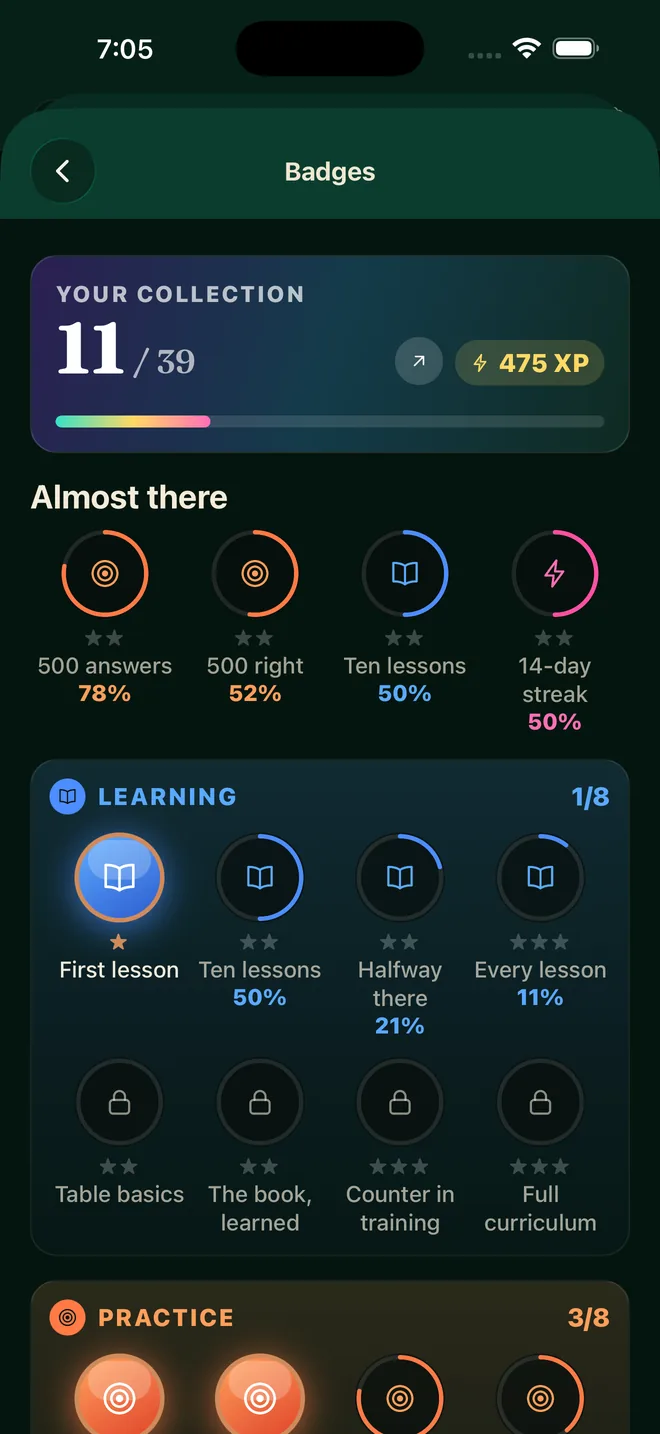
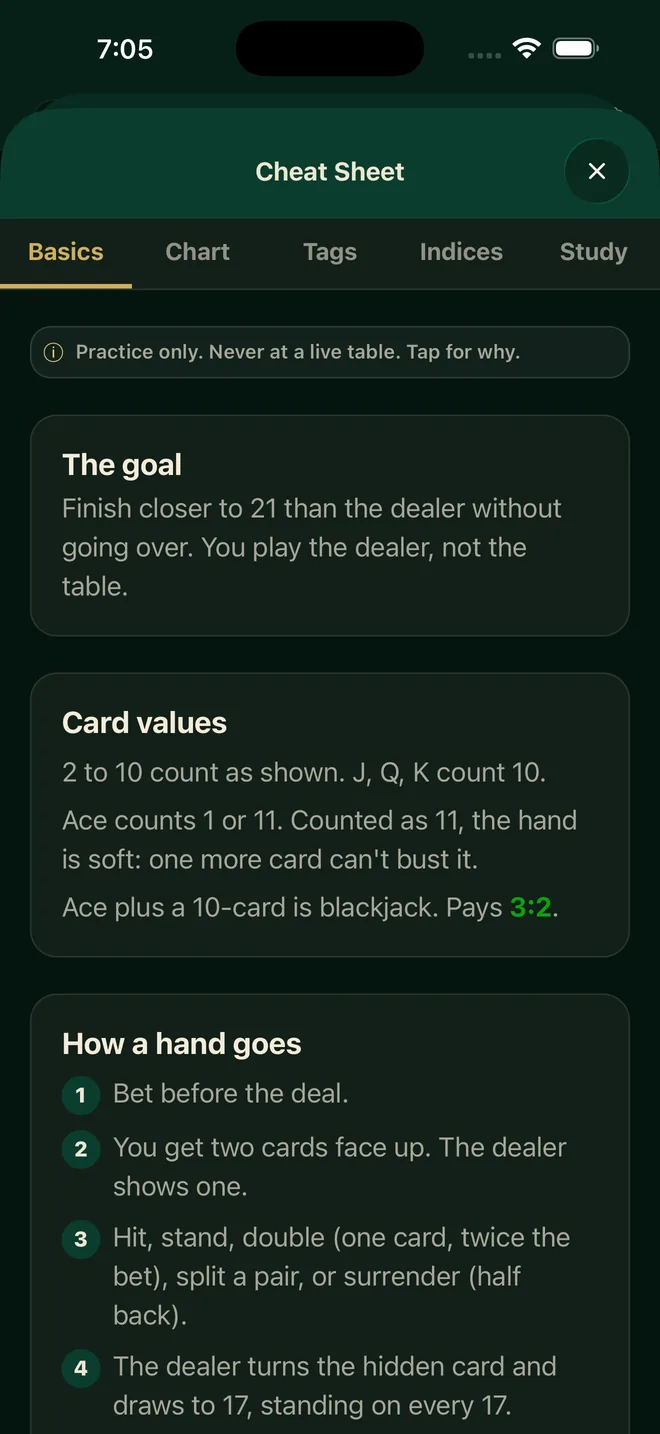
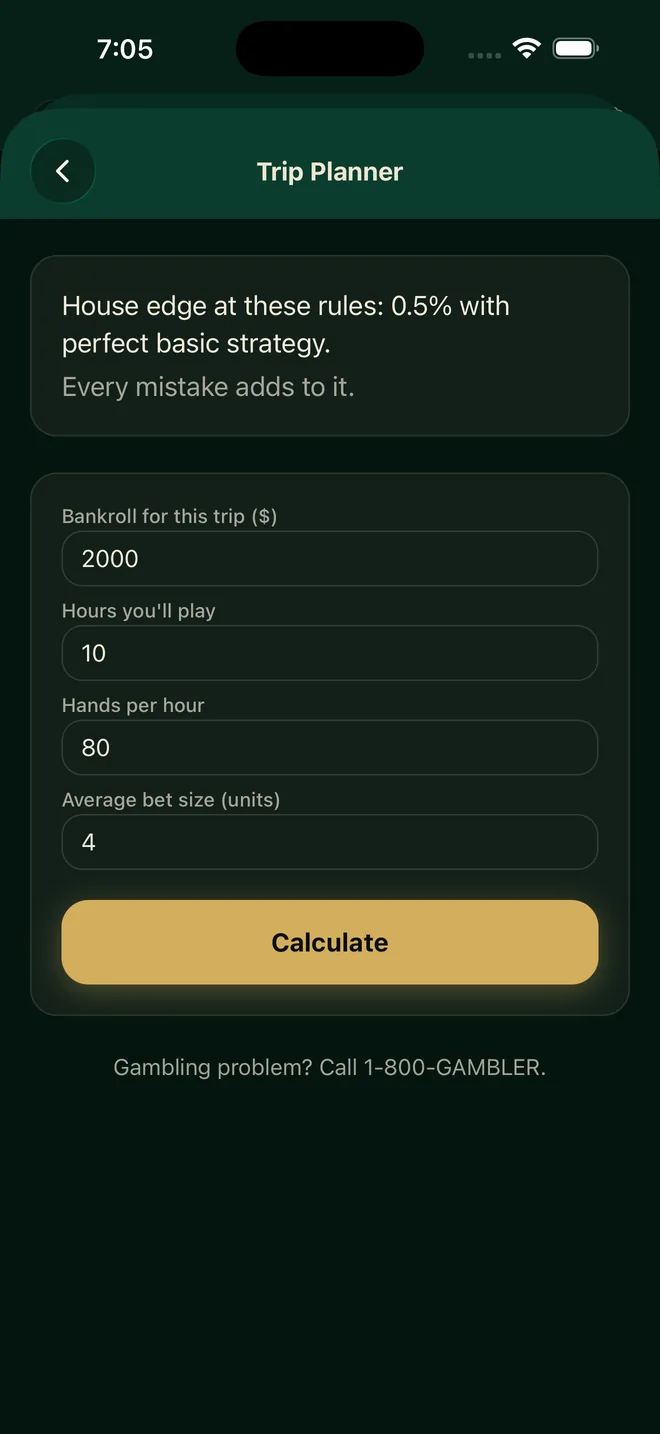
Scroll sideways · 15 screens
I got interested in blackjack the way a lot of people do — I sat down at a table, played on instinct, and lost. What bothered me wasn't the money. It was finding out afterwards that there had been a right answer the whole time — and I simply hadn't known it.
Basic strategy isn't folklore. It was solved with computer simulation decades ago, and it's a finite, learnable thing — roughly 340 decisions with a right answer each. But almost everything built around it is either a casino game wearing a teacher's costume, or a static chart you're told to memorise with no way to check whether you actually have.
So I built the thing I wanted: short lessons, drills that grade you and explain why, a simulator that deals a real shoe, and a mastery system that refuses to tell you you've got it until you've proved it under pressure. And — because this is the part the category gets wrong — a set of numbers that are honest about what all that is worth, including when the honest answer is "you're still losing money, just more slowly."
It's a personal project, built in the open on evenings and weekends, and it's in TestFlight beta right now.
But the real reason it exists is smaller, and more stubborn, than any feature. You never control the cards. In the end a hand comes down to luck, and no chart or drill will ever change that. What you can control is whether you played it right — and once you've genuinely learned this game, a loss stops feeling like a failure. It's just variance doing its job while you did yours. The app can't make the deck fall your way; it can only make sure that when it doesn't, the mistake was never yours — that you did everything the odds allowed, and let the rest be the rest. That's the whole promise. Not that you'll win, but that you'll never again lose to your own ignorance — and that, it turns out, is the only part of the game that was ever yours to win. If that sounds worth having, I'd like to hear from you.
No. There is no real money anywhere in the app, in either direction. Nothing is deposited, wagered, won or withdrawn, and there is nothing to buy. Chips and dollar figures are practice numbers with no value, the way a flight simulator has an altimeter without leaving the ground.
No, and anything that says otherwise is selling something. Perfect basic strategy cuts the house's edge to about half a percent at fair rules. You still lose, just slowly. Only correct card counting can move the edge to the player, and that edge is thin, needs real capital and near-flawless play, and shows only over tens of thousands of hands.
What Upcard offers: you'll understand this game better than almost anyone at the table, and know exactly what that is and isn't worth.
It explains. It never decides. The right play always comes from the app's maths, and the full chart is passed to the model as the answer key. Ace can rephrase a mistake, give you a memory trick, or answer a typed question about your own play. Every AI reply is labelled, capped at a few a day, and the app works fully without it.
Counting in your head is legal in most places. Casinos are private businesses and can ask a counter to leave. Using any device at a live table, including a phone or this app, is a crime in Nevada, New Jersey and many other jurisdictions.
The app is blunt about this. Upcard is for practice away from the table, nowhere else.
No. Basic strategy is something you learn, not something you calculate. Every lesson can be read in simplified language, and you can master basic strategy without anything harder than adding to 21. The maths is there if you want it.
Four checks, all at once: 1,000 decisions, 97% right over your last 200, an average decision under 5 seconds, and practice on at least 3 different days. It recomputes every time, so a bad stretch pulls it back. The bar is always on screen.
No. Guests get the first two tiers of the course, The Parlor table, Quick Bite, 21 Rush, Trip Prep and the trip log. A free account unlocks everything else and syncs your progress across devices.
Yes. Same project, new name and icon.
It's free in TestFlight beta, with no purchases and no ads. Join on TestFlight, or email me if the link says it's full.
Ten minutes on your iPhone: your first hand, a lesson, a few drills. Tell me what's confusing or broken. Free, no account needed.
For adults 18+, available in the United States only.
♠ Upcard — formerly "Blackjack Mastery." A practice simulator and training app.
No real money is ever wagered, deposited, or withdrawn in this app. Every dollar figure in it is a simulated training number with no value, and nothing here promises you winnings. Success in the app does not guarantee success in real-money games.
Card counting is legal to learn. Using any device to assist you at a live table is a separate matter and is a crime in Nevada, New Jersey and many other jurisdictions. This app is for practice away from the table.
Intended for an adult audience, 18+, available in the United States only. If gambling stops being fun, help is available — ncpgambling.org or 1-800-GAMBLER in the US, BeGambleAware.org in the UK.
© 2026 Shreyansh Ojha. All rights reserved.