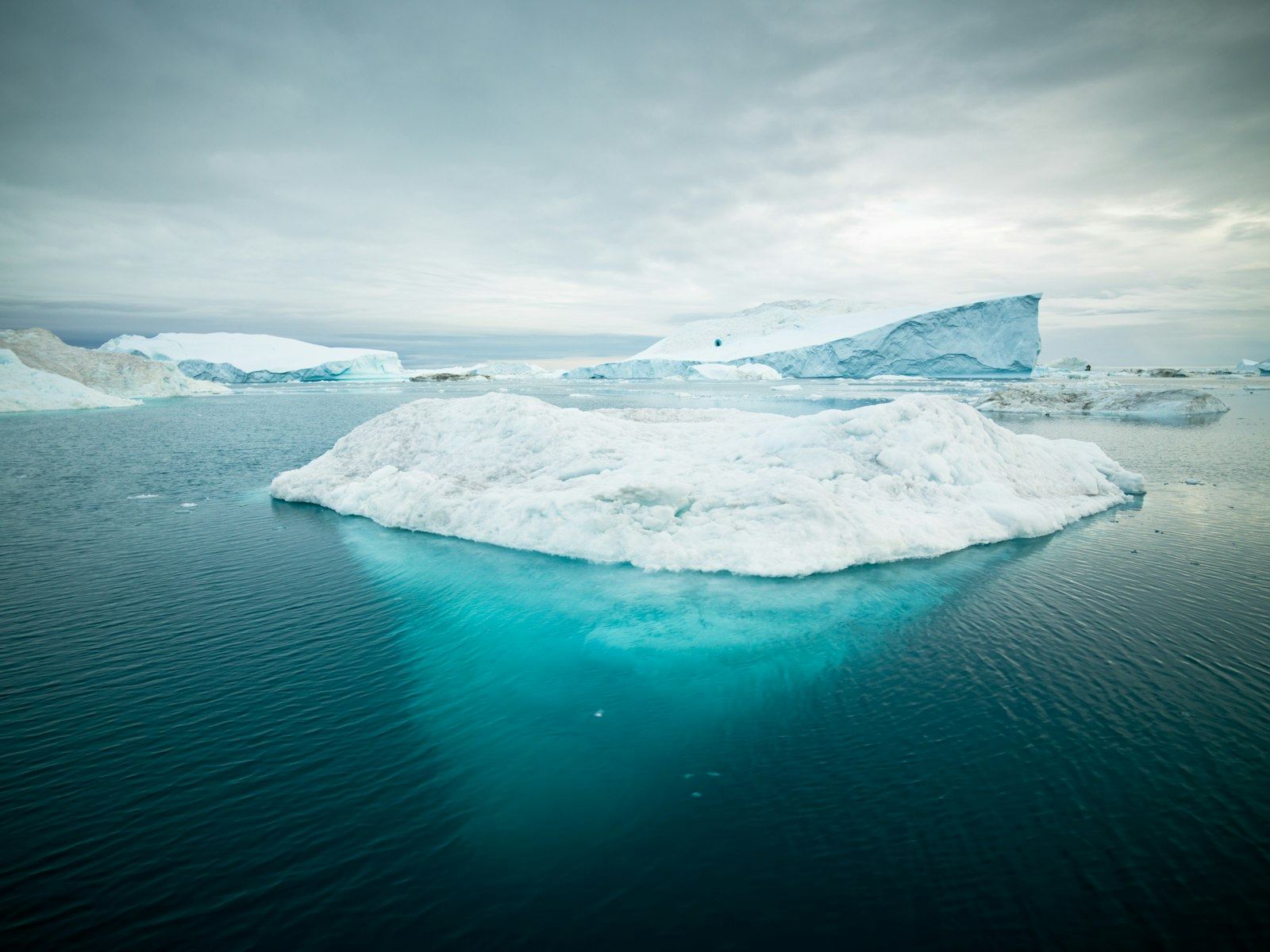
Between 2000 and 2020, the retreat of Greenland’s marine glaciers uncovered roughly 1,620 kilometers of coastline that had not existed before — about a thousand miles of shore where there had been ice. Glaciologists established it by comparing two decades of satellite imagery, in Nature Climate Change. A single glacier in the northeast, Zachariae Isstrøm, produced 81 kilometers of it, more than twice any other in the hemisphere.
The same retreat exposed 35 islands larger than half a square kilometer. Twenty-nine are Greenland’s. Thirteen have never appeared on any map. Five more, charted in the 1960s and then buried again by advancing ice, have now returned.
Thirteen islands no state has claimed — because until recently there was nothing there to claim.
This is what sets Greenland apart from every other Arctic story. Elsewhere the new ocean is ice thinning on water that was always water. Here the ocean is being manufactured out of the island itself: fjords opening, straits appearing where a peninsula used to be, seabed emerging from beneath three kilometers of ice. And the land, relieved of that weight, is rebounding — one study in Nature Communications projects that parts of Greenland’s own coast will rise enough that local sea level falls by one to nearly four meters by 2100, even as the meltwater lifts seas everywhere else.
The island is simultaneously dissolving and surfacing. Its geography is not settled enough to print.
Nor is it stable. In September 2023 a thinning glacier in the east collapsed into Dickson Fjord, throwing up a wave roughly 350 feet high whose oscillation registered on seismometers around the world. The newly exposed coast is fresh rock and loose sediment, cemented by nothing. It moves.
⁂
None of that is quite why anyone wants it. The reason is older and simpler. Greenland sits across the top of the Atlantic approach to North America. Pituffik Space Base — formerly Thule, 750 miles above the Arctic Circle — is the northernmost American installation, and load-bearing for missile warning and space surveillance. The island flanks the passage Russian submarines must take to reach the Atlantic, fronts the Northwest Passage, and hides, under the retreating ice, rare-earth deposits the United States would rather not buy from China.
The melt creates none of that value. It exposes it — and puts a clock on the argument.
⁂
The argument arrived in earnest in January 2026. On the 12th, the American president said the United States would acquire Greenland, warning that otherwise Russia or China would. On the 14th, the Danish and Greenlandic foreign ministers met the vice president and secretary of state — and the two sides described the meeting incompatibly: Copenhagen said they had agreed to explore a common approach to American security concerns; the White House said the subject was technical talks on acquisition. On the 17th came tariffs on Denmark and seven other European countries — ten percent from February, rising to twenty-five in June, to be lifted when the matter was “resolved.”
That same day, Greenlanders held the largest demonstrations in the island’s history. In Nuuk, a town of some 20,000, roughly a quarter of the population turned out. A January 2025 poll had already found that 85 percent did not wish to trade Denmark for the United States. The prime minister, Jens-Frederik Nielsen, had said it plainly the day before: forced to choose, Greenland would choose Denmark, and did not want to be governed by the United States.
On the 21st, at Davos, the president said he sought immediate negotiations and would not use force, announced a framework agreed with NATO’s secretary general covering Greenland and the Arctic, and cancelled the tariffs. Denmark’s prime minister replied that everything was negotiable — security, investment, the economy — except sovereignty. Its defence minister noted that NATO’s secretary general had no authority to negotiate on Denmark’s behalf. The framework, as reported, contemplated American bases as “sovereign base areas” on the Cypriot model, and preferential access to Greenland’s minerals. Greenland’s government called the sovereign-base element a red line.
⁂
Here is the part that clarifies what is actually being asked for. The 1951 Defense of Greenland Agreement, updated in 2004, already grants the United States exclusive jurisdiction within its designated defense areas, free movement between them across Greenlandic territory and waters, and the right to overfly and land anywhere on the island. American forces have been there since the Second World War, and analysts observing the current talks note that Denmark has little practical capacity to refuse American requests made under the pact. The senator who has spent the longest on this file said publicly that he had yet to hear of anything the United States needs from Greenland that Greenlanders were not already prepared to give.
Pressed on why the existing agreement was insufficient, the president answered that ownership was “psychologically needed for success.”
That sentence is the whole story. This is not a dispute about access, because access is not in dispute. It is a demand for title — over an island whose people have said, in poll after poll and in the streets, that they do not want it, and whose legal personality, recognized in Denmark’s 2009 Self-Government Act as a people with a right of self-determination, is the one thing in the entire arrangement that cannot be replaced by somebody else’s engineering.
By May 2026 the negotiations had settled into their real shape: an expanded American military presence, worked out under the 1951 agreement, with Greenland’s prime minister confirming the talks and Washington’s interest in owning or controlling the territory still described as live. Denmark had committed the equivalent of some £3.2 billion in additional Arctic defence spending the previous October, and repeated the pledge in January.
⁂
Set the two processes side by side. One is a negotiation among three governments over who holds sovereignty across 2.16 million square kilometers of ice, conducted in the vocabulary of security concerns, frameworks, red lines and preferential access. The other is an ice sheet withdrawing fast enough to have produced a thousand miles of unmapped shoreline in twenty years, dropped thirteen islands onto no chart at all, and left the coast unstable enough to throw a hundred-meter wave down a fjord.
The second process is faster than the first. That is the strange feature of this dispute, and the one that should worry people more than it does. Sovereignty law assumes a fixed object — a coastline, a baseline from which territorial waters are measured, a landmass that stays where it was put. Greenland is not currently that kind of object. Its shore is redrawn yearly, its islands arrive unannounced, and the seabed beneath its retreating glaciers is becoming ocean floor that no treaty anticipated.
Somewhere in the northeast, a rock that spent centuries under ice is now above water and on nobody’s map. Three capitals are arguing over the deed to a country that is still being drawn.
Liked this? Get the next one in Working Theory.
Going weekly in August (it's in beta now). One genuinely interesting read on building, the brain, and the science most people missed.